

Written and reviewed by Brandon VanLandingham, CFA, CMT, CFP® · Last updated October 24, 2026
Covered Call ETFs: Yield or Trap?
A distribution is cash received. The investment decision depends on what happens to total wealth.
October 23, 2026
A large monthly distribution can make an investment feel like a solution to retirement income. The account sends cash, the bills get paid, and selling shares seems unnecessary. But the payment alone does not tell us whether the investment earned that amount or whether the remaining capital can support future spending. Covered call ETFs deserve an evaluation that separates the cash flow from the economic return.
I do not consider a covered call inherently a trap. It is a trade: accept a different payoff in exchange for option premium. The trap is treating that premium or a fund’s distribution rate as if it were guaranteed interest. Before allocating, decide whether the trade serves the household’s growth, income, and risk needs.
What gets exchanged for the premium
A traditional covered call pairs ownership of a stock with a call sold against an equivalent position. The call buyer receives the right to purchase at the strike price under the contract’s terms. The seller receives premium while surrendering upside beyond that strike during the option’s life. The Options Industry Council’s covered-call explanation emphasizes that substantial downside remains.1
For a fund review, ask how the actual portfolio implements the approach. Which exposure supports the options? What portion is overwritten? How are strikes and expiration dates selected? Does the mandate permit other instruments or exposures? Do not assume the words “covered call” answer those questions. The exact prospectus and holdings need to support the description being used in the plan.
The planning tradeoff is between current cash and participation in future appreciation. That can be reasonable for a limited part of a portfolio, but it should be deliberate. An investor who needs maximum participation in a strong recovery may place a different value on the surrendered upside than someone comfortable monetizing part of it today.
Follow one option period in dollars
Figure 1 shows an intentionally simple expiration example. Assume a share bought for $100, a call sold at a $105 strike, and $3 of premium received and held as cash. Ignore dividends, fees, taxes, interest on the premium, and early assignment. Measure profit against the original $100 stock cost, not the $97 net debit after premium. This is one option period, not an annual return or an ETF forecast.
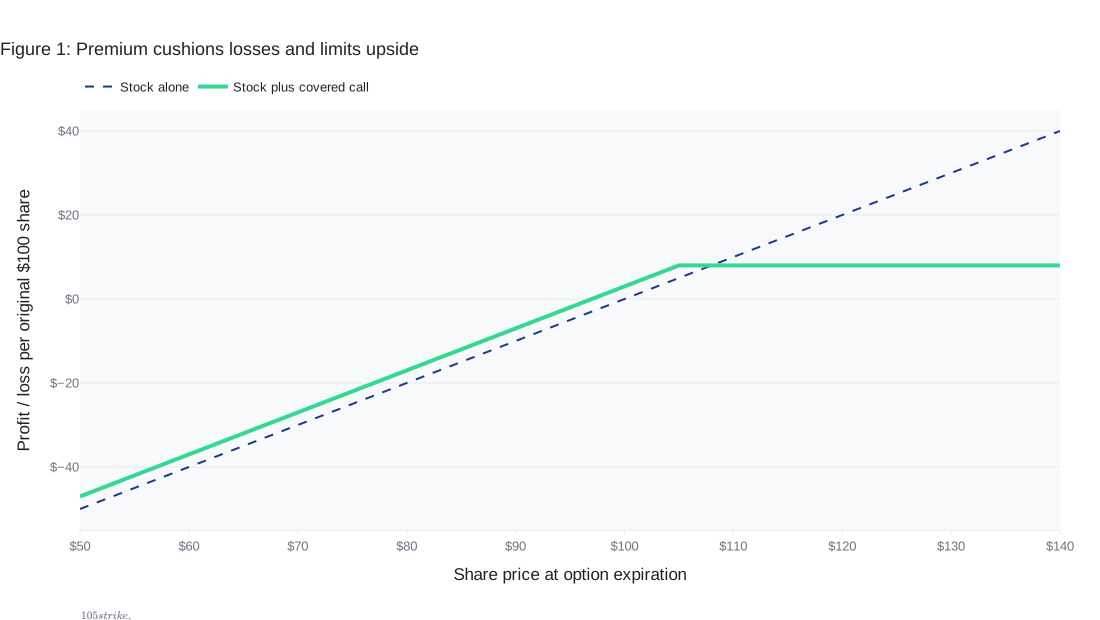
If the share ends at $80, the stock loses $20 and the retained premium offsets $3, leaving a $17 loss. If it ends at $100, the stock is unchanged and the position earns $3. If it ends at $120, the call obligation limits the stock realization to $105, and the premium brings total proceeds to $108. Profit is $8, compared with $20 for the unhedged share.
The break-even share price in this illustration is $97. That small cushion is useful, but it does not turn the position into a protected investment. If the stock became worthless, the assumed premium would leave a $97 loss. The economic exposure still belongs in an equity-risk discussion. A predictable distribution schedule would not change this arithmetic.
The chart also explains why the strategy can look appealing in a flat market while disappointing in a strong rally. That does not prove either environment will occur next. The investment decision should survive more than the market path that makes the sales presentation look best. I would compare the whole portfolio under a decline, a sideways period, and a sharp rebound before deciding what to replace.
Distribution rate is not total return
Use a separate hypothetical fund example. You begin with $100,000. During a year, you receive $12,000 of distributions, do not reinvest them, and make no other purchases or withdrawals. At year-end the remaining shares are worth $82,000. Your combined ending wealth is $94,000: the shares plus the cash received. That is a negative 6% holding-period result before investor-level taxes, even though cash payments equaled 12% of starting capital.
This simplified calculation assumes the distributions remain as non-interest-bearing cash. A standardized reinvested total return would require the actual payment dates and reinvestment prices; it is a different measurement. The point is that recording cash receipts without recording the change in the investment’s value gives an incomplete answer.
Reverse the example and the same discipline applies. A declining share price does not by itself prove the strategy failed if distributions more than offset the decline. Nor does a stable price prove that the payout can continue indefinitely. Ask for total-return history with a clear reinvestment convention, the distribution policy, and an explanation of changes in net asset value. Review them together.
For a spending plan, choose the withdrawal amount from the household’s needs and resources. Do not increase spending simply because the selected fund distributes more. Excess distributions can be retained or reinvested; a shortfall can be met through a planned withdrawal from another holding. The investment’s payment policy should serve the plan rather than set its budget.
Tax character requires a separate review
The IRS distinguishes ordinary and qualified dividends, capital-gain distributions, and nondividend distributions. Its guidance on dividends and other distributions explains that a return of capital generally reduces adjusted basis; further nondividend distributions after basis reaches zero are taxable capital gains.2 A cash payment’s label and tax character matter, but neither is a complete performance measure.
Suppose a taxable investment has $50,000 of adjusted basis and receives a $4,000 distribution correctly classified as return of capital. Under that assumption, basis becomes $46,000. The payment is not automatically an extra $4,000 of economic profit. If the investment is later sold, the lower basis affects the gain or loss calculation. This example ignores other basis adjustments and does not assign a tax classification to any particular fund.
Return of capital is also not, by itself, proof of destructive investing. I would reconcile the tax reporting with total return and the fund’s financial statements before drawing that conclusion. Have the CPA review final reporting, any corrected forms, and the household’s account type. Do not apply taxable-account basis mechanics indiscriminately to retirement-account distributions.
Our discussion of ETFs vs. Mutual Funds: Which Belongs in Your Taxable Account? provides a broader framework for evaluating after-tax outcomes. The ETF wrapper alone cannot settle the tax question. The strategy, holdings, distribution character, and investor’s own circumstances all require attention.
Set a fair comparison and a spending rule
For execution, the SEC’s ETF investor bulletin discusses expenses, bid-ask spreads, and premiums or discounts to net asset value.3 Add those costs to the strategy review. A high distribution rate should not distract from what it costs to buy, own, and sell the exposure.
I would compare a proposed allocation with an appropriate equity holding plus a planned cash withdrawal, using the same starting dollars and spending dates. Include a lower-equity allocation if the real goal is to reduce risk. These alternatives answer different needs, so the comparison should be based on the household assignment rather than a contest between displayed yields.
Connect that decision with How to Build a Tax-Diversified Retirement Portfolio. The source of each spending dollar and its tax effect should be coordinated across accounts. A fund that distributes cash conveniently in one account may still be less useful than a planned withdrawal elsewhere.
The strongest candidate understands the sacrificed upside, can tolerate stock-related losses, and values the specific strategy after costs and taxes. Poor candidates include those seeking a bond substitute, those who would chase the highest payout, and those whose future spending requires more growth than the proposed allocation can reasonably support. No distribution percentage resolves those suitability questions.
Before buying, document the intended allocation, the comparison portfolio, the spending rule, and the conditions for review. Evaluate results through both capital value and cash received. If the family can explain why it accepts limited upside while retaining substantial downside, the decision is grounded in the strategy. If the explanation stops at “it pays every month,” more work is needed.
All my best,
Brandon VanLandingham, CFA, CMT, CFP
Founder / CIO
Citations
- Options Industry Council, Covered Call (Buy/Write). Retrieved October 23, 2026.
- IRS, Topic No. 404: Dividends and Other Corporate Distributions. Retrieved October 23, 2026.
- SEC, Updated Investor Bulletin: Exchange-Traded Funds (ETFs). Retrieved October 23, 2026. Figure 1 and all dollar examples are hypothetical, not quoted yields or product performance.
Important Disclosures
This piece is educational. It is not legal, tax, or accounting advice and is not a recommendation to take or refrain from any specific action. Tax law is fact-specific and changes regularly. Please coordinate any decisions discussed here with your attorney, your CPA, and Perissos before acting.
Perissos Private Wealth Management is a Registered Investment Adviser ("RIA"). Registration as an investment adviser does not imply a certain level of skill or training, and the content of this communication has not been approved or verified by the United States Securities and Exchange Commission or by any state securities authority. Perissos Private Wealth Management renders individualized investment advice to persons in a particular state only after complying with the state's regulatory requirements, or pursuant to an applicable state exemption or exclusion. All investments carry risk, and no investment strategy can guarantee a profit or protect from loss of capital. Past performance is not indicative of future results.
The information contained in this newsletter is intended to provide general information about market themes. It is not intended to offer investment advice. Investment advice will only be given after a client engages our services by executing the appropriate investment services agreement. Information regarding investment products and services is given solely to provide education regarding our investment philosophy and our strategies. You should not rely on any information provided in making investment decisions.
Market data, articles and other content in this material are based on generally available information and are believed to be reliable. Perissos Private Wealth Management does not guarantee the accuracy of the information contained in this material.
Perissos Private Wealth Management will provide all prospective clients with a copy of our current Form ADV, Part 2A (Disclosure Brochure), Part 2B (Supplemental Brochures), and Part 3 (Client Relationship Summary) prior to commencing an advisory relationship. You can also view these documents at any time at adviserinfo.sec.gov or by contacting us requesting a copy.
Explore topics
Share this article
Last reviewed: October 23, 2026
Frequently Asked Questions
- Are covered call ETFs safer than owning stocks outright?
- Not necessarily. Option premium provides only limited downside cushion, while most equity downside risk remains if the underlying holdings fall sharply.
- Does a high distribution rate mean a covered call ETF is performing well?
- No. A fund can distribute significant cash and still produce a negative holding-period result if the share value declines by more than the cash received offsets.
- How should investors compare a covered call ETF with other income options?
- Compare total return, fees, taxes, downside behavior, and how much upside is surrendered in rallies rather than focusing only on the distribution schedule.