

Written and reviewed by Brandon VanLandingham, CFA, CMT, CFP® · Last updated October 3, 2026
ETFs vs. Mutual Funds: Which Belongs in Your Taxable Account?
Compare the investment, the tax timing, and the cost of changing course
October 4, 2026
The best fund for a taxable account depends on more than the letters at the end of its description. An ETF can offer useful tax control and still be the wrong investment. A mutual fund can distribute taxable gains and still be reasonable to retain when selling it would trigger a much larger tax bill. The decision starts with what the household needs to own and what it already owns.
I would compare similar exposures first, then examine operating costs, distributions, trading, and transition taxes. Comparing a narrowly focused ETF with a diversified mutual fund tells us little about the merits of their structures. The underlying investments may explain most of the difference.
The structures change how you transact
Traditional open-end mutual funds generally transact at the next calculated net asset value after an order is received in proper form. ETF shares trade on an exchange during the day at market prices. Both structures can provide pooled investment exposure. The SEC's comparison of mutual funds and ETFs describes these mechanics.1
An ETF's ability to trade throughout the day is useful when it serves a purpose; it is not a reason to trade more often. Investors face a bid-ask spread, and the market price can differ from the underlying portfolio's net asset value. The SEC's ETF bulletin explains these premiums, discounts, and transaction costs.2
For regular investing or withdrawals, ask how the account actually handles dollar-based orders and automation. Available features depend on the account and investment. A convenient arrangement can be valuable, but convenience should be evaluated with its cost rather than assumed from the fund label.
Why ETFs can have a tax advantage
Many ETFs handle large creation and redemption transactions by exchanging securities in kind. That can reduce the need to sell appreciated holdings and distribute realized gains. The SEC notes that ETFs typically have fewer capital-gain distributions than mutual funds because of this mechanism. It is an advantage that can vary by fund, not a promise of zero distributions or zero tax.2
The investor still needs to examine what the fund owns and how it trades. ETF status does not turn interest, dividends, or a gain on selling the investor's shares into tax-free income. A low-turnover mutual fund may be tax efficient, while a strategy with substantial taxable distributions may be less attractive in a taxable account regardless of its wrapper.1
The amount distributed also is not the amount earned. A distribution transfers value from the fund to shareholders; it is not a bonus on top of the fund's assets.1 I would evaluate total return and ending after-tax wealth, not choose the investment with the largest payout. A household seeking spending cash can compare distributions with a deliberate withdrawal policy.
Understand the distribution before buying
Capital-gain distributions can create a tax liability even when the investor did not sell fund shares. Reinvesting does not make a taxable distribution disappear. The IRS explains that capital-gain distributions are treated as long-term gains regardless of how long the shareholder owned the fund; distributions of net short-term gains generally enter ordinary-dividend treatment instead.3
Before a substantial purchase, review announced or estimated distributions, their character, and the relevant dates. Estimates can change. Avoid treating a calendar tactic as an investment thesis: waiting for a distribution date changes market exposure during the wait, and a needed allocation decision should account for that risk.
Keep basis records current. Amounts used to buy additional shares through reinvestment establish basis in those shares. IRS Publication 550 explains this treatment.4 Ignoring that basis can distort the eventual gain calculation and make the same economic return appear taxed twice. Our discussion of tax diversification in retirement places taxable funds within the broader account mix.
A comparison that includes the eventual sale
Figure 1 uses two fictional investments to separate current taxes from taxes at liquidation. Each begins with $1 million of value and basis, and each earns an assumed $70,000 gross total return during the year. Opening shares already qualify for long-term treatment. Assume all return consists of long-term capital appreciation or capital-gain distributions, with no ordinary dividends. These are teaching assumptions, not typical fund results.
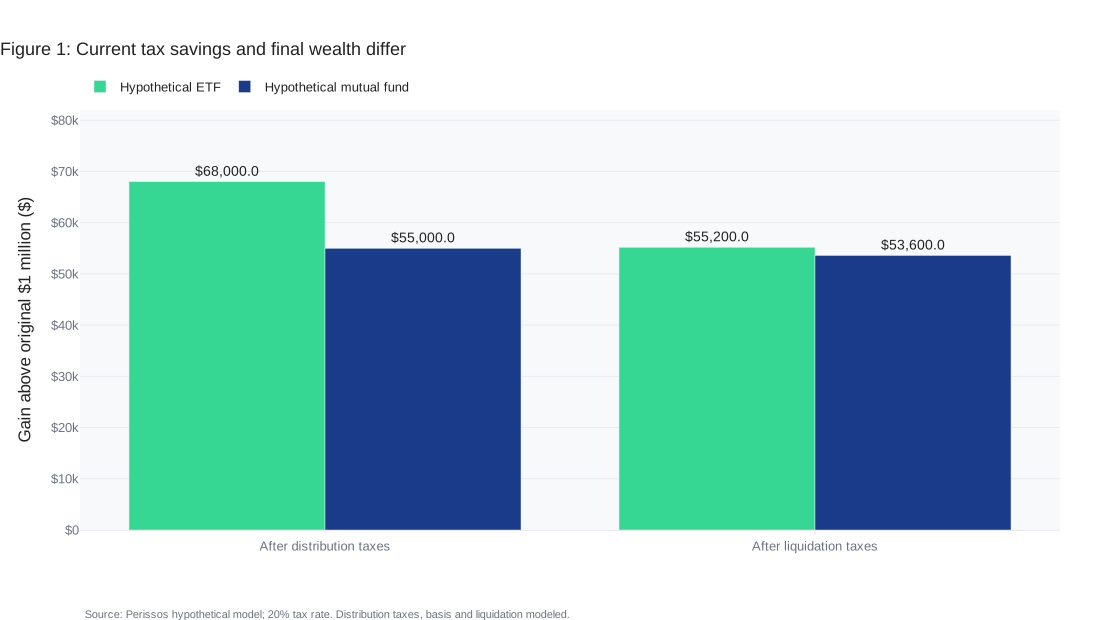
The hypothetical ETF incurs $1,000 of operating costs and distributes $5,000 of gains. The hypothetical mutual fund incurs $3,000 of operating costs and distributes $60,000. Assume a 20% effective tax rate on both distributions and subsequent gains. Taxes are paid from the distributions, and the remaining cash is immediately reinvested at year-end. Costs are simplified fixed amounts, with no trading costs, outside contributions, or intervening reinvestment returns.
Before liquidating, the ETF ends at $1,068,000: starting wealth plus $70,000 return, less $1,000 costs and $1,000 distribution tax. The mutual fund ends at $1,055,000 after $3,000 costs and $12,000 distribution tax. The difference is $13,000. Distribution amounts are already part of total return and are not subtracted a second time.
Now sell both immediately after reinvestment. The ETF's basis is $1,004,000, reflecting $4,000 of reinvested after-tax cash. Its remaining gain is $64,000, generating another $12,800 of tax. The mutual fund's basis is $1,048,000; its remaining $7,000 gain generates $1,400 of tax. Ending wealth after liquidation is $1,055,200 and $1,053,600, respectively. The difference shrinks to $1,600, the after-tax value of the assumed $2,000 cost difference.
The chart shows gains above the original $1 million under both views. It is not a forecast or a claim that either structure produces these distributions. A longer holding period may make deferral more valuable, and different tax rates, losses, gifts, or estate outcomes can change the result. The example demonstrates why a current-tax comparison should not be mistaken for a permanent-tax comparison.
Costs extend beyond the expense ratio
The prospectus fee table is an important starting point. Examine gross expenses, any waiver or reimbursement, and how long a reduced expense arrangement lasts. Also investigate account-level advisory charges, transaction charges, and any applicable sales or redemption fees. The SEC's fund-fee bulletin explains why the expense ratio alone is incomplete.5
For a proposed ETF trade, consider spreads and execution alongside annual costs. For a mutual fund, confirm the exact share class and all charges available through the account. I would request the anticipated dollar cost for the intended position size and holding period. A small percentage becomes easier to evaluate when attached to the dollars the family expects to invest.
Decide whether to buy, retain, or transition
New cash and an appreciated existing holding require different analyses. A tax-efficient destination does not automatically justify realizing a large gain to reach it. Estimate the transition tax with the CPA, then compare immediate sale, gradual changes, and directing new money elsewhere. Our discussion of tax-loss harvesting tradeoffs reinforces the importance of the full investment decision.
ETFs may fit a taxable investor who values control over realization, accepts exchange trading, and finds a suitable exposure at a reasonable total cost. Mutual funds may remain appropriate when their strategy, available share class, account features, or transition economics fit better. Either can be a poor choice when the underlying risk does not match the household's time horizon.
Before acting, document the exposure being purchased, expected holding period, total costs, likely distributions, and tax consequences of leaving the current investment. Review income-tax interactions and state treatment with the CPA rather than applying the illustration's rate. Involve the attorney when trust restrictions affect authority. The useful answer identifies the specific holding to buy or retain and explains why its expected after-tax role justifies the choice.
All my best,
Brandon VanLandingham, CFA, CMT, CFP
Founder / CIO
Citations
- SEC Investor.gov, Characteristics of Mutual Funds and Exchange-Traded Funds. Retrieved October 3, 2026.
- SEC Investor.gov, Exchange-Traded Funds. Retrieved October 3, 2026.
- IRS, Mutual Funds: Costs and Distributions. Retrieved October 3, 2026.
- IRS, Publication 550: Investment Income and Expenses. Current available 2025 edition; reinvestment and basis rules retrieved October 3, 2026.
- SEC Investor.gov, Mutual Fund and ETF Fees and Expenses. July 23, 2025; retrieved October 3, 2026.
Important Disclosures
This piece is educational. It is not legal, tax, or accounting advice and is not a recommendation to take or refrain from any specific action. Tax law is fact-specific and changes regularly. Please coordinate any decisions discussed here with your attorney, your CPA, and Perissos before acting.
Perissos Private Wealth Management is a Registered Investment Adviser ("RIA"). Registration as an investment adviser does not imply a certain level of skill or training, and the content of this communication has not been approved or verified by the United States Securities and Exchange Commission or by any state securities authority. Perissos Private Wealth Management renders individualized investment advice to persons in a particular state only after complying with the state's regulatory requirements, or pursuant to an applicable state exemption or exclusion. All investments carry risk, and no investment strategy can guarantee a profit or protect from loss of capital. Past performance is not indicative of future results.
The information contained in this newsletter is intended to provide general information about market themes. It is not intended to offer investment advice. Investment advice will only be given after a client engages our services by executing the appropriate investment services agreement. Information regarding investment products and services is given solely to provide education regarding our investment philosophy and our strategies. You should not rely on any information provided in making investment decisions.
Market data, articles and other content in this material are based on generally available information and are believed to be reliable. Perissos Private Wealth Management does not guarantee the accuracy of the information contained in this material.
Perissos Private Wealth Management will provide all prospective clients with a copy of our current Form ADV, Part 2A (Disclosure Brochure), Part 2B (Supplemental Brochures), and Part 3 (Client Relationship Summary) prior to commencing an advisory relationship. You can also view these documents at any time at adviserinfo.sec.gov or by contacting us requesting a copy.
Explore topics
Share this article
Last reviewed: October 3, 2026
Frequently Asked Questions
- Are ETFs always more tax efficient than mutual funds in a taxable account?
- Not always. ETFs often have fewer capital-gains distributions because of in-kind creations and redemptions, but fund holdings, turnover, and the tax cost of eventually selling still matter.
- Can a mutual fund distribution create taxes even if shares are not sold?
- Yes. Capital-gain distributions can be taxable in the year received even when they are reinvested, and reinvestment does not remove the tax liability.
- Why does the tax advantage of an ETF sometimes narrow after liquidation?
- A fund that distributed less taxable gain earlier may leave more unrealized gain inside the position, which can create a larger tax bill when the shares are eventually sold.