

Written and reviewed by Brandon VanLandingham, CFA, CMT, CFP® · Last updated October 3, 2026
Factor Investing: Value, Momentum, Quality, and Low Volatility Explained
Understand the exposure before deciding whether the tilt belongs in your plan
October 7, 2026
An investor can own a broad collection of stocks and still make a concentrated bet on one kind of company. A portfolio may favor inexpensive businesses, strong recent performers, profitable companies, or stocks with relatively quiet price histories. Factor investing makes those preferences explicit and applies a repeatable process to selecting or weighting securities.
The important decision is whether that exposure improves your household's portfolio after costs and practical constraints. A persuasive label is not enough. I would want to understand the selection rules, the reason for owning the strategy, and the conditions under which its performance could be uncomfortable.
A factor is a characteristic, not a guarantee
Equity factors describe characteristics used to explain differences in returns or construct portfolios. A factor strategy deliberately emphasizes one or more of those characteristics. It might follow a custom index or use an active process. The SEC's bulletin on nontraditional index funds explains that an index-based strategy can still embed substantial choices about how investments are selected and weighted.1
Rules make those choices more systematic; they do not make them neutral. The definition of a factor, the starting universe, and the rebalancing process all deserve scrutiny. Two portfolios with the same factor label can own different companies or carry different industry concentrations. Research examining factor portfolios by sector illustrates why looking through the label matters.2
What the four factors actually measure
Value looks for securities priced inexpensively relative to a fundamental measure such as earnings or book value. A low price relative to fundamentals is different from a low share price. Momentum emphasizes comparatively strong recent price performance. It looks at what prices have been doing rather than asking whether a company appears inexpensive. Quality commonly emphasizes financial characteristics such as profitability and limited leverage. Low volatility focuses on comparatively low historical price variability; implementations may also consider how holdings interact within the portfolio.2
These definitions create different questions for the buyer. For value, I would ask whether the measure treats a struggling business as inexpensive because its earnings are temporarily high or its prospects have deteriorated. For momentum, I would examine how quickly positions change and how the strategy handles a reversal. For quality, I would ask what price the portfolio pays for the selected financial characteristics. For low volatility, I would ask whether the final holdings introduce an industry concentration the household already has.
None of those questions supplies a forecast. They are ways to examine the tradeoffs before investing. An attractive company is not automatically an attractive investment at every price. A stock with a quiet history can still decline sharply. And a strategy designed to behave differently from a broad market benchmark must leave room for disappointing relative results. The SEC explicitly cautions that nontraditional index funds need not outperform, or even match, the market.1
Look at the portfolio you already own
Adding a factor allocation starts with an inventory. Review the household's existing stocks and funds, including employer equity and holdings in accounts managed elsewhere. A new quality allocation may repeat characteristics already prominent in the portfolio. A value allocation may change industry weights more than the investor expects.
Multifactor models can help attribute risk and returns to underlying exposures. CFA Institute's overview of multifactor models describes their use in portfolio analysis and risk control.3 The practical question is whether the proposed addition changes an exposure you intentionally want to change. A report should explain that connection in language the family understands.
This is where investment analysis and financial planning belong in the same discussion. Our article on how different analytical disciplines inform portfolio decisions describes that broader process. The best factor allocation for a long-term growth goal may be inappropriate for money needed to fund a near-term purchase.
Calculate the hurdle before debating the premium
Fees reduce the amount available to compound, as the SEC's investment-fee guidance explains.4 I would compare the proposed strategy with the portfolio it would replace and identify the incremental costs. A claim of potential additional return is incomplete without that comparison.
Figure 1 uses a hypothetical $1 million allocation over one year. Assume a factor strategy costs 0.25 percentage point more than the comparison portfolio, or $2,500. Also assume its implementation creates an additional $2,000 of tax cost that year. That second amount is a selected scenario input, not a tax rate or a prediction about any factor strategy. The combined hurdle is $4,500, equivalent to 0.45% of the starting allocation.
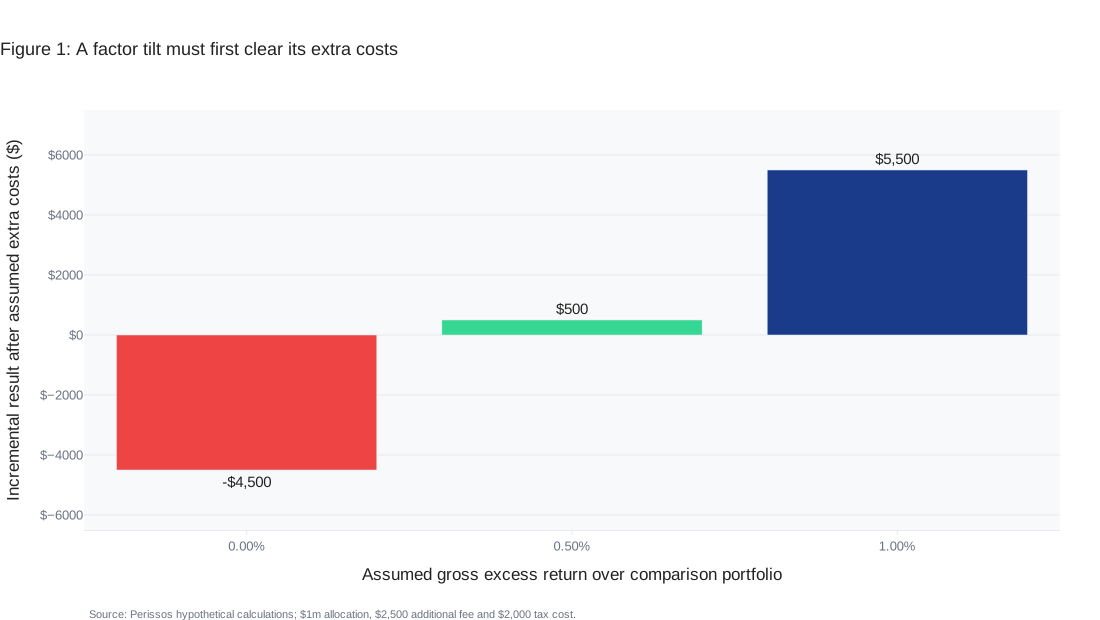
If the strategy produces no gross excess return, its incremental result is minus $4,500. A gross advantage of 0.50%, or $5,000, leaves $500 after the assumed additional costs. A 1.00% advantage leaves $5,500. The chart applies simple dollar arithmetic to the starting balance; it does not model daily fee accrual, changing asset values, reinvestment, or future tax consequences.
This exercise cannot establish whether a factor will outperform. It establishes how much benefit the strategy would need under the stated assumptions. Actual taxes may be lower, higher, deferred, or absent in the selected account, and transaction costs could add another hurdle. Ask for a range of outcomes rather than treating an estimated gross premium as spendable money.
Patience needs a review policy
A long horizon is useful only if the investor can stay with the chosen process. Before allocating, describe what disappointing performance would look like in dollars and relative to the benchmark. Decide which evidence would justify a change. A methodological change, unexplained exposure, or cost increase deserves a different response from a period of poor returns with the intended strategy intact.
For example, a household could schedule an annual review of holdings, exposures, expenses, and implementation while monitoring major process changes as they arise. That is a suggested governance practice, not an optimal trading schedule. It creates a reason to review the strategy without assuming every disappointing quarter demands a replacement.
Combining factors does not remove this responsibility. Ask whether the portfolio blends separate factor sleeves or selects stocks using a combined score, and how conflicting signals are handled. Prefer a clear explanation of the resulting holdings over a claim that owning several factors guarantees diversification. No committee of labels can substitute for examining actual exposures.
Make the allocation small enough to understand and sustain
Factor investing may fit a household seeking a deliberate, measurable departure from its existing equity exposure and willing to evaluate it over time. It is a weaker fit when the investor expects immediate outperformance, needs the money soon, or would abandon the approach after a modest relative shortfall. A simpler broad portfolio remains a legitimate alternative.
Before implementation, determine the funding source and whether the transition itself creates costs. Review account placement alongside the household's tax-diversified retirement portfolio. Coordinate projected tax effects with the CPA, and involve the attorney if trust restrictions affect investment authority. Keep the allocation decision separate from a desire to generate activity.
I would leave the review with a written purpose, a comparison benchmark, an allocation limit, and a cost budget. Also record what would cause us to reconsider. The household should be able to explain why it owns the exposure when that exposure is out of favor. If that explanation depends entirely on a recent performance chart, more work is needed before making the trade.
All my best,
Brandon VanLandingham, CFA, CMT, CFP
Founder / CIO
Citations
- SEC Investor.gov, Smart Beta, Quant Funds and Other Non-Traditional Index Funds. Retrieved October 3, 2026.
- CFA Institute, What's in a Factor? A Breakdown by Sectors. Original factor-portfolio research; retrieved October 3, 2026.
- CFA Institute, Using Multifactor Models. Retrieved October 3, 2026.
- SEC Investor.gov, How Fees and Expenses Affect Your Investment Portfolio. July 23, 2025; retrieved October 3, 2026.
Important Disclosures
This piece is educational. It is not legal, tax, or accounting advice and is not a recommendation to take or refrain from any specific action. Tax law is fact-specific and changes regularly. Please coordinate any decisions discussed here with your attorney, your CPA, and Perissos before acting.
Perissos Private Wealth Management is a Registered Investment Adviser ("RIA"). Registration as an investment adviser does not imply a certain level of skill or training, and the content of this communication has not been approved or verified by the United States Securities and Exchange Commission or by any state securities authority. Perissos Private Wealth Management renders individualized investment advice to persons in a particular state only after complying with the state's regulatory requirements, or pursuant to an applicable state exemption or exclusion. All investments carry risk, and no investment strategy can guarantee a profit or protect from loss of capital. Past performance is not indicative of future results.
The information contained in this newsletter is intended to provide general information about market themes. It is not intended to offer investment advice. Investment advice will only be given after a client engages our services by executing the appropriate investment services agreement. Information regarding investment products and services is given solely to provide education regarding our investment philosophy and our strategies. You should not rely on any information provided in making investment decisions.
Market data, articles and other content in this material are based on generally available information and are believed to be reliable. Perissos Private Wealth Management does not guarantee the accuracy of the information contained in this material.
Perissos Private Wealth Management will provide all prospective clients with a copy of our current Form ADV, Part 2A (Disclosure Brochure), Part 2B (Supplemental Brochures), and Part 3 (Client Relationship Summary) prior to commencing an advisory relationship. You can also view these documents at any time at adviserinfo.sec.gov or by contacting us requesting a copy.
Explore topics
Share this article
Last reviewed: October 3, 2026
Frequently Asked Questions
- What does factor investing actually mean?
- Factor investing emphasizes specific stock characteristics, such as value, momentum, quality, or low volatility, through a rules-based or active process. The label alone does not show how securities are selected, weighted, or rebalanced.
- Why should investors review costs and taxes before adding a factor strategy?
- A factor portfolio must first overcome any added fees, trading friction, and possible tax costs relative to the investment it replaces. Even a modest cost difference can create a meaningful performance hurdle over time.
- Can two funds with the same factor label be meaningfully different?
- Yes. Two strategies labeled value, momentum, quality, or low volatility can hold different companies, use different definitions, and create different sector concentrations depending on their rules.