

Written and reviewed by Brandon VanLandingham, CFA, CMT, CFP® · Last updated October 3, 2026
Direct Indexing for Tax-Aware Investors
Measure the value of tax control across the full holding period
October 6, 2026
A taxable portfolio can rise overall while individual stocks inside it fall. Owning those stocks directly can create opportunities to realize selected losses without selling the entire market exposure. That is one reason direct indexing attracts investors with substantial taxable assets. The planning question is whether the additional control is valuable enough to justify the costs, tracking differences, and ongoing coordination.
I would start with the household's tax return and existing holdings. A large account alone does not establish a need for direct indexing. An investor with usable capital gains, flexible funding, and a long horizon faces a different decision from someone with a large loss carryforward and an upcoming need to spend the money.
What changes when you own the stocks
Direct indexing generally means owning individual securities intended to approximate an index, rather than owning shares of a pooled index fund. Holdings can be customized, including exclusions or changes intended to accommodate other investments. FINRA's explanation of direct indexing describes both this flexibility and the possibility of higher costs and returns that differ materially from the index.1
The distinction matters at the tax-lot level. A fund shareholder can decide which fund shares to sell; a direct investor can decide which individual stock lots to sell. That creates more decisions, and therefore more responsibility. I would ask who monitors those decisions, how replacement investments are selected, and how the manager balances tax opportunities against maintaining the intended exposure.
Customization should solve an identifiable problem. For an employee with substantial employer stock, excluding that company from another account may avoid adding to an existing concentration. It does not diversify the employer shares already owned. For a household with investment restrictions, exclusions can help implement preferences, but the resulting portfolio still needs a coherent risk review.
A realized loss is not the same as tax savings
Federal capital-loss rules determine when a harvested loss becomes useful. Capital losses offset capital gains under the applicable netting rules. If losses exceed gains, an individual generally may deduct up to $3,000 against other income, or $1,500 if married filing separately, with remaining losses carried forward. The IRS explains these mechanics in Topic 409.2
That means a report showing $50,000 of harvested losses is not a report showing $50,000 of savings. The benefit depends on the gains being offset, their character, the investor's tax rates, and whether the losses can be used now. An unused carryforward may have future value, but it should not be reported as though the household already received cash.
For implementation, I would have the CPA confirm the available gains and existing carryforwards before setting a harvesting objective. Include expected sales outside the managed account. The most useful loss may offset a transaction elsewhere in the household, but that connection needs to be documented rather than assumed.
Understand the future tax bill as well as today's benefit
Suppose a stock lot costs $100,000 and is sold for $80,000, creating a $20,000 loss. Assume the investor has sufficient compatible gains to use the entire loss immediately at an effective 20% tax rate. The current tax reduction is $4,000. Every dollar and rate in this example is hypothetical; the selected rate is not a calculation of any household's federal, state, or surtax liability.
Now assume the $80,000 buys a permissible replacement investment, with no wash sale, and that replacement is eventually sold for $120,000. Its gain is $40,000. Compare that with a deliberately simplified alternative in which the original $100,000-basis position is retained and also ultimately sold for $120,000, producing a $20,000 gain. Cost generally establishes purchased-property basis under the IRS's basis guidance.3
At the same assumed 20% rate, harvesting creates $4,000 more tax at the later sale. The example therefore produces tax deferral rather than a permanent $4,000 saving. It assumes equal ultimate investment values, which real replacement holdings will not necessarily deliver. Trading costs, dividends, fees, and changes in tax law or rates are excluded.
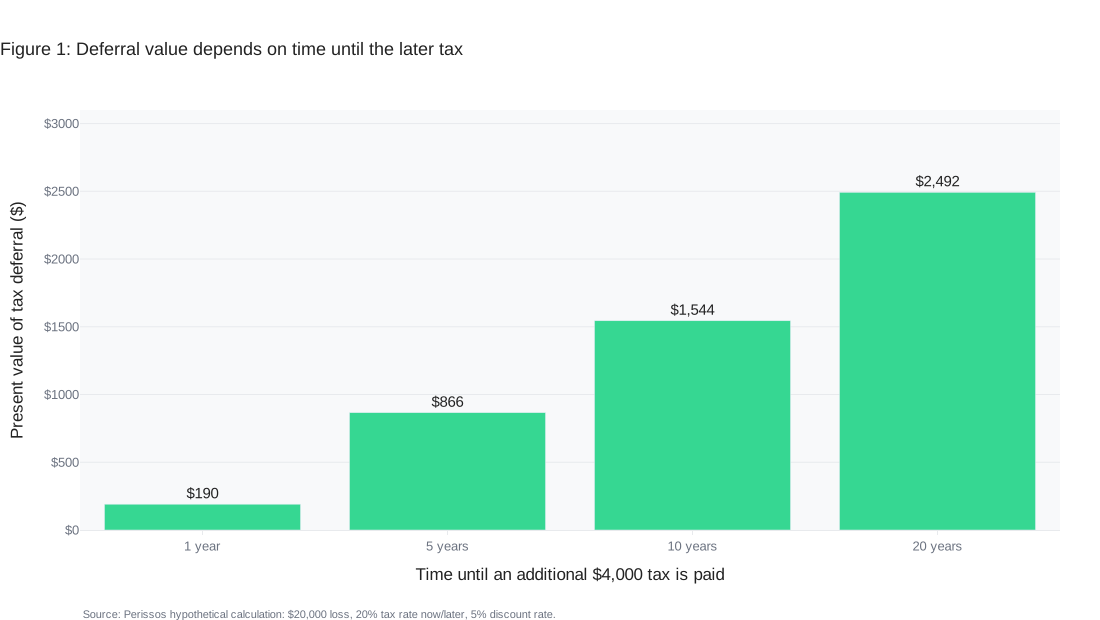
Figure 1 values that single $4,000 deferral using an assumed 5% annual discount rate. Subtracting the present value of the later $4,000 liability from today's $4,000 benefit produces approximately $190 for a one-year deferral, $866 for five years, $1,544 for ten years, and $2,492 for twenty years. These are present-value illustrations, not investment returns or forecasts. Longer deferral increases the modeled benefit, but does not prove a recurring management fee is worthwhile.
Our article on when paying the tax can be the better trade explores why the tax entry should be evaluated alongside the investment decision. Ask for results after an assumed liquidation, not just a cumulative tally of harvested losses.
Wash-sale coordination must reach beyond one account
The wash-sale rule generally disallows a securities loss when substantially identical securities are acquired within 30 days before or after the sale. Purchases by a spouse can matter, as can acquisitions in an IRA or Roth IRA. In an ordinary taxable-account wash sale, the disallowed loss generally increases replacement basis. IRS Publication 550 explains the rules and reporting responsibility.4
An IRA replacement is especially important: Revenue Ruling 2008-5 provides that the taxable loss is disallowed without increasing the IRA's basis.5 Do not assume a loss is merely deferred whenever a retirement account is involved.
Before enabling automated harvesting, inventory other managed accounts, self-directed trading, dividend reinvestment, and employer purchase arrangements. Establish how outside purchases will be communicated. A manager's controls cannot reliably incorporate transactions it never sees. The phrase substantially identical also requires judgment; a different ticker is not a universal assurance that a replacement is acceptable. Coordinate uncertain cases with the CPA rather than relying on a software label.4
Examine the transition and the exit
Funding with cash and funding with appreciated holdings create different starting points. I would request a lot-by-lot transition plan showing positions to retain, proposed sales, expected realized gains, and the resulting exposure. Set a gain budget before trading. A desire to reach a clean target portfolio immediately should not override the household's broader tax plan.
Ask what happens if harvesting opportunities diminish or the investor changes advisers. Compare ongoing fees, the ability to transfer holdings, and the costs of consolidating many positions later. Also ask how withdrawals will be funded if selling the most convenient holdings would create substantial gains. A strategy should have a workable exit as well as an attractive opening presentation.
Holding appreciated assets until death can change the basis analysis because inherited property generally receives a basis tied to fair market value, subject to exceptions.3 Our discussion of basis adjustments at inheritance explains why estate intentions matter. That possible outcome should be modeled separately from a lifetime liquidation, not assumed for every household or asset.
Require a household-specific comparison
Direct indexing may be useful when the investor can use losses, values customization, and accepts differences from the benchmark. It may add little when the account is tax sheltered, usable gains are limited, the horizon is short, or additional fees overwhelm the expected benefit. Tax benefits also do not prevent investment losses or guarantee that replacement securities keep pace.1
Before proceeding, ask for a comparison with a simpler diversified implementation using the same starting assets, cash flows, and liquidation assumptions. Have the CPA review loss usability, wash-sale coordination, and applicable taxes; involve the attorney when trust ownership or estate intentions affect the plan. Record the expected benefit, additional costs, acceptable tracking differences, and who supplies outside-account information. Those commitments give us a practical basis for deciding whether the extra control is earning its place.
All my best,
Brandon VanLandingham, CFA, CMT, CFP
Founder / CIO
Citations
- FINRA, The Basics of Direct Indexing. Retrieved October 3, 2026.
- IRS, Topic 409: Capital Gains and Losses. Retrieved October 3, 2026; no prior-year capital-gain bracket thresholds used.
- IRS, Topic 703: Basis of Assets. Retrieved October 3, 2026.
- IRS, Publication 550: Investment Income and Expenses, Wash Sales. 2025 edition, current available publication retrieved October 3, 2026; standing wash-sale rules.
- IRS, Revenue Ruling 2008-5. IRA replacement purchases and disallowed losses; retrieved October 3, 2026.
Important Disclosures
This piece is educational. It is not legal, tax, or accounting advice and is not a recommendation to take or refrain from any specific action. Tax law is fact-specific and changes regularly. Please coordinate any decisions discussed here with your attorney, your CPA, and Perissos before acting.
Perissos Private Wealth Management is a Registered Investment Adviser ("RIA"). Registration as an investment adviser does not imply a certain level of skill or training, and the content of this communication has not been approved or verified by the United States Securities and Exchange Commission or by any state securities authority. Perissos Private Wealth Management renders individualized investment advice to persons in a particular state only after complying with the state's regulatory requirements, or pursuant to an applicable state exemption or exclusion. All investments carry risk, and no investment strategy can guarantee a profit or protect from loss of capital. Past performance is not indicative of future results.
The information contained in this newsletter is intended to provide general information about market themes. It is not intended to offer investment advice. Investment advice will only be given after a client engages our services by executing the appropriate investment services agreement. Information regarding investment products and services is given solely to provide education regarding our investment philosophy and our strategies. You should not rely on any information provided in making investment decisions.
Market data, articles and other content in this material are based on generally available information and are believed to be reliable. Perissos Private Wealth Management does not guarantee the accuracy of the information contained in this material.
Perissos Private Wealth Management will provide all prospective clients with a copy of our current Form ADV, Part 2A (Disclosure Brochure), Part 2B (Supplemental Brochures), and Part 3 (Client Relationship Summary) prior to commencing an advisory relationship. You can also view these documents at any time at adviserinfo.sec.gov or by contacting us requesting a copy.
Explore topics
Share this article
Last reviewed: October 3, 2026
Frequently Asked Questions
- How does direct indexing differ from owning an index fund?
- Direct indexing generally means owning individual stocks designed to approximate an index rather than a pooled fund. That structure allows tax-lot level decisions, exclusions, and customization, but it can also increase costs and tracking differences.
- Does harvesting a loss automatically create tax savings?
- No. Capital losses first offset capital gains, and if losses exceed gains, an individual generally may deduct up to $3,000 against other income, with the remainder carried forward under federal rules.
- Why do wash-sale rules matter in direct indexing?
- A wash sale can disallow a loss if substantially identical securities are bought within 30 days before or after the sale. Coordination may need to include a spouse's accounts, IRAs, Roth IRAs, dividend reinvestment, and outside trading.