

Why a CFA + CMT + CFP Team Builds Different Portfolios
How investment analysis, market behavior, and financial planning inform one decision
October 02, 2026
An investment can look attractive on a valuation worksheet and still be too large for a family's portfolio. Its price trend may be improving while the household needs cash for an approaching obligation. Selling it may reduce concentration but create another planning question that deserves attention before the trade. Portfolio construction becomes more useful when those considerations are examined together.
That is the potential value of combining the disciplines associated with the CFA charter, the CMT designation, and CFP certification. The different training can broaden the questions a team asks and the evidence it considers. Credentials alone do not establish that one portfolio will outperform another or lose less in a downturn. I would look for the connection between the training and the actual work delivered to the family.
Investment analysis tests what you own
The CFA Program curriculum includes financial statement analysis, equity and fixed-income analysis, economics, quantitative methods, portfolio construction, and ethical standards. It supplies a broad foundation for evaluating investments and their role within a portfolio. It is not limited to selecting individual stocks.1
Consider the questions that foundation can support. What assumptions make an investment attractive? How sensitive is the conclusion to weaker revenue, higher financing costs, or a different valuation? Does the position duplicate risks the household already owns elsewhere? A sound investment case should describe what could go wrong as clearly as what could go right.
Portfolio-level reasoning matters as much as the merits of a particular holding. A promising business may still deserve a modest allocation because the family already depends on the same industry for employment or business income. Conversely, an asset with an unremarkable standalone outlook may serve a useful funding or diversification purpose. Those judgments require an understanding of the whole balance sheet, not just an attractive research report.
Technical analysis examines market behavior
The CMT Association's learning objectives emphasize technical analysis, market dynamics, trend analysis, and the management of positions and risk. This discipline brings attention to how markets are behaving, alongside an analysis of what an investment might be worth.2
A team might examine whether a position's price behavior supports or challenges its investment thesis, how the position responds during market stress, or whether a proposed trading rule produces consistent decisions. Those are examples of applications, not evidence that a particular indicator predicts the future. A technical observation becomes useful only when the team can explain what action it permits and what evidence would change the conclusion.
There are meaningful tradeoffs. A rule can respond after a price has already moved, reverse repeatedly, or reduce exposure before a rebound. A process should therefore specify position sizing, review frequency, implementation costs, and what happens after an exit. A chart that looks persuasive after the fact is not enough to justify a trading policy.
I would also want to know when the team deliberately chooses not to act. Monitoring market behavior should not create a requirement to trade whenever a signal changes. The size of the risk, the reliability of the evidence, and the consequences for the household all belong in the decision.
Financial planning defines the job of the money
CFP Board's principal knowledge topics cover investment planning alongside retirement income, tax planning, insurance and risk management, estate planning, and the psychology of financial planning. That breadth helps connect investment recommendations with the family's other decisions.3
For a household approaching retirement, the starting questions include the spending requirement, reliable income sources, upcoming commitments, and the ability to adjust if markets disappoint. The plan should identify which assets support near-term needs and which can remain invested for longer. A risk questionnaire is useful information, but a family's willingness to endure a decline and its financial ability to endure one can differ.
Account structure deserves attention, too. Our memo on building a tax-diversified retirement portfolio explains the planning questions that arise when assets sit in different account types. An investment allocation cannot answer those questions by itself. Implementation involving tax, legal, or insurance matters should be coordinated with the CPA, attorney, or appropriately licensed professional.
These areas overlap across the credential programs. A CFA charterholder can understand financial planning, a CFP professional can understand portfolio construction, and a CMT charterholder can incorporate fundamental information. The value of the combination is collaboration and a broader review process, not exclusive ownership of particular questions.1,2,3
A concentrated position makes the interaction concrete
Assume a hypothetical family has a $5 million investment portfolio, including $1.25 million in one stock. The stock represents 25% of the portfolio. The family likes the business and has held it for years, but now wants to evaluate how much exposure fits its retirement plan. These are illustrative assumptions, not facts about a Perissos client.
Investment analysis can examine the business and the assumptions supporting its valuation. Technical analysis can inform a defined review of market behavior and execution choices. Financial planning can establish whether the family can tolerate the loss, when cash may be needed, and which implementation questions require professional coordination. None of those disciplines should have to work without the others' information.
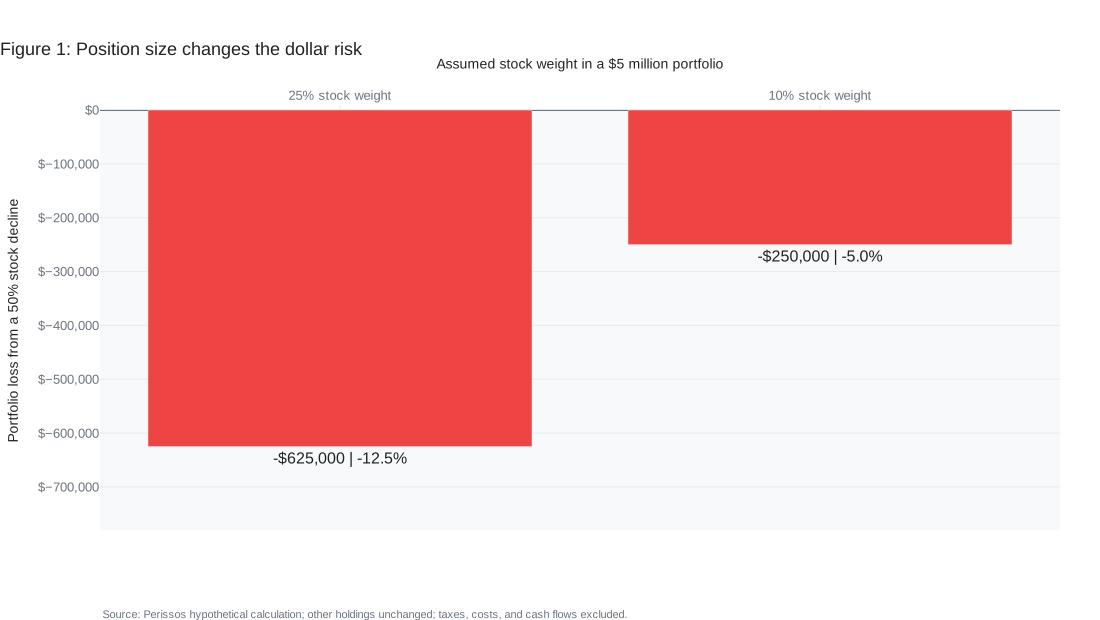
Figure 1 isolates position size. If that stock loses 50% while every other holding stays unchanged, a 25% position produces a $625,000 portfolio loss, or 12.5% of the starting portfolio. At a 10% starting weight in an otherwise $5 million portfolio, the same stock decline produces a $250,000 loss, or 5.0%. The difference is $375,000. The example excludes taxes, fees, trading costs, cash flows, and all changes in the other holdings.
The calculation does not prove that 10% is an appropriate allocation, that the stock will decline, or that credentialed managers would avoid the loss. A smaller position would also contribute less if the stock rose. The chart gives the family a concrete risk exposure to discuss; it is not a comparison of investment performance across credentials.
For an appreciated holding, the path to a smaller position needs its own analysis. Our discussion of planning around a highly appreciated portfolio identifies related questions to examine with the tax team. The investment decision and its implementation should be documented together, including the consequences of keeping the position, changing it promptly, or changing it over time.
Judge the team by its decision process
Ask the professionals to walk through a decision where their perspectives differ. If an investment looks attractive but exceeds the family's risk capacity, who resolves the conflict? If a market signal favors selling but implementation has material consequences, what information is required before acting? The answer should identify responsibility and a repeatable process, rather than end with a list of designations.
Verify the credentials themselves. The SEC's guide to financial professional designations explains that designations are distinct from registration or licensing and encourages investors to investigate what a credential requires and whether the professional holds it. Review relevant background and disciplinary information as well.4
A broad team can be helpful when investment, retirement, ownership, and tax decisions interact. It can be unnecessary expense when the household needs a narrow service and receives little benefit from additional coordination. More specialists can also create confusion if no one owns the final recommendation. The engagement should make accountability easier for the family to understand.
Before hiring, request a sample investment policy and a written description of the work you will receive. Look for spending and liquidity objectives, allocation limits, a review process, clear fees, and the treatment of exceptions. Ask who will explain an uncomfortable result and how the plan will be updated when your life changes. The most useful evidence of a multidisciplinary approach is a decision you can understand, with its reasoning and tradeoffs recorded before implementation.
All my best,
Brandon VanLandingham, CFA, CMT, CFP
Founder / CIO
Citations
- CFA Institute, CFA Program Curriculum. Retrieved September 26, 2026.
- CMT Association, Understanding the Learning Objectives for the CMT Program. Retrieved September 26, 2026.
- CFP Board, Program Content for Registered Programs: Principal Knowledge Topics. Current principal-topic framework retrieved September 26, 2026.
- U.S. Securities and Exchange Commission, Investor.gov, Making Sense of Financial Professional Designations: Investor Bulletin. Retrieved September 26, 2026.
Important Disclosures
This piece is educational. It is not legal, tax, or accounting advice and is not a recommendation to take or refrain from any specific action. Tax law is fact-specific and changes regularly. Please coordinate any decisions discussed here with your attorney, your CPA, and Perissos before acting.
Perissos Private Wealth Management is a Registered Investment Adviser ("RIA"). Registration as an investment adviser does not imply a certain level of skill or training, and the content of this communication has not been approved or verified by the United States Securities and Exchange Commission or by any state securities authority. Perissos Private Wealth Management renders individualized investment advice to persons in a particular state only after complying with the state's regulatory requirements, or pursuant to an applicable state exemption or exclusion. All investments carry risk, and no investment strategy can guarantee a profit or protect from loss of capital. Past performance is not indicative of future results.
The information contained in this newsletter is intended to provide general information about market themes. It is not intended to offer investment advice. Investment advice will only be given after a client engages our services by executing the appropriate investment services agreement. Information regarding investment products and services is given solely to provide education regarding our investment philosophy and our strategies. You should not rely on any information provided in making investment decisions.
Market data, articles and other content in this material are based on generally available information and are believed to be reliable. Perissos Private Wealth Management does not guarantee the accuracy of the information contained in this material.
Perissos Private Wealth Management will provide all prospective clients with a copy of our current Form ADV, Part 2A (Disclosure Brochure), Part 2B (Supplemental Brochures), and Part 3 (Client Relationship Summary) prior to commencing an advisory relationship. You can also view these documents at any time at adviserinfo.sec.gov or by contacting us requesting a copy.
Explore topics
Share this article
Last reviewed: September 26, 2026
Frequently Asked Questions
- Why might a CFA + CMT + CFP team build a portfolio differently?
- The combination can broaden the review process by testing investment assumptions, market behavior, and household planning constraints together. That may change position size, implementation timing, or how near-term cash needs are funded.
- Does having CFA, CMT, and CFP credentials mean better returns?
- No. The content states that credentials alone do not prove a portfolio will outperform or lose less in a downturn; the practical difference is a broader decision process.
- How does concentration risk affect a retirement portfolio?
- In the example, a $1.25 million stock position inside a $5 million portfolio equals 25% of assets, so a 50% drop would reduce the portfolio by $625,000, or 12.5%. At a 10% weight, the same drop would reduce the portfolio by $250,000, or 5.0%.


