

Written and reviewed by Brandon VanLandingham, CFA, CMT, CFP® · Last updated November 7, 2026
ESPPs: The Most Underrated Employee Benefit
Separate the purchase benefit from the decision to hold employer shares
November 06, 2026
An employee stock purchase plan can be a valuable benefit that receives less attention than salary, bonuses, or retirement contributions. The opportunity is straightforward: buy employer shares on favorable terms and use the resulting value to advance the household plan. The mistake is assuming that an attractive purchase automatically makes the stock an attractive long-term holding.
The title reflects a planning judgment, not a ranking of employee benefits. Some ESPPs deserve enthusiastic participation; others offer limited value after restrictions and household cash needs are considered. I would evaluate the purchase benefit and the decision to retain shares separately. You can appreciate the employer's offer without building your retirement around its stock price.
Read the offering before choosing a payroll deduction
This memo addresses U.S. tax-qualified plans under Section 423. An arrangement called an ESPP may instead be nonqualified, and its tax treatment can differ. The IRS overview of statutory stock options includes qualified employee stock purchase plans and explains that income generally arises on disposition rather than at grant or exercise.1
A plan may offer a discount, a lookback to an earlier price, or both. Neither feature should be assumed. Treasury's ESPP regulations permit qualifying pricing no lower than 85% of the relevant grant-date or exercise-date fair market value, subject to the plan rules. They also impose the $25,000 annual accrual limit measured using grant-date value. That figure is not simply a universal $25,000 cash-contribution allowance.2
Obtain the offering document and ask payroll to explain enrollment deadlines, contribution limits, purchase dates, withdrawals, refunds after termination, and sale restrictions. A lookback may improve economics when the price rises, but it does not guarantee that the shares can be sold immediately at the displayed market price. Settlement delays, fees, blackouts, and required holding periods belong in the evaluation.
The cash-flow question comes first. Payroll deductions reduce money available for current expenses until shares are purchased and any permitted sale settles. An employee who needs that money for rent, emergency reserves, or expensive debt may need a smaller contribution even when the plan's discount is compelling. A benefit is useful only if the family can afford its implementation.
What a discount actually earns
Assume a plan buys stock for 85% of the purchase-date market price and that there is no additional lookback benefit. If the market price is $100, the employee pays $85. Selling at $100 produces a $15 gross gain on an $85 investment, or approximately 17.65%. A 15% discount is therefore not the same denominator as a 15% investment return.
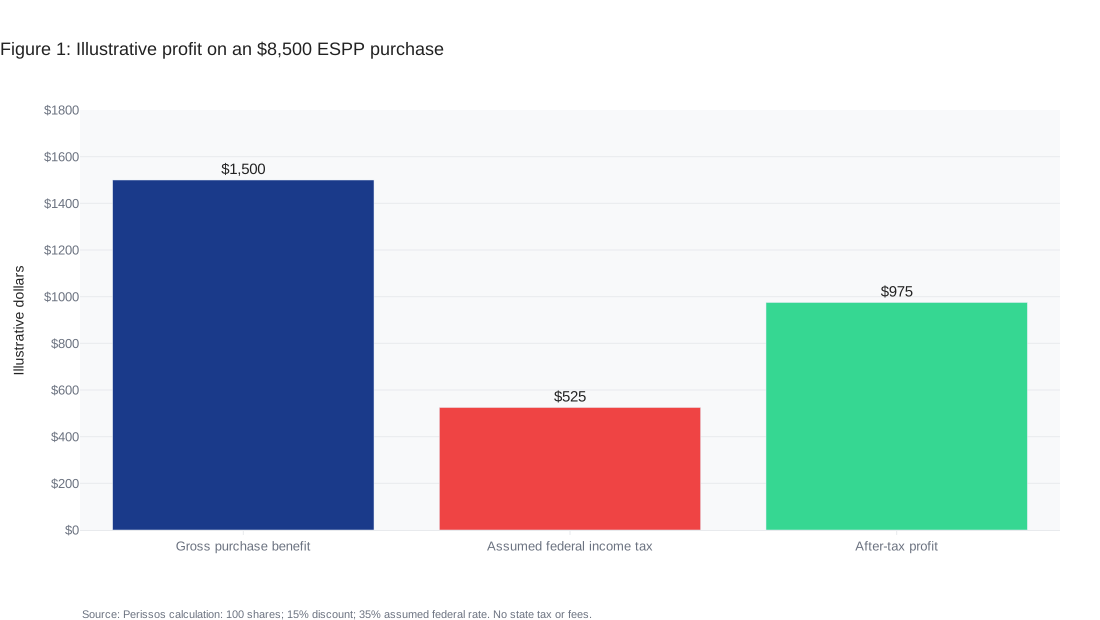
That result is an illustration before tax and costs, not an annualized yield or a guaranteed profit. Assume 100 shares, an $8,500 cost, immediate sale permission, no price movement before execution, and a 35% marginal ordinary federal income-tax rate. A $1,500 compensation component produces $525 of assumed federal tax and $975 of net profit, or about 11.47% of the original contribution. State tax, fees, and household-specific interactions are excluded.
Figure 1 compares the $1,500 gross discount benefit, the $525 assumed federal tax, and the $975 remaining profit. The chart deliberately does not annualize the result. Payroll contributions may arrive at different times, and the money may be tied up for an offering period. A flashy annualized return can distract from the actual dollars available and the operational risk required to capture them.
The tax clock can reward patience, but demands risk
A qualifying disposition generally requires satisfying both the two-year period after grant and the one-year period after transfer of the shares. Satisfying only one is insufficient. When the holding conditions are met, compensation generally equals the lesser of the grant-date discount amount, calculated under the applicable rules, or the actual gain. Remaining gain is capital gain. IRS Publication 525 explains these distinctions and the necessary basis adjustment.3
An earlier sale is a disqualifying disposition. The purchase-date spread generally becomes ordinary income even if the stock subsequently declines; sale proceeds compared with basis increased by that income create a separate capital gain or loss. A favorable purchase followed by a bad holding decision can therefore leave both compensation income and a capital loss.3
Consider a separate hypothetical lookback offering: grant-date market value is $100, purchase-date value is $120, and the purchase price is $85. A prompt sale at $120 produces $35 per share of ordinary income. If both holding periods are satisfied and the eventual sale price is still $120, assume the qualifying compensation amount is $15 and remaining long-term gain is $20. At assumed rates of 35% on ordinary income and 15% on long-term gain, federal tax is $12.25 for the prompt sale versus $8.25 for the qualifying sale. The $4 difference is the illustrative tax reward for waiting.2,3
That comparison holds the sale price constant to isolate tax character; the market does not. The owner must accept company risk during the additional holding period. Capital-gain rates depend on the return, and state tax and surtaxes can change the result. Ask the CPA for a household-specific comparison before deciding that the tax savings justify the exposure. There is no universal rule that a qualifying disposition is economically best.
Keep the benefit from turning into concentration
An employee may already hold company stock through previous ESPP purchases, vested equity awards, and retirement-plan investments. Future compensation and employment income add dependence that does not appear in the brokerage account. Measure all of those exposures before deciding to retain another purchase.
A prompt-sale policy may fit an employee who wants to capture the purchase benefit and redirect proceeds to diversified investments or a near-term goal. A deliberate holding policy may fit someone with substantial independent resources, a modest employer position, and willingness to bear losses. Neither policy should be selected merely because colleagues prefer it or because the shares were acquired at a discount.
For shares accumulated over years, our discussion of reducing gains on an appreciated portfolio provides a broader framework for coordinating sales. The starting question remains what loss the household can absorb. Avoid letting a desire for favorable tax character postpone necessary diversification indefinitely.
Make the records as deliberate as the purchase
Keep grant and purchase dates, market values, purchase prices, share counts, sale confirmations, and payroll records by lot. Form 3922 provides information about transfers of shares acquired through qualifying ESPPs, but it does not replace sale records or determine your entire tax return.4 Have the preparer reconcile compensation already included in wages with brokerage basis so the same economic amount is not taxed twice.3
Our guide to building a tax-diversified retirement portfolio can help determine where the net proceeds belong alongside retirement accounts and other taxable savings. The ESPP is one funding source within that larger plan, not a substitute for it.
Before enrolling, write down an affordable payroll contribution, the earliest permitted sale date, the intended holding policy, and the destination of proceeds. Confirm those choices with the plan administrator and coordinate the tax reserve with your CPA. Revisit the policy when employment, cash reserves, or the employer position changes. A repeatable process lets the benefit serve the family without asking every purchase to become a prediction about the company.
All my best,
Brandon VanLandingham, CFA, CMT, CFP
Founder / CIO
Citations
- IRS Topic 427: Stock Options (retrieved October 31, 2026).
- 26 CFR 1.423-2 (retrieved October 31, 2026).
- IRS Publication 525 (retrieved October 31, 2026).
- IRS About Form 3922 (retrieved October 31, 2026).
Important Disclosures
This piece is educational. It is not legal, tax, or accounting advice and is not a recommendation to take or refrain from any specific action. Tax law is fact-specific and changes regularly. Please coordinate any decisions discussed here with your attorney, your CPA, and Perissos before acting.
Perissos Private Wealth Management is a Registered Investment Adviser ("RIA"). Registration as an investment adviser does not imply a certain level of skill or training, and the content of this communication has not been approved or verified by the United States Securities and Exchange Commission or by any state securities authority. Perissos Private Wealth Management renders individualized investment advice to persons in a particular state only after complying with the state's regulatory requirements, or pursuant to an applicable state exemption or exclusion. All investments carry risk, and no investment strategy can guarantee a profit or protect from loss of capital. Past performance is not indicative of future results.
The information contained in this newsletter is intended to provide general information about market themes. It is not intended to offer investment advice. Investment advice will only be given after a client engages our services by executing the appropriate investment services agreement. Information regarding investment products and services is given solely to provide education regarding our investment philosophy and our strategies. You should not rely on any information provided in making investment decisions.
Market data, articles and other content in this material are based on generally available information and are believed to be reliable. Perissos Private Wealth Management does not guarantee the accuracy of the information contained in this material.
Perissos Private Wealth Management will provide all prospective clients with a copy of our current Form ADV, Part 2A (Disclosure Brochure), Part 2B (Supplemental Brochures), and Part 3 (Client Relationship Summary) prior to commencing an advisory relationship. You can also view these documents at any time at adviserinfo.sec.gov or by contacting us requesting a copy.
Explore topics
Share this article
Last reviewed: November 6, 2026
Frequently Asked Questions
- Is a 15% ESPP discount the same as a 15% investment return?
- No. Buying at 85% of market value and selling at full market value creates a 17.65% gross gain on the amount invested before taxes, fees, and timing constraints.
- When does an ESPP sale receive qualifying tax treatment?
- A qualifying disposition generally requires holding the shares at least one year after transfer and at least two years after the grant date. Meeting only one of those periods is not enough.
- Why might an employee sell ESPP shares promptly instead of holding them?
- A prompt sale may help capture the purchase discount while limiting added exposure to employer stock. Holding longer can improve tax character, but it also increases company-specific market risk.