

Written and reviewed by Brandon VanLandingham, CFA, CMT, CFP® · Last updated October 21, 2026
Real Estate Inside and Outside Your Portfolio
Count the property, the debt, and the demands on cash
October 21, 2026
Real estate often occupies two places in a family's thinking. The investment account is reviewed as a portfolio, while the home, rental houses, and business building sit on a separate mental list. That separation can hide how much of the household depends on property values, local tenants, and the ability to refinance debt.
I would bring those pieces onto one balance sheet before deciding whether to buy more. A building can be a productive investment and a source of financial concentration at the same time. The useful question is what each property contributes to the family's plan, what cash it might demand, and whether ownership still serves the life the family wants.
Separate housing, investment, and business use
A primary residence provides a place to live. Its equity belongs in net worth, but I would not count that equity as available retirement funding without a specific plan to sell, downsize, or borrow. A higher estimated sale price does not automatically provide money for next month's expenses. Moving also requires a replacement housing budget.
A rental property has a different job: produce income and, potentially, appreciation. Evaluate it as an operating asset with tenants, expenses, maintenance, financing, and eventual selling costs. A vacation home may primarily provide personal enjoyment. Calling it an investment should not obscure the cost of that enjoyment or assume rental income that the family is unwilling to pursue.
An owner-occupied business building adds another connection. If the same household owns both the business and its premises, the rent may look like a separate income source while ultimately depending on the same operating company. My planning approach is to stress both together. If the business struggles, could it continue paying rent, and could another tenant use the space without expensive modifications?
Use both gross value and net equity
Net equity is property value less associated debt. It is useful for measuring wealth, but gross value matters when evaluating exposure to price changes. A household with a highly financed building can have much more property-price risk than its small equity line suggests.
Figure 1 illustrates this with an assumed $1 million property and a 15% price decline. Without debt, equity falls from $1 million to $850,000, a 15% loss. With a fixed $500,000 loan balance, equity falls from $500,000 to $350,000, a 30% loss. With $750,000 of debt, equity falls from $250,000 to $100,000, a 60% loss. These are hypothetical valuation shocks before rent, interest, amortization, taxes, and transaction costs. They are not property forecasts or recommended borrowing levels.
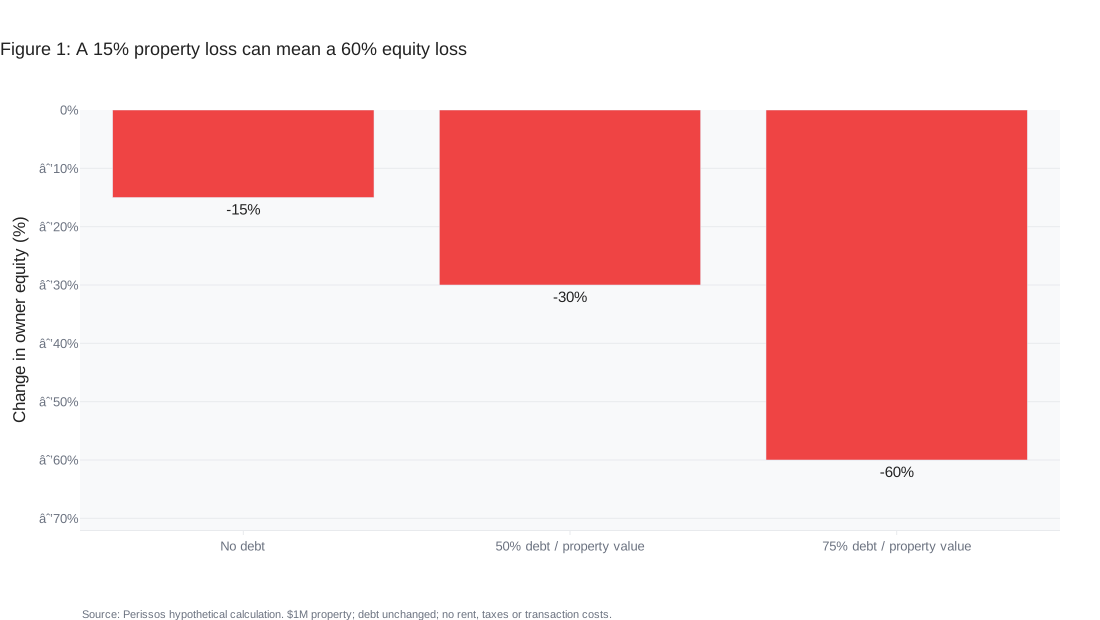
The property suffers the same $150,000 decline in every case. Financing changes the amount of owner capital absorbing it. This arithmetic is why I would track gross property value, debt, and net equity together. Also record maturity dates, fixed or variable rates, collateral, and any personal guarantees. A family needs to know both what it owns and what it has promised.
Find the amount that can actually be spent
Start with rent actually collected rather than advertised rent at full occupancy. Deduct recurring operating expenses, then distinguish debt service, capital replacements, and cash set aside for irregular costs. Principal repayment builds equity but still uses cash. An accounting profit and an available household distribution are different measurements.
For example, assume a rental collects $100,000 annually, incurs $35,000 of operating costs, pays $40,000 of total debt service, and reserves $15,000 for future replacements. That leaves $10,000 before income tax for the owner to spend. The $65,000 remaining after operating expenses alone would substantially overstate the cash available to support retirement. Each input is illustrative; actual reserves should reflect the building's condition and documented needs.
Our discussion of building a retirement paycheck is relevant here: match reliable funding sources to recurring obligations. I would keep a property-level reserve separate from the household's emergency fund. Otherwise, a roof replacement and a family expense may compete for the same dollars.
Treat taxes as a separate layer
The IRS guidance on rental income and expenses explains reporting rental income and eligible expenses, including the distinction between deductible costs and improvements that must be capitalized. Cash-flow projections should not assume that every check written produces an immediate deduction.1
Depreciation is another reason taxable income differs from cash. IRS Publication 527 explains that land is not depreciable and that the basis attributable to a rental building is treated separately. Tax rules also distinguish personal use from rental use. Keep acquisition records, improvement invoices, depreciation schedules, and usage records together rather than trying to reconstruct them at a sale.2
Rental losses also do not automatically offset wages or investment income. The IRS passive-activity guidance describes restrictions and exceptions, including special rules for qualifying real estate professionals. Owning property or spending time on it does not, by itself, establish that a particular exception applies.3 Have the CPA evaluate the facts before treating projected tax savings as money available to fund the purchase.
For Oklahoma households, location-specific carrying costs deserve their own review. Our article on Oklahoma property taxes and neighboring states helps frame that comparison. Use the property's actual assessment, exemptions, insurance terms, and maintenance needs in the acquisition model. A general state comparison cannot substitute for the costs of the specific building.
Choose the ownership route deliberately
Direct ownership offers control over financing, improvements, leasing, and the sale decision. Those choices can be valuable for a capable owner who wants the work or has a well-supervised management arrangement. They also create responsibilities that must continue when the owner travels, becomes ill, or no longer wants to manage tenants.
Securities-based real estate exposure changes the job. The SEC's REIT overview explains how real estate investment trusts provide exposure to income-producing real estate. Publicly traded and nontraded structures differ materially in liquidity; the presence of the REIT label does not establish that shares can be sold readily.4
I would compare the underlying holdings before calling a new allocation diversifying. A property fund concentrated in the same region or tenant industry as the family's existing buildings may repeat a familiar risk. Conversely, a carefully selected exposure elsewhere may broaden the opportunity set while giving up direct operating control. Neither route eliminates property, financing, or valuation risk.
Build the property decision into the family plan
More real estate may fit an owner with operating expertise, adequate reserves, a patient time horizon, and a clear advantage in the particular asset. It may fit poorly when retirement already depends on several local properties, when a purchase consumes most available cash, or when the next generation has no interest in ownership responsibilities.
Before buying, refinancing, or retaining a property, prepare a one-page ownership review. Include current value and valuation date, debt terms, sustainable cash available to the family, upcoming capital work, the expected holding period, and who would manage it if circumstances changed. Have the CPA estimate sale consequences and the attorney review ownership, guarantees, and succession; have the insurance professional check the actual exposure and coverage.
Then test a vacancy period, a large repair, a lower sale price, and an unfavorable refinancing outcome together. Decide which asset would fund the shortfall without assuming another property could be sold immediately. That exercise turns a collection of buildings into a plan the household can manage.
All my best,
Brandon VanLandingham, CFA, CMT, CFP
Founder / CIO
Citations
- IRS, Topic 414: Rental Income and Expenses. Retrieved October 16, 2026.
- IRS, Publication 527: Residential Rental Property, 2025 edition available at retrieval; used for continuing structural rules, not an unannounced 2026 amount. Retrieved October 16, 2026.
- IRS, Topic 425: Passive Activities — Losses and Credits. Retrieved October 16, 2026.
- SEC Investor.gov, Real Estate Investment Trusts. Retrieved October 16, 2026.
Important Disclosures
This piece is educational. It is not legal, tax, or accounting advice and is not a recommendation to take or refrain from any specific action. Tax law is fact-specific and changes regularly. Please coordinate any decisions discussed here with your attorney, your CPA, and Perissos before acting.
Perissos Private Wealth Management is a Registered Investment Adviser ("RIA"). Registration as an investment adviser does not imply a certain level of skill or training, and the content of this communication has not been approved or verified by the United States Securities and Exchange Commission or by any state securities authority. Perissos Private Wealth Management renders individualized investment advice to persons in a particular state only after complying with the state's regulatory requirements, or pursuant to an applicable state exemption or exclusion. All investments carry risk, and no investment strategy can guarantee a profit or protect from loss of capital. Past performance is not indicative of future results.
The information contained in this newsletter is intended to provide general information about market themes. It is not intended to offer investment advice. Investment advice will only be given after a client engages our services by executing the appropriate investment services agreement. Information regarding investment products and services is given solely to provide education regarding our investment philosophy and our strategies. You should not rely on any information provided in making investment decisions.
Market data, articles and other content in this material are based on generally available information and are believed to be reliable. Perissos Private Wealth Management does not guarantee the accuracy of the information contained in this material.
Perissos Private Wealth Management will provide all prospective clients with a copy of our current Form ADV, Part 2A (Disclosure Brochure), Part 2B (Supplemental Brochures), and Part 3 (Client Relationship Summary) prior to commencing an advisory relationship. You can also view these documents at any time at adviserinfo.sec.gov or by contacting us requesting a copy.
Explore topics
Share this article
Last reviewed: October 16, 2026
Frequently Asked Questions
- Should home equity be counted as retirement income?
- Home equity belongs in net worth, but it should not be treated as spendable retirement funding without a specific plan to sell, downsize, or borrow against it.
- Why does gross property value matter if I track net equity?
- Gross value shows total exposure to property-price changes, while leverage can make a modest percentage decline produce a much larger percentage loss in owner equity.
- How should rental property cash flow be evaluated?
- Start with rent actually collected, then subtract operating costs, debt service, and reserves for replacements to estimate what cash may truly be available before income taxes.