

Written and reviewed by Brandon VanLandingham, CFA, CMT, CFP® · Last updated October 20, 2026
REITs vs. Direct Real Estate: A Tax and Risk Comparison
Compare ownership responsibilities as carefully as tax treatment
October 20, 2026
A rental property and a real estate investment trust can both provide exposure to real estate, but they ask very different things of the owner. One may put you in charge of the roof, the lease, the financing, and the eventual sale. The other puts capital under a management team whose decisions you generally influence only indirectly.
I would not choose between them by comparing a rental's advertised cash yield with a REIT's distribution rate. Those figures may exclude different costs and carry different tax consequences. Start with the role real estate should play, then compare the underlying assets, financing, ownership structure, and after-tax dollars available to the family.
First identify which REIT you mean
The SEC's REIT overview distinguishes publicly traded REITs from public nontraded REITs and private REITs. Publicly traded shares offer market liquidity, while nontraded investments can restrict an investor's ability to exit. The same acronym does not imply the same access to cash.1
Also distinguish property ownership from real estate lending. Review what the entity actually owns, how it borrows, and how it earns money. A collection of apartments, an office portfolio, and a mortgage-focused business are different economic exposures. I would compare a direct building with the relevant exposure, rather than assume all real estate investments are interchangeable.
Direct ownership may allow an investor to choose the property, negotiate financing, approve improvements, and decide when to sell. That control can be an advantage when the owner has skill and time. Delegating management reduces daily work, but it does not eliminate the need to oversee the manager, evaluate major expenses, or make ownership decisions.
REIT distributions can have several tax characters
For a taxable account, read the tax reporting rather than infer treatment from the cash deposit. IRS guidance on dividends and distributions distinguishes ordinary dividends, qualified dividends, capital-gain distributions, and nondividend distributions. Return of capital generally reduces basis; once basis is exhausted, further nondividend distributions can produce taxable capital gain. It is not automatically tax-free economic profit.2
Qualified REIT dividends can also receive a separate tax benefit. The IRS explanation of the Section 199A deduction provides for a deduction of up to 20% of qualified REIT dividends, subject to applicable requirements and taxable-income limitations. The qualified REIT component is distinct from the qualified-business-income component and is not subject to the latter's wage and property-basis limits.3
Do not apply that deduction to every dollar distributed. Have the CPA check the classification, holding-period requirements, and the taxpayer's return. The headline distribution may contain components with different rules, and a distribution reinvested in new shares can still create a current tax obligation. A spending plan needs a tax reserve even when the investment account retains the cash.2
Direct ownership separates cash from taxable income
Rental property introduces a different set of deductions and records. IRS Publication 527 explains depreciation, the exclusion of land from depreciable basis, and limits affecting rental losses. An improvement may need to be capitalized rather than deducted immediately. The deduction shown on a tax return therefore will not necessarily equal the owner's cash outlay.4
Figure 1 uses a deliberately limited rental illustration. Assume $30,000 of annual rent collected, $10,000 of cash operating expenses deductible in that year, and $8,000 of allowable depreciation. With no debt service or capital expenditures in this example, cash before income tax is $20,000, while taxable rental income before other limitations is $12,000. The $8,000 difference is a noncash deduction, not additional rental receipts.
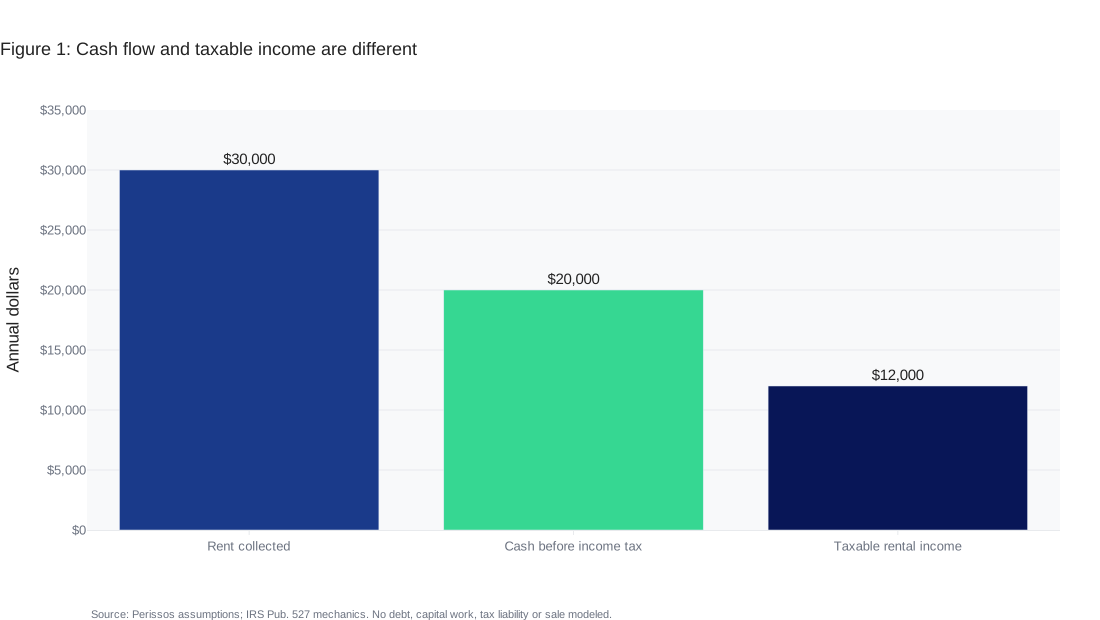
The example excludes Section 199A, passive-loss interactions, state tax, and the eventual sale. It is intended to explain accounting mechanics, not estimate a property's return or prove that direct ownership has a lower lifetime tax cost. A real projection also needs vacancy assumptions, major repairs, the purchase price, and the actual financing schedule.
A rental loss is not automatically available against salary. Publication 527 describes the passive-activity rules and relevant exceptions.4 Likewise, rental property does not automatically qualify for the business-income deduction. The IRS describes a rental real estate safe harbor and other ways an activity may qualify as a trade or business.3 Those are separate eligibility questions for the CPA; one favorable classification does not answer every tax question.
Include the tax cost of getting out
Direct owners should model sale proceeds after selling costs, debt payoff, and tax. Depreciation reduces basis and can affect the character of gain. The IRS identifies a maximum 25% federal rate for unrecaptured Section 1250 gain; that is not a flat rate on every dollar of every property sale. Other gain components can have different treatment.5
Qualifying investment or business real estate can sometimes receive gain deferral through a Section 1031 exchange. The IRS like-kind exchange guidance explains the restrictions; ordinary REIT shares are not qualifying real estate for this purpose. An exchange requires advance coordination and compliance with the rules, rather than simply buying another investment after selling.6 Deferral also does not remove the need to evaluate whether the replacement property is worth owning.
The net investment income tax can affect dividends, rental income, and gains, depending on income and the activity's treatment. Its 3.8% rate applies under a separate calculation.7 Our explanation of what triggers NIIT is a useful companion to the CPA's projection. Do not assume a deduction that reduces regular income tax produces the same reduction in NIIT.
Compare risk on the same basis
For the investment review, ask both alternatives the same questions: what tenants support income, what debt must be serviced, what spending is required to maintain the assets, and what could impair the exit value? A liquid security can fall sharply in price; an infrequently valued building can also lose economic value without producing a daily quote.
Direct property can concentrate the household in one tenant, location, or operating problem. A REIT may spread exposure across properties, but inspect that diversification rather than assume it. Financing also matters on both sides. Comparing a highly leveraged rental with a conservatively financed portfolio without adjusting for debt can make the apparent return advantage misleading.
Account location is a separate decision from asset selection. A retirement account changes the timing and character of the household's tax consequences, so the taxable-account discussion above is not a complete account-location analysis. Our discussion of tax-diversified retirement portfolios helps put that choice alongside future withdrawals and spending needs.
Choose the responsibilities you want to keep
Direct property may suit a patient investor with operating expertise, sufficient reserves, and a reason to value control. It may fit poorly when the family needs easy partial withdrawals, lacks a management successor, or would depend on one tenant for essential spending. Publicly traded REIT exposure may suit someone who wants delegated operations and market access, provided the underlying risks and price volatility fit. An illiquid REIT requires a separate exit and cash-flow assessment.
Before choosing, ask for two comparable projections: annual cash after realistic costs and taxes, and net proceeds under a conservative exit scenario. Coordinate the assumptions with the CPA, attorney, and insurance professional. Include the value of your time and the needs of whoever inherits the responsibility. The preferable structure is the one whose economics and obligations the household can sustain through a difficult period.
All my best,
Brandon VanLandingham, CFA, CMT, CFP
Founder / CIO
Citations
- SEC Investor.gov, Real Estate Investment Trusts. Retrieved October 16, 2026.
- IRS, Topic 404: Dividends and Other Corporate Distributions. Retrieved October 16, 2026.
- IRS, Qualified Business Income Deduction. Retrieved October 16, 2026; includes post-2025 rules.
- IRS, Publication 527: Residential Rental Property, 2025 edition, continuing structural rules. Retrieved October 16, 2026.
- IRS, Topic 409: Capital Gains and Losses, unrecaptured Section 1250 gain discussion. Retrieved October 16, 2026.
- IRS, Like-Kind Exchanges: Real Estate Tax Tips. Retrieved October 16, 2026.
- IRS, Topic 559: Net Investment Income Tax. Retrieved October 16, 2026.
Important Disclosures
This piece is educational. It is not legal, tax, or accounting advice and is not a recommendation to take or refrain from any specific action. Tax law is fact-specific and changes regularly. Please coordinate any decisions discussed here with your attorney, your CPA, and Perissos before acting.
Perissos Private Wealth Management is a Registered Investment Adviser ("RIA"). Registration as an investment adviser does not imply a certain level of skill or training, and the content of this communication has not been approved or verified by the United States Securities and Exchange Commission or by any state securities authority. Perissos Private Wealth Management renders individualized investment advice to persons in a particular state only after complying with the state's regulatory requirements, or pursuant to an applicable state exemption or exclusion. All investments carry risk, and no investment strategy can guarantee a profit or protect from loss of capital. Past performance is not indicative of future results.
The information contained in this newsletter is intended to provide general information about market themes. It is not intended to offer investment advice. Investment advice will only be given after a client engages our services by executing the appropriate investment services agreement. Information regarding investment products and services is given solely to provide education regarding our investment philosophy and our strategies. You should not rely on any information provided in making investment decisions.
Market data, articles and other content in this material are based on generally available information and are believed to be reliable. Perissos Private Wealth Management does not guarantee the accuracy of the information contained in this material.
Perissos Private Wealth Management will provide all prospective clients with a copy of our current Form ADV, Part 2A (Disclosure Brochure), Part 2B (Supplemental Brochures), and Part 3 (Client Relationship Summary) prior to commencing an advisory relationship. You can also view these documents at any time at adviserinfo.sec.gov or by contacting us requesting a copy.
Frequently Asked Questions
- Are REIT distributions taxed the same way as rental property income?
- No. REIT distributions can include ordinary dividends, capital-gain distributions, and return of capital, while direct rental property typically involves rent, deductible expenses, and depreciation reported under separate tax rules.
- Can direct real estate offer tax benefits that REITs do not?
- Sometimes. Direct ownership may allow depreciation deductions and, in qualifying cases, Section 1031 exchange deferral, but those benefits depend on facts, records, and IRS rules.
- Is a REIT always less risky than owning a rental property directly?
- Not necessarily. REITs may offer broader diversification and liquidity, but they can still face market declines, leverage risk, and sector-specific exposure; direct property can add concentration, tenant, and operational risks.