

Written and reviewed by Brandon VanLandingham, CFA, CMT, CFP® · Last updated October 17, 2026
Bitcoin and Crypto Allocations: A Fiduciary's Perspective
Decide what the household can lose before deciding what to own
October 17, 2026
The first question I would ask about a crypto allocation is not how high the price could go. It is what happens to the household if the investment disappoints badly, becomes difficult to access, or creates an administrative problem at the wrong time. A compelling technology thesis does not answer those planning questions.
For some households, a limited speculative allocation may be compatible with the rest of the plan. For others, no allocation is a reasonable decision. Neither enthusiasm nor skepticism should substitute for examining objectives, financial capacity, implementation, and costs. The decision needs to remain defensible when the price moves against the investor.
What the fiduciary perspective requires
The SEC's interpretation of an investment adviser's standard of conduct describes duties of care and loyalty, with the client's best interest as the overarching principle. Understanding the client's circumstances and the investment's risks is part of that responsibility.1 Our discussion of wealth managers and brokers offers broader context for evaluating an advisory relationship.
Applied here, I would want a written explanation of why the exposure belongs in this household's plan, what alternatives were considered, and how it will be monitored. A client request is an important input, but the analysis should still address concentration, spending needs, and conflicts. Access through a familiar account is not itself a reason to allocate.
This memo describes a decision framework, not a statement that Perissos holds crypto for clients or recommends a particular token, platform, or vehicle. Any actual recommendation requires the household-specific review, investment diligence, and implementation approvals applicable to that relationship.
Define the investment before discussing a percentage
Bitcoin, other tokens, lending arrangements, and exchange-traded exposures should not be grouped into one undifferentiated position. Ask what creates demand, what rights the investor receives, who controls access, and how value could be impaired. A thesis about one asset does not establish a case for every asset with a similar label.
The SEC's bulletin on bitcoin and ether exchange-traded products distinguishes spot commodity trusts from futures-based products and identifies volatility, tracking, fees, and other risks. Spot bitcoin and ether commodity trusts are not registered investment companies under the Investment Company Act of 1940.2 That distinction belongs in the review of protections and structure; it is not a price forecast.
For a household whose investment objective is simply price exposure, compare whether direct ownership's additional responsibilities serve any useful purpose. Conversely, someone who needs to use an asset on a network is asking a different operational question. Define the purpose before choosing the ownership route.
Size the potential loss in household dollars
Figure 1 assumes a $5 million investment portfolio and starting crypto allocations of 1%, 3%, and 5%. A hypothetical 70% decline in the crypto position produces losses of $35,000, $105,000, and $175,000, respectively. A complete loss produces $50,000, $150,000, and $250,000 of losses. The rest of the portfolio is held unchanged solely to isolate the position's contribution; these are stress assumptions, not forecasts or recommended weights.
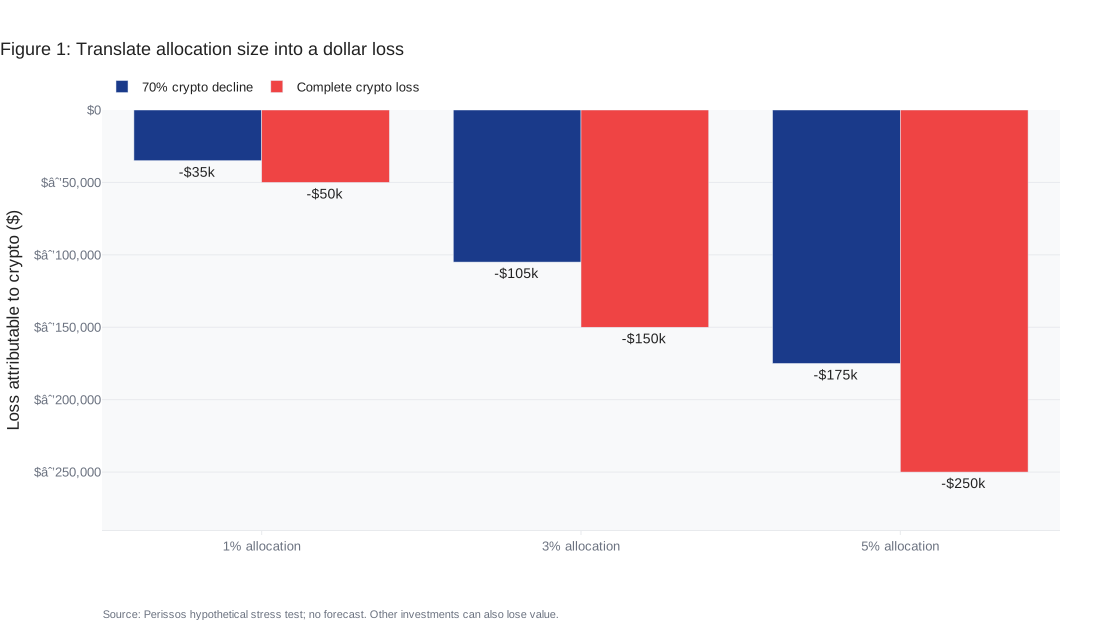
The corresponding portfolio impacts are 0.7%, 2.1%, and 3.5% for the 70% shock, and 1%, 3%, and 5% for a total loss. Other investments could fall simultaneously, so these are not maximum household drawdowns. Taxes, trading costs, leverage, and additional deposits are excluded.
Put those dollar amounts beside the actual plan. Would the loss delay retirement, reduce a planned gift, or require selling assets reserved for essential expenses? A household with a large balance sheet but a tight spending margin may have less capacity than its net worth suggests. Our discussion of active drawdown management explains why cash needs and market losses must be considered together.
Also test whether an investor would borrow or repeatedly add money after a loss. An initially small position does not remain small if it becomes a reason to abandon the agreed budget. I would define the maximum capital at risk across all accounts and arrangements, including exposures that are economically related.
Custody and succession are investment decisions
The SEC's crypto-custody bulletin explains the distinction between self-custody and third-party custody, and the consequences of losing private keys. Access arrangements and security failures can matter independently of the market price.3
Before funding direct ownership, document who can access the assets, what recovery arrangements exist, and what happens after death or incapacity. Work with the estate attorney on a secure succession process. Do not place secret recovery information in a document that may become public or circulate ordinary passwords as a substitute for a deliberate access plan. Test the process without exposing the credentials.
For third-party arrangements, review ownership terms, withdrawal procedures, segregation practices, insurance limitations, and what happens if the provider fails. An account interface showing a balance is not enough. If the household cannot explain its legal claim and operational access, the investment review is unfinished.
Treat promises of yield as a separate risk decision. The SEC's bulletin on crypto interest-bearing accounts describes risks that differ from a bank deposit, including counterparty and insolvency concerns.4 Lending an asset to earn income changes the arrangement; it should not be treated as a costless enhancement to holding that asset.
Build the tax records before trading
The IRS treats digital assets as property. Its current digital-asset transaction FAQs, generally applicable to transactions from January 1, 2025 onward, explain that sales and exchanges can create gains or losses. For capital assets, the holding period helps determine whether the result is short-term or long-term.5
Track acquisition dates, units, dollar basis, transaction costs, proceeds, and transfers by wallet or account. Exchanging one digital asset for another can create a tax event even when no dollars are withdrawn.5 Ask the CPA how to reconcile records before activity becomes difficult to reconstruct, especially if assets have moved between providers.
The IRS's current reporting overview says broker gross-proceeds reporting began for covered transactions from January 1, 2025, with basis reporting for certain transactions from January 1, 2026.6 A form is therefore useful evidence, not assurance that every position's full history is included. Reconcile it with your own records and coordinate estimated taxes when gains are realized. Do not build the investment case around an assumed tax loophole or an unreviewed loss-harvesting strategy.
Set a rule for success as well as failure
A sharp gain can change the portfolio without a new purchase. In a separate hypothetical, a 5% position that doubles while everything else is unchanged becomes about 9.52% of the portfolio: 10 divided by 105. That calculation excludes fees and taxes. The original allocation decision should include how such an increase would be handled.
For a household with ample reserves, patient capital, a clear purpose, and the ability to absorb a complete loss, a carefully limited position may merit evaluation. It is a poor fit for essential near-term spending, borrowed money, or a household unwilling to maintain the custody and tax work. Write down the target range, review triggers, rebalancing approach, and who is responsible for records. If the rationale, loss budget, or access arrangements cannot be documented clearly, defer the allocation until they can.
All my best,
Brandon VanLandingham, CFA, CMT, CFP
Founder / CIO
Citations
- SEC, Commission Interpretation Regarding Standard of Conduct for Investment Advisers, Release IA-5248. Retrieved October 16, 2026.
- SEC Investor.gov, Exchange-Traded Products Providing Exposure to Bitcoin and Ether. Retrieved October 16, 2026.
- SEC Investor.gov, Crypto Asset Custody Basics for Retail Investors. Retrieved October 16, 2026.
- SEC Investor.gov, Crypto Asset Interest-Bearing Accounts. Retrieved October 16, 2026.
- IRS, Frequently Asked Questions on Digital Asset Transactions, current Part II guidance. Retrieved October 16, 2026.
- IRS, Digital Assets, broker reporting phase-in. Retrieved October 16, 2026.
Important Disclosures
This piece is educational. It is not legal, tax, or accounting advice and is not a recommendation to take or refrain from any specific action. Tax law is fact-specific and changes regularly. Please coordinate any decisions discussed here with your attorney, your CPA, and Perissos before acting.
Perissos Private Wealth Management is a Registered Investment Adviser ("RIA"). Registration as an investment adviser does not imply a certain level of skill or training, and the content of this communication has not been approved or verified by the United States Securities and Exchange Commission or by any state securities authority. Perissos Private Wealth Management renders individualized investment advice to persons in a particular state only after complying with the state's regulatory requirements, or pursuant to an applicable state exemption or exclusion. All investments carry risk, and no investment strategy can guarantee a profit or protect from loss of capital. Past performance is not indicative of future results.
The information contained in this newsletter is intended to provide general information about market themes. It is not intended to offer investment advice. Investment advice will only be given after a client engages our services by executing the appropriate investment services agreement. Information regarding investment products and services is given solely to provide education regarding our investment philosophy and our strategies. You should not rely on any information provided in making investment decisions.
Market data, articles and other content in this material are based on generally available information and are believed to be reliable. Perissos Private Wealth Management does not guarantee the accuracy of the information contained in this material.
Perissos Private Wealth Management will provide all prospective clients with a copy of our current Form ADV, Part 2A (Disclosure Brochure), Part 2B (Supplemental Brochures), and Part 3 (Client Relationship Summary) prior to commencing an advisory relationship. You can also view these documents at any time at adviserinfo.sec.gov or by contacting us requesting a copy.
Frequently Asked Questions
- How should a fiduciary evaluate a crypto allocation?
- A fiduciary review starts with the household's ability to absorb loss, plus custody, taxes, implementation, and conflicts of interest. The question is whether the position remains defensible if price falls sharply or access becomes difficult.
- What size of crypto allocation can materially affect a portfolio?
- In the example provided, a 1%, 3%, and 5% crypto allocation in a $5 million portfolio would lose $35,000, $105,000, and $175,000 after a 70% decline. A total loss would equal $50,000, $150,000, and $250,000, respectively.
- Why do custody and taxes matter as much as price exposure?
- Direct ownership can introduce key-management, succession, withdrawal, and provider-failure risks that exist apart from market moves. The IRS also treats digital assets as property, so sales and exchanges may trigger taxable gains or losses.