

When to Hire a Wealth Manager vs. Stay With a Broker
Match the relationship to the decisions your family needs to make
October 03, 2026
The right time to reconsider your financial relationship is when the decisions have become harder to coordinate. Retirement is approaching. A business sale is taking shape. One spouse manages everything and the other would struggle to step in. Your accounts may be performing reasonably well, yet no one can explain how the investments, spending, taxes, and estate plan fit together.
I would start there, before comparing titles or portfolio returns. A wealth manager should earn the relationship through clearly defined work that matters to your family. A brokerage relationship can remain appropriate when its services fit your needs and you are comfortable taking responsibility for the decisions outside its scope. The useful question is who is responsible for what, at what cost, and under which agreement.
Read the agreement behind the title
Start by identifying whether the proposed account is brokerage or advisory. Some firms and professionals offer both; the same person can serve you in different capacities across accounts. The SEC's guide to relationship summaries explains these distinctions and how Form CRS describes services, costs, conflicts, and disciplinary information. Ask the professional to identify the capacity that applies to each recommendation.1
Investment advisers have a fiduciary obligation to act in clients' best interests. Their services often include ongoing portfolio advice and monitoring, but the agreement determines the engagement's scope. Hiring an adviser does not automatically mean comprehensive financial planning, tax preparation, estate-document drafting, or unlimited access to specialists. The SEC's investment adviser guidance specifically emphasizes reading the agreement and understanding its limitations.2
Brokers also have meaningful obligations. Under Regulation Best Interest, covered recommendations to retail customers must be in the customer's best interest when made, without putting the broker's interests ahead of the customer's. The regulation itself does not impose an ongoing monitoring duty, although a broker may agree to monitoring. That distinction is more accurate than saying a broker can recommend anything merely because it is suitable.3
Put the service commitments in writing. Who reviews the portfolio between meetings? Who can authorize trades? Who identifies an approaching planning deadline? Who follows up when a recommendation has not been implemented? The answers should describe an actual working relationship.
When broader coordination becomes valuable
Consider a hypothetical couple nearing retirement with taxable investments, retirement accounts, a rental property, and an estate plan they have not reviewed recently. Choosing investments is only one decision. They also need to establish a spending policy, identify which assets support near-term expenses, decide how much investment risk the household can carry, and coordinate recommendations with their CPA and attorney.
An investment recommendation can look attractive in isolation and still create a problem elsewhere. A proposed allocation may overlook money needed for a property repair. A proposed sale may ignore a tax question that the CPA needs to analyze. A change in ownership may require the attorney's involvement. A capable coordinator should surface those interactions before implementation and document who owns each next step.
Our discussion of building a tax-diversified retirement portfolio illustrates why account structure belongs in the investment conversation. Similarly, a review of estate planning documents for Oklahoma families can help organize the questions to take to counsel. Neither task is completed simply by holding a diversified collection of investments.
Complexity can also be personal. Someone may have the knowledge to manage a portfolio but no longer want the ongoing responsibility. A spouse may need a trusted person who understands the household's finances. Those are legitimate reasons to hire help, provided the engagement includes the continuity and communication the family actually needs.
When staying with a broker can make sense
Suppose your financial arrangements are straightforward, you trade infrequently, you understand your holdings, and you have a reliable process for coordinating planning separately. A brokerage relationship may provide the access and assistance you need. The SEC notes that transaction-based pricing can be preferable from a cost perspective when trading is infrequent or investments are held for long periods.1
The important condition is that someone remains responsible for the work outside the brokerage agreement. That may be you, a separately retained planner, or another professional acting within a clearly defined engagement. Make that responsibility explicit. A collection of capable professionals can still leave a gap if everyone assumes someone else is tracking the same issue.
An ongoing wealth-management engagement may be a poor fit if you want only a specific project, are unwilling to share the information needed for planning, or do not intend to use the offered services. It can also be poor value when the proposal offers extensive coordination but the actual service consists mainly of investment selection. Ask for concrete deliverables before deciding that a broader arrangement is worth its price.
Turn the fee percentage into dollars
Compare costs using your expected activity and the same asset base. Include the advisory or planning fee, investment expenses, trading costs, and any separate charges. Confirm what is included, what is billed separately, and how the amount changes as assets or services change. Both brokerage and advisory arrangements can involve costs beyond their most visible fee.1,2
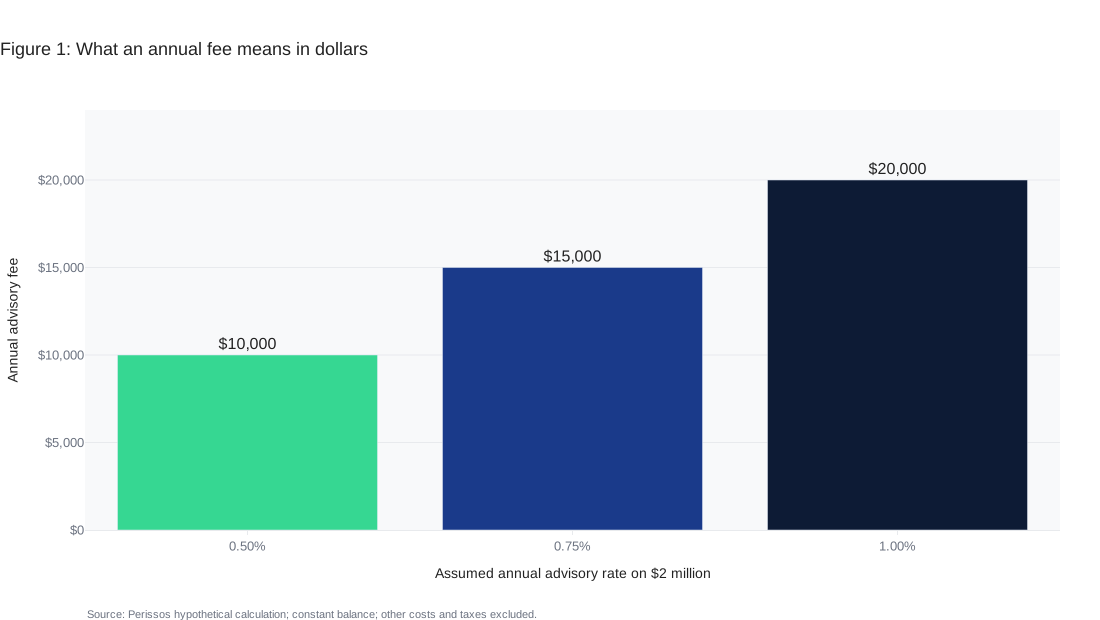
Figure 1 shows a deliberately simple illustration: a constant $2 million account with annual advisory fees of 0.50%, 0.75%, or 1.00% would incur $10,000, $15,000, or $20,000, respectively. These are assumed rates, not Perissos prices, market averages, or a comparison with an actual broker. The calculation excludes investment expenses, trading costs, taxes, and changes in account value. Its purpose is to make the annual commitment tangible.
The difference between the lowest and highest illustrated fee is $10,000 annually. That does not establish which engagement is better. A family may reasonably pay more for specific services it needs and uses. But it should be able to name those services and the person accountable for providing them. Avoid treating an unverified promise of higher returns or tax savings as a guaranteed offset to the fee.
Ask about incentives as well. Transaction compensation can reward more activity; an asset-based arrangement can reward gathering or retaining assets. The relevant question is how the professional identifies and manages those conflicts in your circumstances. A compensation label alone does not eliminate conflicts.1,2
Evaluate the work before moving the assets
Request a sample planning deliverable, an example meeting agenda, and an explanation of the review process. Ask how the team handles a disagreement between an investment recommendation and your cash-flow needs. Find out who will meet with you, who performs the analysis, and who covers the relationship when your primary contact is unavailable.
Review the firm's disclosures and the individual's background. Form ADV Part 2 provides information about an adviser's business practices, fees, conflicts, and disciplinary matters; brochure supplements address relevant personnel. Use the regulatory records to inform follow-up questions rather than treating a polished presentation as sufficient due diligence.4
Before any transition, request a written inventory of holdings, account registrations, cost-basis records, pending transactions, and assets requiring special handling. Have the receiving team explain what can move, what might need to remain, and whether any proposed changes require separate tax or legal review. Coordinate with your CPA and attorney before implementing recommendations in their areas of responsibility.
Then define the first review. Which decisions should be completed, which documents should be gathered, and how will progress be recorded? I would want an engagement that makes those responsibilities easy to understand. If your current relationship already delivers what your family needs at a reasonable total cost, staying can be sensible. If important decisions have no clear owner, use those specific gaps to write the job description for the professional you hire.
All my best,
Brandon VanLandingham, CFA, CMT, CFP
Founder / CIO
Citations
- U.S. Securities and Exchange Commission, Investor.gov, Investor.gov/CRS: Comparing brokerage and advisory relationships. Retrieved September 26, 2026.
- U.S. Securities and Exchange Commission, Investor.gov, Investment Advisers. Retrieved September 26, 2026.
- U.S. Securities and Exchange Commission, Regulation Best Interest: A Small Entity Compliance Guide. Retrieved September 26, 2026.
- U.S. Securities and Exchange Commission, Investor.gov, Form ADV: Investment Adviser Brochure and Brochure Supplement. Retrieved September 26, 2026.
Important Disclosures
This piece is educational. It is not legal, tax, or accounting advice and is not a recommendation to take or refrain from any specific action. Tax law is fact-specific and changes regularly. Please coordinate any decisions discussed here with your attorney, your CPA, and Perissos before acting.
Perissos Private Wealth Management is a Registered Investment Adviser ("RIA"). Registration as an investment adviser does not imply a certain level of skill or training, and the content of this communication has not been approved or verified by the United States Securities and Exchange Commission or by any state securities authority. Perissos Private Wealth Management renders individualized investment advice to persons in a particular state only after complying with the state's regulatory requirements, or pursuant to an applicable state exemption or exclusion. All investments carry risk, and no investment strategy can guarantee a profit or protect from loss of capital. Past performance is not indicative of future results.
The information contained in this newsletter is intended to provide general information about market themes. It is not intended to offer investment advice. Investment advice will only be given after a client engages our services by executing the appropriate investment services agreement. Information regarding investment products and services is given solely to provide education regarding our investment philosophy and our strategies. You should not rely on any information provided in making investment decisions.
Market data, articles and other content in this material are based on generally available information and are believed to be reliable. Perissos Private Wealth Management does not guarantee the accuracy of the information contained in this material.
Perissos Private Wealth Management will provide all prospective clients with a copy of our current Form ADV, Part 2A (Disclosure Brochure), Part 2B (Supplemental Brochures), and Part 3 (Client Relationship Summary) prior to commencing an advisory relationship. You can also view these documents at any time at adviserinfo.sec.gov or by contacting us requesting a copy.
Explore topics
Share this article
Last reviewed: September 26, 2026
Frequently Asked Questions
- When does a wealth manager make more sense than a broker?
- A wealth manager may be more useful when retirement, a business sale, tax planning, estate coordination, or household continuity creates decisions that need ongoing oversight across multiple areas. The key issue is whether someone is clearly responsible for...
- Can the same professional act as both a broker and an adviser?
- Yes. Some firms and individuals serve in both capacities across different accounts, which is why the article stresses identifying whether each account is brokerage or advisory and reading the agreement for each arrangement.
- How should investors compare broker and wealth management costs?
- Compare the same asset base and expected activity, then total advisory or planning fees, investment expenses, trading costs, and separate charges. The article uses a $2 million example where 0.50%, 0.75%, and 1.00% equal $10,000, $15,000, and $20,000 per ye...