

What 'Active Drawdown Management' Actually Means
A practical framework for managing losses while funding retirement
October 01, 2026
A retiree can make a sound long-term investment decision and still face a difficult short-term problem: the portfolio is down, but the monthly transfer to the checking account still needs to happen. Selling investments to fund that transfer leaves less capital available for a recovery. The household needs a process for handling that pressure before markets become uncomfortable.
In this memo, active drawdown management means a deliberate process for monitoring portfolio losses and adjusting risk, liquidity, or spending within a documented plan. It describes a planning and investment discipline, not a promise to avoid losses. I would judge such a process by the decisions it governs, the tradeoffs it acknowledges, and whether a family can follow it through a difficult market.
Define the loss you are trying to manage
A drawdown measures a decline from an earlier peak. For investment evaluation, measure the decline in a return series adjusted for contributions and withdrawals, so a distribution does not masquerade as poor investment performance. Separately track the dollars remaining to fund the household. Those are related measures, but they answer different questions.
The arithmetic explains why losses matter. A 20% decline requires a 25% gain to recover, before withdrawals or other costs. The required gain equals the loss divided by the amount remaining: 20 divided by 80. This is a mathematical relationship, not a forecast of the next market move.
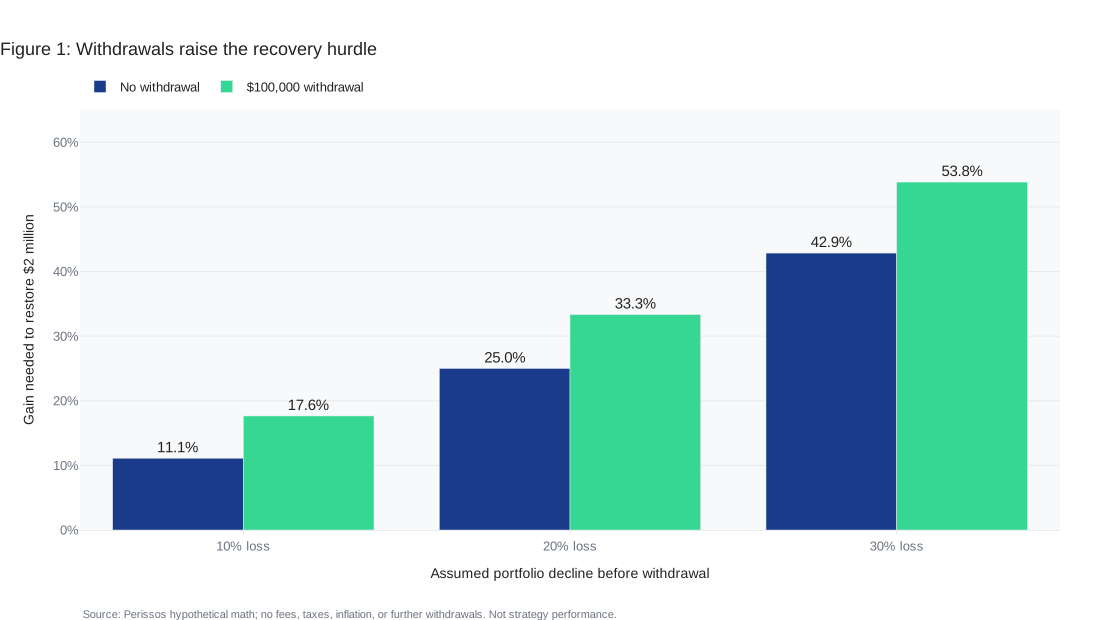
Figure 1 adds retirement spending to the illustration. Assume a $2 million portfolio first experiences a 10%, 20%, or 30% loss. With no distribution, the gains needed to return to $2 million are 11.1%, 25.0%, and 42.9%. If the household withdraws $100,000 immediately after each decline, the required gains rise to 17.6%, 33.3%, and 53.8%. We assume no other cash flows, taxes, fees, inflation, or further withdrawals during recovery. Restoring the original nominal balance is the comparison target; it is not a retirement-success test.
This illustration isolates the effect of taking money out of a smaller balance. It does not assume that a manager could have prevented any of these declines. Our discussion of historical sequence-of-returns examples explores the related problem of return order during retirement. A recovery percentage alone says nothing about how long recovery will take or whether the household can comfortably wait.
Start with the household's cash needs
Before discussing a sell signal, identify the expenses the portfolio must support. Separate essential commitments from discretionary spending and large, irregular purchases. Then subtract income available from outside the portfolio. The resulting funding need provides a practical starting point for deciding how much liquidity to hold and how much uncertainty the household can accept.
The SEC's explanation of asset allocation and diversification connects investment choices with time horizon and risk tolerance. A reserve can give near-term expenses a dedicated source of funding, while longer-term assets pursue growth. Diversification helps distribute risk; it cannot make a portfolio immune to market declines.1
For a hypothetical household requiring $100,000 annually from investments, a $200,000 reserve represents two years of that assumed funding need before interest, taxes, or inflation. That is an illustration, not a recommended reserve for every retiree. A household with flexible spending and substantial outside income may choose a different amount from one whose portfolio pays nearly every bill.
Our now, soon, and later framework provides a way to organize that conversation. A reserve needs a replenishment policy. Otherwise, the family may simply postpone the same selling decision until the cash has been depleted. Holding more liquidity also reduces the amount participating in the returns, positive or negative, of the investments it replaces.
Put investment actions and re-entry in writing
An active process might use allocation ranges, concentration limits, trend measures, or other predefined risk indicators. The choice should follow the household's objectives and the evidence supporting the method. These are examples of possible tools, not a description of an undisclosed Perissos trading model or a claim that any particular signal is effective.
The written policy should explain what is measured, how frequently it is reviewed, what action a signal permits, and who approves exceptions. A modest reduction in risk and a complete move out of growth assets are materially different decisions. Specify the destination for sale proceeds and the risks of those replacement holdings, rather than describing every defensive allocation as safe.
Re-entry deserves equal attention. A process that reduces exposure during a decline can miss part of a subsequent rebound. Repeated reversals can cause the portfolio to sell after weakness and repurchase after strength. Before adopting a rule, ask how it behaves in a rapid recovery, an extended decline, and a market that repeatedly changes direction. A rule should be understandable before it is tested by a stressful period.
Execution also matters. FINRA explains that stop orders can trade far from their trigger prices in volatile markets. A stop-limit order introduces a different risk: the order may not execute. Neither order type establishes a guaranteed maximum portfolio loss.2
Make room for costs and spending decisions
Every proposed trade should be considered alongside implementation costs and the household's account structure. FINRA notes that selling appreciated investments while rebalancing a taxable account can create capital-gains tax consequences. Review those effects with the CPA before acting; the existence of a risk signal does not make the tax question disappear.3
Tax awareness should inform the decision without controlling it. Keeping an unsuitable concentration solely to defer a tax bill can create a different problem. Conversely, repeated trading that produces costs without a convincing risk-management benefit should not be defended merely because it is called active. Ask for a comparison that includes the relevant expenses and acknowledges what the approach gives up.
Spending flexibility is another tool. A family might agree to defer a large discretionary purchase or revisit future withdrawals after a significant decline. Identify those choices in advance, including the expenses that cannot reasonably be reduced. Spending adjustments can relieve pressure on the portfolio, but they also have a real lifestyle cost. Do not hide that cost inside a more favorable projection.
If your plan requires a strategy to prevent every large loss, the plan needs another review. A tactical rule can fail, markets can move between observations, and defensive holdings can carry their own risks. Essential spending should be evaluated against adverse outcomes rather than supported by an assumed perfect exit.
Ask for evidence you can evaluate
When reviewing a manager, ask how the proposed approach has been evaluated, which results are actual, which are hypothetical, and what assumptions drive the comparison. The SEC's bulletin on performance claims cautions that back-tested results are hypothetical and do not represent actual performance. It also highlights the importance of fees, benchmarks, and the periods selected.4
I would want to see the full experience: losses, recoveries, periods of lagging a suitable benchmark, trading activity, and effects on withdrawals. Smaller losses in one episode do not by themselves demonstrate a superior long-term plan. The benchmark should reflect the portfolio's mandate and risk level; a retirement portfolio need not resemble an all-stock index.
An active approach may fit a household that values a defined response process and can tolerate its costs and periods of disappointment. It may be a poor fit for someone who wants certainty, will abandon the rules after a short period of underperformance, or would be better served by a simpler allocation and spending policy. More trading is not evidence of more useful planning.
Before implementation, document the spending requirement, reserve policy, permitted risk changes, re-entry rules, monitoring responsibility, and review schedule. Ask your adviser to explain what would happen if the approach failed to reduce a major decline. Then coordinate account and tax decisions with the appropriate professionals. A usable drawdown policy leaves the household knowing what decisions come next, even when the next market move remains uncertain.
All my best,
Brandon VanLandingham, CFA, CMT, CFP
Founder / CIO
Citations
- U.S. Securities and Exchange Commission, Investor.gov, Asset Allocation and Diversification. Retrieved September 26, 2026.
- FINRA, Stop Orders: Factors to Consider During Volatile Markets. March 26, 2025; retrieved September 26, 2026.
- FINRA, Asset Allocation and Diversification. Retrieved September 26, 2026.
- U.S. Securities and Exchange Commission, Investor.gov, Investor Bulletin: Performance Claims. Retrieved September 26, 2026.
Important Disclosures
This piece is educational. It is not legal, tax, or accounting advice and is not a recommendation to take or refrain from any specific action. Tax law is fact-specific and changes regularly. Please coordinate any decisions discussed here with your attorney, your CPA, and Perissos before acting.
Perissos Private Wealth Management is a Registered Investment Adviser ("RIA"). Registration as an investment adviser does not imply a certain level of skill or training, and the content of this communication has not been approved or verified by the United States Securities and Exchange Commission or by any state securities authority. Perissos Private Wealth Management renders individualized investment advice to persons in a particular state only after complying with the state's regulatory requirements, or pursuant to an applicable state exemption or exclusion. All investments carry risk, and no investment strategy can guarantee a profit or protect from loss of capital. Past performance is not indicative of future results.
The information contained in this newsletter is intended to provide general information about market themes. It is not intended to offer investment advice. Investment advice will only be given after a client engages our services by executing the appropriate investment services agreement. Information regarding investment products and services is given solely to provide education regarding our investment philosophy and our strategies. You should not rely on any information provided in making investment decisions.
Market data, articles and other content in this material are based on generally available information and are believed to be reliable. Perissos Private Wealth Management does not guarantee the accuracy of the information contained in this material.
Perissos Private Wealth Management will provide all prospective clients with a copy of our current Form ADV, Part 2A (Disclosure Brochure), Part 2B (Supplemental Brochures), and Part 3 (Client Relationship Summary) prior to commencing an advisory relationship. You can also view these documents at any time at adviserinfo.sec.gov or by contacting us requesting a copy.
Explore topics
Share this article
Last reviewed: September 26, 2026
Frequently Asked Questions
- What does active drawdown management mean in retirement?
- It means using a documented process to monitor portfolio losses and adjust liquidity, investment risk, or spending as conditions change. It is a planning discipline, not a promise to prevent losses.
- Why do withdrawals matter more after a market decline?
- Taking money from a reduced portfolio leaves less capital available for a recovery. The post notes that a 20% loss requires a 25% gain before withdrawals, and the required gain rises further if money is withdrawn immediately afterward.
- What should be written into a drawdown plan?
- A written plan should define what is measured, how often it is reviewed, what actions are allowed, where sale proceeds go, and how re-entry is handled. It should also address taxes, trading costs, and possible spending adjustments.


