

Why Retirees Need Three Types of Money: Now, Soon, Later
Match retirement spending to the time available to fund it
September 25, 2026
The money that pays next month's bills has a different job from the money intended to support life twenty years from now. Treating both identically can produce an uncomfortable choice: accept market risk with near-term spending money, or hold so much cash that long-term purchasing power becomes the concern. Separating those jobs can make a retirement portfolio easier to manage and easier to live with.
“Now, Soon, Later” is a way to organize decisions about timing. It does not require three financial institutions, three legal accounts, or a fixed percentage in each category. The useful question is how much spending must come from the portfolio, when that money is needed, and how the reserves will be replenished. I would settle those questions before selecting investments.
Start with the gap the portfolio must fill
A reserve should reflect the household's actual cash requirement after dependable income. Begin with living expenses, taxes, insurance, and known irregular purchases. Then subtract the pension, Social Security, and other income expected to arrive. Use consistent gross or net amounts so withholding is neither omitted nor counted twice. Our article on the basics of retirement budgeting explains how to establish that spending foundation.
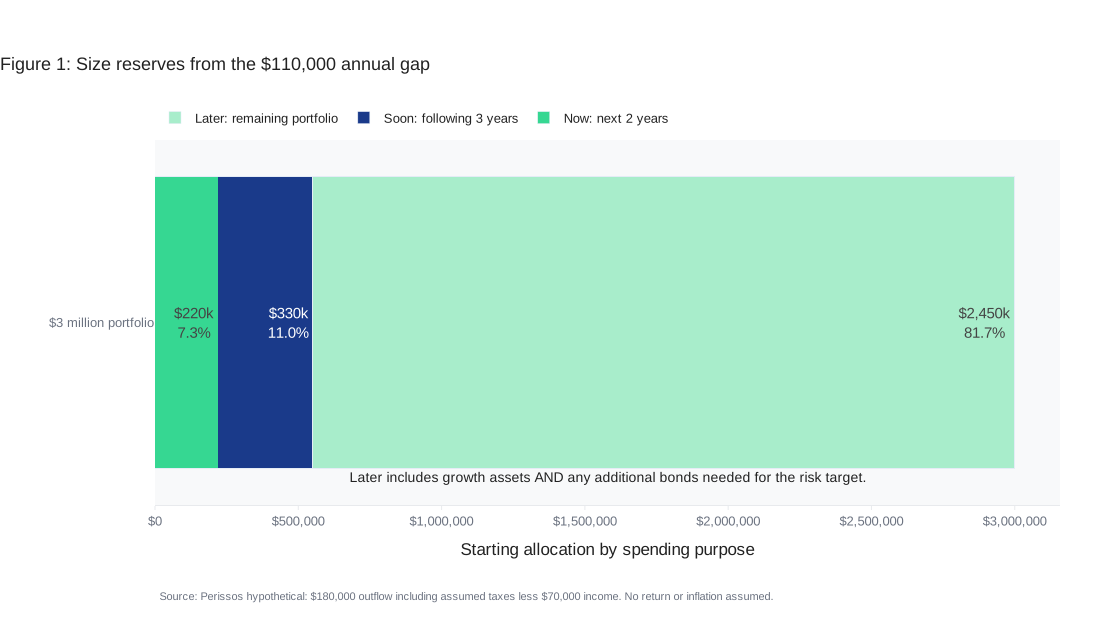
Consider a hypothetical household with a $3 million investable portfolio. Assume annual living expenses of $150,000, a separate $30,000 tax allowance, and $70,000 of gross reliable income. The portfolio must provide $110,000 annually: $180,000 of total cash outflow less $70,000 of income. The tax allowance is an assumption, not a calculated liability; a CPA would revise it using the actual withdrawal sources.
For illustration, place two years of that gap, or $220,000, in Now. Assign the following three years, or $330,000, to Soon. The remaining $2.45 million belongs to Later. Figure 1 shows the amounts and their share of the portfolio. The example assumes flat spending and income, with no investment return or inflation; it sizes starting reserves and does not establish that the household can retire safely.
Those boundaries should change with circumstances. A family waiting for pension payments to begin may have a temporarily larger gap. A planned roof replacement belongs in the year it is expected, rather than being hidden inside a vague emergency allowance. A large care need deserves its own scenario. Reserve sizing works best when the cash-flow calendar captures these differences.
Now should be available when the bill arrives
Now supports routine transfers to the household checking account and known immediate obligations. Its priorities are ready access and dependable nominal value. Eligible deposits at an FDIC-insured bank receive coverage subject to the $250,000 limit per depositor, per insured bank, per ownership category. Multiple accounts in the same category at one bank do not each receive a fresh limit.1
A money market mutual fund is different from an insured bank deposit. It invests in short-term instruments and can lose value; FDIC insurance does not cover the fund.2 Treasury bills offer another way to schedule near-term cash, with payment of face value at maturity. A bill should mature before the money is needed, and a sale before maturity exposes the owner to the price available then.3
The implementation detail is access. Check transfer instructions, settlement and processing time, scheduled payments, and which person can act if the usual decision-maker is unavailable. A reserve does little good when a spouse cannot find it or an automatic reinvestment instruction keeps cash from reaching the spending account.
Soon buys planning time
Soon addresses expenses beyond the immediate reserve. Depending on the family's needs, it might hold a sequence of high-quality bonds with maturities aligned to future withdrawals. Matching maturities can reduce dependence on selling at a convenient market price, but the issuer must still pay as promised. Credit, interest-rate, inflation, and call risks deserve separate attention.4
An individual bond and a conventional bond fund serve different purposes. A bond has a contractual maturity payment subject to its terms and issuer credit. A conventional bond fund generally does not promise to return a particular investor's purchase amount on a chosen date. Review the actual holdings and structure before treating a fund balance as a scheduled maturity.4
Do not increase credit risk simply to make this reserve appear more productive. If the purpose is to support spending during a difficult market, investments vulnerable to the same economic stress as the growth portfolio may disappoint at the wrong time. Soon should be designed around the expense it funds and the loss the household could tolerate.
Later must support a long retirement
Later has a longer investment horizon and can accept fluctuations that would be inappropriate for next month's bills. Diversified growth investments may belong here, together with whatever additional fixed income the overall risk plan requires. Time horizon and risk tolerance should guide allocation; diversification reduces concentration but does not guarantee against loss.5
In the example, Later holds about 81.7% of the portfolio. That is not an instruction to hold 81.7% in stocks. If the family's appropriate total stock allocation were lower, part of Later would contain bonds or other suitable assets. Categories based on spending dates must not override the household investment policy.
A retiree also needs to distinguish money intended for personal spending from assets earmarked for heirs or charity. Different purposes can support different horizons, but the family should not describe money as a legacy reserve and simultaneously rely on it to pay essential future expenses. The plan must identify which goal has priority when circumstances change.
Decide how the reserves refill
The framework is incomplete without a replenishment rule. One workable policy is to fund monthly withdrawals from Now, direct scheduled maturities and selected portfolio cash flows into it, and review the total allocation at planned intervals. When rebalancing calls for trimming appreciated assets, some proceeds can restore reserves. Consider taxes and transaction costs before making those trades.5,6
A market decline does not automatically mean stopping every sale until prices recover. If the household spends only reserves for several years, the remaining portfolio may become more aggressive as those reserves shrink. Waiting indefinitely for a recovery is a market forecast disguised as an operating policy. Review the remaining funding horizon and overall risk together.
Set a practical escalation point before trouble arrives. For example, a family might review discretionary travel if Now falls below its agreed minimum and the plan's projected spending capacity has deteriorated. That threshold is a household decision, not a universal rule. The response could combine spending adjustments, rebalancing, and revised reserve targets rather than relying on a single action.
Keep account taxes and household needs connected
Now, Soon, and Later describe uses of money, not tax categories. A bond maturing inside a traditional IRA does not make its proceeds tax free when distributed; distribution rules still apply. Selling securities in a taxable account can realize capital gains. Required IRA distributions may also generate cash regardless of the preferred reserve schedule.6,7 Coordinate replenishment and tax withholding with the CPA.
Larger reserves are not always better. They can reduce expected growth, create administrative work, and leave too much of a long retirement exposed to purchasing-power erosion. This framework may add little for someone whose dependable income comfortably covers spending and who already follows a disciplined total-portfolio withdrawal policy. An early retiree with several years before benefits begin may find it more useful; our discussion of considerations before early retirement addresses that transition.
Turn the categories into instructions
Write down the next several years of portfolio-funded expenses, assign the immediate reserve and dated maturities, and reconcile the remaining investments with the total risk target. Identify who authorizes transfers, how frequently the plan is reviewed, and what would trigger a spending change. Then test a prolonged market decline, higher expenses, and a surviving-spouse scenario. The framework has earned its place when both spouses can explain where next year's spending will come from and what happens if the original plan changes.
All my best,
Brandon VanLandingham, CFA, CMT, CFP
Founder / CIO
Citations
- FDIC, Understanding Deposit Insurance.
- SEC Investor.gov, Money Market Funds.
- TreasuryDirect, Treasury Bills.
- SEC Investor.gov, Bonds FAQs.
See also SEC Investor.gov, Bond Funds and Income Funds.
- SEC Investor.gov, Asset Allocation and Diversification.
- IRS, Topic 409, Capital Gains and Losses.
- IRS, Publication 590-B, Distributions from Individual Retirement Arrangements.
Important Disclosures
This piece is educational. It is not legal, tax, or accounting advice and is not a recommendation to take or refrain from any specific action. Tax law is fact-specific and changes regularly. Please coordinate any decisions discussed here with your attorney, your CPA, and Perissos before acting.
Perissos Private Wealth Management is a Registered Investment Adviser ("RIA"). Registration as an investment adviser does not imply a certain level of skill or training, and the content of this communication has not been approved or verified by the United States Securities and Exchange Commission or by any state securities authority. Perissos Private Wealth Management renders individualized investment advice to persons in a particular state only after complying with the state's regulatory requirements, or pursuant to an applicable state exemption or exclusion. All investments carry risk, and no investment strategy can guarantee a profit or protect from loss of capital. Past performance is not indicative of future results.
The information contained in this newsletter is intended to provide general information about market themes. It is not intended to offer investment advice. Investment advice will only be given after a client engages our services by executing the appropriate investment services agreement. Information regarding investment products and services is given solely to provide education regarding our investment philosophy and our strategies. You should not rely on any information provided in making investment decisions.
Market data, articles and other content in this material are based on generally available information and are believed to be reliable. Perissos Private Wealth Management does not guarantee the accuracy of the information contained in this material.
Perissos Private Wealth Management will provide all prospective clients with a copy of our current Form ADV, Part 2A (Disclosure Brochure), Part 2B (Supplemental Brochures), and Part 3 (Client Relationship Summary) prior to commencing an advisory relationship. You can also view these documents at any time at adviserinfo.sec.gov or by contacting us requesting a copy.
Explore topics
Share this article
Last reviewed: September 18, 2026
Frequently Asked Questions
- What does Now, Soon, Later mean in retirement planning?
- It is a cash-flow framework that separates money by when it will be spent. Near-term bills go in Now, the next several years of withdrawals go in Soon, and long-horizon assets stay in Later.
- How much should a retiree keep in the Now reserve?
- The article’s example uses two years of the portfolio spending gap after reliable income is subtracted. The right amount depends on actual expenses, taxes, income timing, and known irregular costs.
- Why not hold all retirement assets in cash or all in growth investments?
- Using one approach for every dollar can create a tradeoff between market risk and lost purchasing power. Separating short-term spending money from long-term assets can make withdrawals easier to manage.