

Written and reviewed by Brandon VanLandingham, CFA, CMT, CFP® · Last updated August 28, 2026
Why a static withdrawal rule is giving way to monitored guardrails, flexible spending, and better conversations about regret
August 27, 2026
The 4% rule is one of the most useful ideas retirement planning ever borrowed from research. It gave retirees a simple starting point: take a small first withdrawal, adjust it for inflation each year, and avoid running out of money during a long retirement. That was a major improvement over guessing.
But as a client-facing retirement income plan in 2026, the 4% rule is dead. Not because Bengen's research was careless. It was not. The problem is that a historical worst-case spending rule is not the same thing as a living plan for a real household.
The old question was, "What withdrawal rate probably will not fail?" The better question is, "How much can I spend now, what would make that number change, and how will we know when to adjust?" That is where guardrails, including risk-based guardrail software such as Income Lab, have changed the conversation.10
Where the 4% Rule Came From
The history matters because the popular version of the rule is less careful than the original work. William P. Bengen published "Determining Withdrawal Rates Using Historical Data" in the Journal of Financial Planning in October 1994.1 In his own later summary, Bengen explained that the original result was not a slogan. He found that a 4.15% initial withdrawal rate from a tax-advantaged account, followed by annual inflation adjustments, had survived every historical 30-year retirement sequence he reconstructed from 1926 forward.2
That structure is often misunderstood. The rule does not say to withdraw 4% of the current balance every year. It says to withdraw roughly 4% of the starting balance in year one, then increase that dollar amount for inflation each year, regardless of whether the portfolio had a good or bad year. A $2 million retiree would start near $80,000. If inflation were 3%, the next year's withdrawal would be about $82,400. The percentage of the current portfolio could be much higher after a bear market or much lower after a bull market.
The rule became sticky because it was simple. Bengen's 4.15% finding was rounded down into the "4% rule," and a later body of research reinforced the general idea. Cooley, Hubbard, and Walz, in work often associated with the Trinity Study, tested nominal and inflation-adjusted withdrawals across 15-, 20-, 25-, and 30-year payout periods using historical stock and bond returns. They defined success as finishing the payout period with terminal value above zero and found that portfolios with at least 75% stocks supported 4% to 5% inflation-adjusted withdrawals in the historical periods tested.3
The rule solved an important problem: sequence-of-returns risk. A retiree who suffers poor returns early while taking withdrawals can do lasting damage, even if the long-run average return later looks fine. Wade Pfau has summarized Bengen's contribution this way: the sustainable withdrawal rate can be much lower than the average portfolio return because an early decline creates a hole that is hard to refill while withdrawals continue.5
That is why I still respect the 4% rule. It is a good warning label. It is a poor steering wheel.
What the Rule Gets Right
The 4% rule gets three big things right.
First, it acknowledges that retirement income is not just an investment return problem. Timing matters. The same 30-year average return can produce very different outcomes depending on whether the weak years show up early or late.
Second, it links spending to a planning horizon. A 65-year-old couple planning for 30 years is not in the same position as an 80-year-old widow planning for 15 years or a 55-year-old early retiree planning for 40 years. Fidelity's 2026 guidance makes this point plainly: a sustainable withdrawal rate depends on factors retirees cannot control, such as longevity, inflation, and market returns, and factors they can influence, such as retirement age and investment mix.6
Third, it gives a conservative household a disciplined starting point. A retiree who truly wants a high floor, does not mind leaving a large estate, and dislikes changing spending may still prefer a fixed real withdrawal approach. There is nothing inherently wrong with that preference. The mistake is assuming that every retiree has that same preference.
Where It Breaks Down
The 4% rule breaks down because real retirement spending is not a straight inflation-adjusted line. Social Security may start at 67 or 70. A mortgage may end. Travel may be higher from 65 to 75 and lower later. Long-term care risk may be real but uncertain. Taxes depend on which account funds the spending. Required minimum distributions eventually arrive. Charitable giving, Roth conversions, home repairs, adult children, and one-time family opportunities do not fit neatly into one starting percentage.
It also breaks down emotionally. The rule is designed around avoiding depletion in very difficult historical sequences. That sounds prudent, and sometimes it is. But in most better-than-worst-case sequences, a strict rule can leave retirees spending too little for too long. Bengen himself has warned that someone using the 4% rule should not be surprised if they accumulate considerable wealth as they age, because the adverse late-1968-style sequence is unlikely to repeat for every retiree.2
That is the remorse problem. A retiree can follow the rule faithfully, skip trips, delay gifts, decline family experiences, avoid home improvements, and then reach age 84 with a much larger nest egg than expected. The spreadsheet calls that success. Many families experience it as regret.
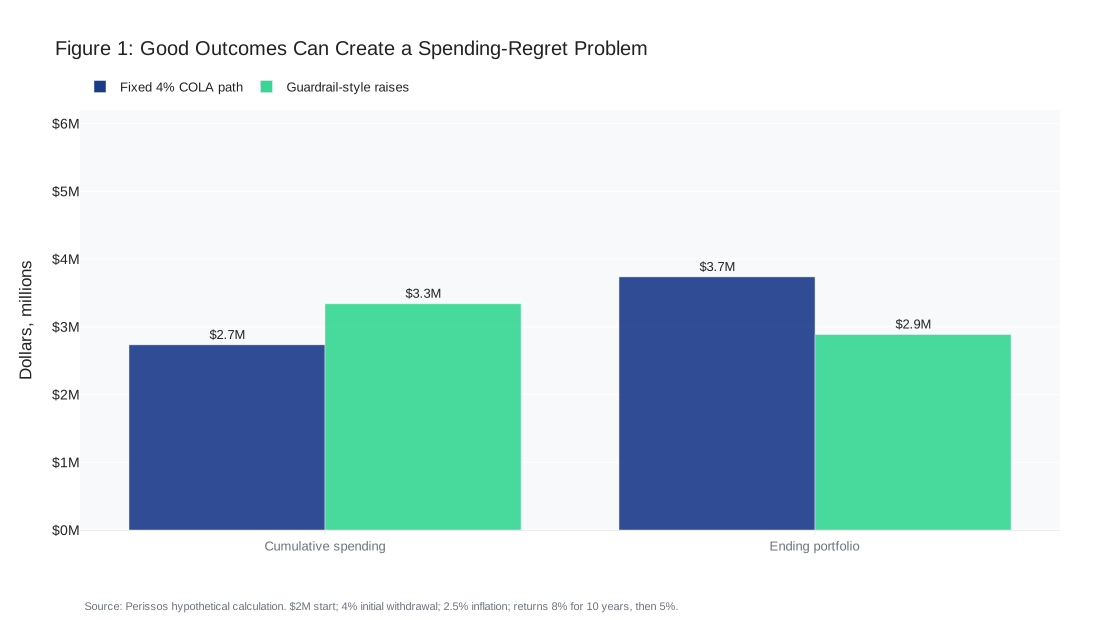
Figure 1 shows a simplified version of the tradeoff. It assumes a $2 million retiree starts at $80,000 of spending, gets normal inflation raises, and experiences a favorable early-return sequence. The fixed 4% COLA path preserves more ending wealth. A guardrail-style path, by contrast, allows spending raises when the portfolio becomes meaningfully ahead of plan. The point is not that this exact formula should be used. The point is that a plan needs permission to respond to good news, not just bad news.
What Replaces It
What replaces the 4% rule is not a new magic percentage. It is a monitored retirement income process.
A modern income plan should answer three questions in dollars. How much can we spend now? What would make us change that number? If we hit that point, how much would we adjust?
That is the guardrail framework. A lower guardrail protects against overspending if the plan deteriorates. An upper guardrail protects against underspending if the plan improves. The upper guardrail is the part many retirees never get from a traditional plan. It says, in effect, "You are now spending so little relative to your resources that it is reasonable to raise your income, accelerate a gift, take the trip, improve the house, or reduce the legacy target."
Guyton and Klinger helped move the planning profession in this direction. Their 2006 decision-rule research tested real-time spending triggers and found that small spending adjustments could increase safe initial withdrawal rates by 10% to 20%.4 The broader insight was more important than the specific percentage: flexible spending is a powerful planning tool because it turns retirement income from a one-time bet into a series of managed decisions.
Income Lab's approach is a more current, software-driven version of that concept. Its methodology starts by answering the client's real question, "How much can I spend?" in dollar terms, then identifies what portfolio changes would justify an adjustment and what those changes could look like.7 The software models a cloud of possible futures and, by default, selects a conservative spending level around the 20th percentile of possible retirement paychecks, with settings that can be adjusted for the household's risk tolerance.7
The important distinction is that Income Lab frames risk on both sides. Overspending risk is obvious. Underspending risk is easier to miss. Income Lab's own guidance describes these risks as complementary: reducing overspending risk increases underspending risk, and underspending can mean forgoing life experiences and increasing later regret.8 That is exactly the issue the 4% rule often hides.
Income Lab also refigures guardrails over time in tracked and monitored plans. Its help documentation says guardrails are updated monthly as clients age, plan length changes, purchasing power changes, goals move closer or farther away in real terms, economic context changes, capital market assumptions change, and additional data becomes available.9 That is a very different process from printing a 4% number at retirement and treating it as permanent.
What This Means in Practice
For clients, the shift from the 4% rule to guardrails changes the planning conversation.
Instead of saying, "You can spend 4% and hope history is kind," we can say, "Here is your current retirement paycheck. Here is the lower guardrail where we would trim. Here is the upper guardrail where we would raise spending or revisit legacy goals. Here is how tax planning, Social Security timing, account sequencing, and portfolio risk fit together."
That last sentence matters. A withdrawal strategy is not isolated from the rest of the plan. The right number depends on guaranteed income, portfolio allocation, tax location, Roth conversion windows, required minimum distributions, charitable goals, home equity, insurance, and estate intent. Fidelity's 2026 guidance points in the same direction by suggesting that essential expenses are often best covered by guaranteed income sources such as Social Security, pensions, or income annuities, with savings withdrawals funding expenses that can be adjusted more easily.6
There are tradeoffs. Guardrails require monitoring. They require clients to accept that spending may change. They require the advisor to define the rules before markets test everyone emotionally. They can also create uncomfortable conversations after a decline, because a lower guardrail may call for trimming spending when clients least want to hear it.
But the tradeoff is worth considering because the alternative is not risk-free. A static 4% rule can reduce the risk of running out of money while increasing the risk of running out of time to enjoy the money.
Closing
The 4% rule should not be thrown away. It should be demoted. It belongs in the toolkit as a historical reference point, a stress-test input, and a useful reminder that early market losses matter.
What replaces it in 2026 is a guardrail-based retirement income process: set a spending target, define the conditions for raising or lowering it, monitor the plan, and coordinate the investment, tax, Social Security, estate, and cash-flow decisions around that process.
For many retirees, the best plan is not the one that dies with the biggest balance. It is the one that gives enough confidence to spend when spending still has meaning, enough discipline to adjust when conditions require it, and enough structure to reduce both financial fear and late-life remorse.
All my best,
Brandon VanLandingham, CFA, CMT, CFP
Founder / CIO
Citations
- Financial Planning Association, "Determining Withdrawal Rates Using Historical Data," William P. Bengen, Journal of Financial Planning, October 1994. https://www.financialplanningassociation.org/learning/publications/journal/OCT94-determining-withdrawal-rates-using-historical-data
- William P. Bengen, "The 4% Rule," Bill Bengen / Bengen Financial Services, accessed August 22, 2026. https://www.bengenfs.com/the-4-percent-rule/
- Philip L. Cooley, Carl M. Hubbard, and Daniel T. Walz, "Sustainable Withdrawal Rates from Your Retirement Portfolio," Financial Counseling and Planning, 1999, available through ResearchGate full-text record. https://www.researchgate.net/publication/228707593_Sustainable_withdrawal_rates_from_your_retirement_portfolio
- Jonathan T. Guyton and William J. Klinger, "Decision Rules and Maximum Initial Withdrawal Rates," Journal of Financial Planning, March 2006, publication page. https://cornerstonewealthadvisors.com/decision-rules-and-maximum-initial-withdrawal-rates/
- Wade D. Pfau, "Is the 4 Percent Rule Too Low or Too High?" Journal of Financial Planning, August 2014. https://www.financialplanningassociation.org/article/journal/AUG14-4-percent-rule-too-low-or-too-high
- Fidelity Viewpoints, "How can I make my retirement savings last?" May 26, 2026. https://www.fidelity.com/viewpoints/retirement/how-long-will-savings-last
- Income Lab, "How are the retirement paycheck and guardrails calculated?" last published March 6, 2026. https://help.incomelaboratory.com/en_US/methodology/how-are-the-retirement-paycheck-and-guardrails-calculated
- Income Lab, "Income Settings and Guardrail Settings," last published February 23, 2026. https://help.incomelaboratory.com/en_US/faqs/income-settings-and-guardrial-settings
- Income Lab, "Guardrails in Retirement Stress Test and Tracked & Monitored Plans," last published February 14, 2026. https://help.incomelaboratory.com/methodology/guardrails-in-the-retirement-stress-test-and-tracked-plans
- Income Lab, "Retirement Guardrails Software for Advisors," accessed August 22, 2026. https://incomelaboratory.com/retirement-guardrails-software/
Important Disclosures
This piece is educational. It is not legal, tax, or accounting advice and is not a recommendation to take or refrain from any specific action. Tax law is fact-specific and changes regularly. Please coordinate any decisions discussed here with your attorney, your CPA, and Perissos before acting.
Perissos Private Wealth Management is a Registered Investment Adviser ("RIA"). Registration as an investment adviser does not imply a certain level of skill or training, and the content of this communication has not been approved or verified by the United States Securities and Exchange Commission or by any state securities authority. Perissos Private Wealth Management renders individualized investment advice to persons in a particular state only after complying with the state's regulatory requirements, or pursuant to an applicable state exemption or exclusion. All investments carry risk, and no investment strategy can guarantee a profit or protect from loss of capital. Past performance is not indicative of future results.
The information contained in this newsletter is intended to provide general information about market themes. It is not intended to offer investment advice. Investment advice will only be given after a client engages our services by executing the appropriate investment services agreement. Information regarding investment products and services is given solely to provide education regarding our investment philosophy and our strategies. You should not rely on any information provided in making investment decisions.
Market data, articles and other content in this material are based on generally available information and are believed to be reliable. Perissos Private Wealth Management does not guarantee the accuracy of the information contained in this material.
Perissos Private Wealth Management will provide all prospective clients with a copy of our current Form ADV, Part 2A (Disclosure Brochure), Part 2B (Supplemental Brochures), and Part 3 (Client Relationship Summary) prior to commencing an advisory relationship. You can also view these documents at any time at adviserinfo.sec.gov or by contacting us requesting a copy.
Sources
Explore topics
Share this article
Last reviewed: August 22, 2026
Frequently Asked Questions
- What is the primary flaw of the original 4% rule?
- The original rule relies on a static inflation-adjusted withdrawal regardless of market performance, which often leads to underspending and significant regret if the portfolio experiences favorable returns.
- How do retirement income guardrails work?
- Guardrails establish pre-defined portfolio value thresholds that trigger spending adjustments, increasing income during bull markets and decreasing it during prolonged downturns to preserve capital.
- Does the 4% rule account for sequence-of-returns risk?
- Yes, the rule was originally designed to protect against sequence-of-returns risk by ensuring a withdrawal rate could survive the worst historical market cycles in U.S. history.