

Written and reviewed by Brandon VanLandingham, CFA, CMT, CFP® · Last updated September 5, 2026
Most retirement income plans start with a deceptively simple question: "How much can I safely spend?"
That question matters, but it can push retirees toward a false choice. One answer says to pick a fixed withdrawal amount, increase it every year for inflation, and stay the course. Another answer says to let spending float completely with the market. Most real households need something in between.
That is where variable withdrawal strategies become useful. Guyton-Klinger is one of the better-known examples because it gives the retiree a documented set of rules for when spending can rise, when it should stay flat, and when it needs to be reduced. The goal is not to make retirement painless in every market. The goal is to replace ad hoc decisions with pre-agreed discipline.
What Guyton-Klinger Is Trying To Solve
The classic fixed real withdrawal approach is clean on paper. A retiree withdraws a starting amount from the portfolio, then adjusts that dollar amount for inflation each year. The problem is that markets do not cooperate with clean formulas.
If poor returns arrive early, blindly raising withdrawals can put too much pressure on the portfolio. If strong returns arrive early, the retiree may underspend relative to what the plan can reasonably support. Guyton's decision-rule framework and the later Guyton-Klinger research were designed to make the spending path more responsive to the retiree's actual portfolio experience.1,2
The important word is "rules." Guyton-Klinger is not a feeling-based spending policy. It uses guardrails. If the current withdrawal rate rises too far above the starting rate, spending is cut. If the current withdrawal rate falls far enough below the starting rate, spending can increase. Inflation adjustments may also be skipped after a negative portfolio year, depending on the rule set being used.2
How The Guardrails Work
A common Guyton-Klinger framing starts with an initial withdrawal rate and then watches the retiree's current withdrawal rate over time. The current withdrawal rate is simply the planned withdrawal divided by the current portfolio value.
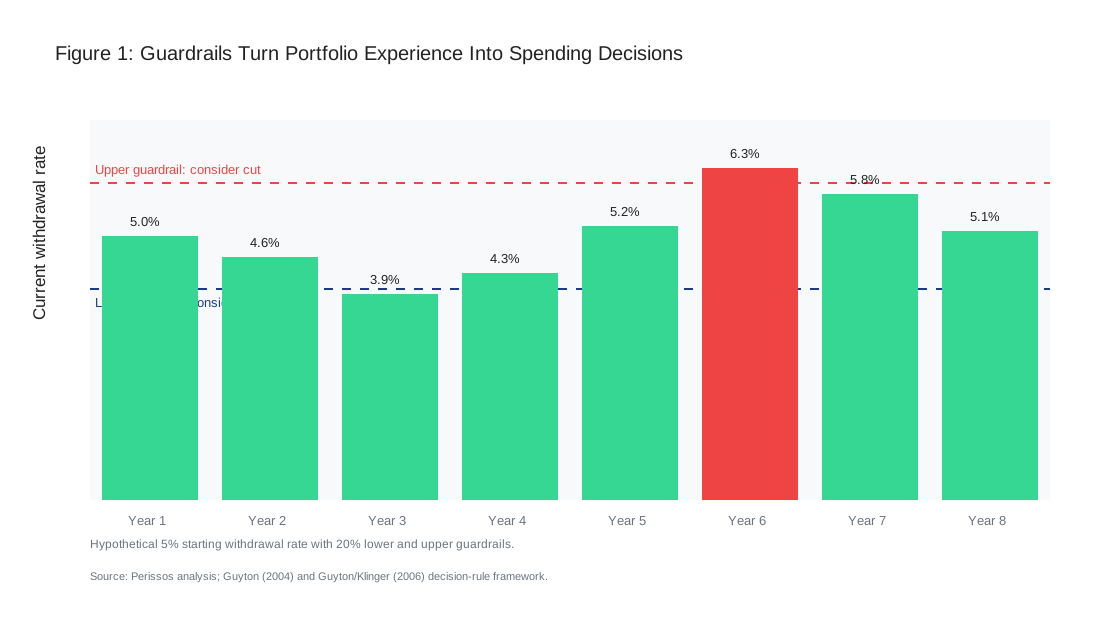
For example, assume a $2 million portfolio and a first-year withdrawal of $100,000. That is a 5% starting withdrawal rate. If the portfolio later grows enough that the same spending amount is only 4% of the portfolio, the retiree may have room for a raise. If the portfolio declines enough that the spending amount becomes 6% of the portfolio, the plan may call for a reduction.
Figure 1 shows the concept using a hypothetical 5% starting withdrawal rate, a 20% upper guardrail, and a 20% lower guardrail. Under that illustration, a current withdrawal rate below 4% signals room to consider a spending raise, while a rate above 6% signals the need to reduce spending. The exact settings should be chosen deliberately; the chart is an illustration, not a recommendation.
Why This Can Feel Better Than A Static Rule
The appeal of Guyton-Klinger is behavioral as much as mathematical.
Retirees usually understand that spending cannot be completely disconnected from portfolio returns. What they need is a way to know which changes are normal and which changes require action. A guardrail strategy gives the retiree permission to enjoy good markets while also making the hard conversations less arbitrary after bad markets.
That matters because retirement income is not only about maximizing a spreadsheet outcome. It is about keeping a household comfortable enough to use the plan while also keeping the portfolio durable enough to fund later life, health care, surviving-spouse needs, taxes, and legacy goals.
Where The Strategy Can Go Wrong
Guyton-Klinger is not a substitute for judgment.
The first risk is overconfidence in the starting withdrawal rate. A higher initial rate may be sustainable in some historical or modeled scenarios, but it usually comes with a greater chance that spending cuts will be required. A client who cannot tolerate a cut should be careful about using a high starting rate merely because the rule set allows it.
The second risk is pretending all spending is equally flexible. Core household expenses, insurance premiums, taxes, charitable commitments, family support, and travel do not all adjust the same way. If the plan labels everything "discretionary," the first real spending cut will feel harsher than the model implied.
The third risk is tax drag. A withdrawal policy that looks reasonable before tax may behave differently once IRA distributions, capital gains, Roth conversions, Social Security taxation, Medicare premiums, and state taxes are considered. The IRS says required minimum distributions generally begin at age 73 for IRAs and many retirement accounts, and those distributions generally must be included in taxable income except for basis or qualified tax-free distributions.3 A variable withdrawal policy needs to work with that tax calendar, not around it.
Who It Fits
Guyton-Klinger can fit retirees who have meaningful portfolio-funded spending, can distinguish essential from discretionary expenses, and are willing to accept documented adjustments instead of demanding the same inflation-adjusted dollar amount every year.
It can be especially useful for high-net-worth retirees whose plans include travel, charitable giving, family gifts, Roth conversions, taxable-account management, and large irregular purchases. Those households may have the flexibility to hold spending flat or trim discretionary items after weak markets without disrupting their core lifestyle.
It may be a poor fit for retirees whose essential expenses consume most of the withdrawal, who are emotionally unwilling to reduce spending, or who need a guaranteed income floor. In those cases, the plan may need more cash reserves, bond ladders, pension income, annuity income, or a lower starting withdrawal rate before a variable strategy is appropriate.
The Perissos View
I like guardrails because they force the spending conversation to happen before the market tests the plan.
For a retiree, the decision is not simply whether Guyton-Klinger is "better" than the 4% rule. The real decision is whether the household wants a documented spending policy that changes when the evidence changes. That policy should define the starting withdrawal, guardrail thresholds, inflation rule, review date, cash reserve policy, and the order in which discretionary spending would be adjusted.
Investment management and planning have to be integrated here. Asset allocation affects the odds of guardrail breaches, taxes affect the after-tax spending amount, and estate or charitable goals affect how much flexibility the retiree actually wants. The implementation should be coordinated with the client's CPA and attorney when withdrawals, Roth conversions, charitable giving, trust distributions, or estate liquidity are involved.
Closing
The takeaway is that Guyton-Klinger is not magic. It is a disciplined compromise.
It gives retirees a way to spend more when the plan can support it and spend less when the portfolio needs protection. Used carefully, that can be more honest than pretending retirement spending will rise smoothly every year regardless of markets. The guardrails do not remove uncertainty, but they make the next decision clearer.
All my best,
Brandon VanLandingham, CFA, CMT, CFP
Citations
- Jonathan T. Guyton, "Decision Rules and Portfolio Management for Retirees: Is the 'Safe' Initial Withdrawal Rate Too Safe?," Journal of Financial Planning, retrieved August 29, 2026, https://www.financialplanningassociation.org/article/journal/OCT04-decision-rules-and-portfolio-management-retirees-safe-initial-withdrawal-rate-too-safe.
- Jonathan T. Guyton and William J. Klinger, "Decision Rules and Maximum Initial Withdrawal Rates," Journal of Financial Planning, retrieved August 29, 2026, https://cornerstonewealthadvisors.com/wp-content/uploads/2014/09/08-06_WebsiteArticle.pdf.
- Internal Revenue Service, "Retirement topics - Required minimum distributions (RMDs)," retrieved August 29, 2026, https://www.irs.gov/retirement-plans/plan-participant-employee/retirement-topics-required-minimum-distributions-rmds.
Important Disclosures
This piece is educational. It is not legal, tax, or accounting advice and is not a recommendation to take or refrain from any specific action. Tax law is fact-specific and changes regularly. Please coordinate any decisions discussed here with your attorney, your CPA, and Perissos before acting.
Perissos Private Wealth Management is a Registered Investment Adviser ("RIA"). Registration as an investment adviser does not imply a certain level of skill or training, and the content of this communication has not been approved or verified by the United States Securities and Exchange Commission or by any state securities authority. Perissos Private Wealth Management renders individualized investment advice to persons in a particular state only after complying with the state's regulatory requirements, or pursuant to an applicable state exemption or exclusion. All investments carry risk, and no investment strategy can guarantee a profit or protect from loss of capital. Past performance is not indicative of future results.
The information contained in this newsletter is intended to provide general information about market themes. It is not intended to offer investment advice. Investment advice will only be given after a client engages our services by executing the appropriate investment services agreement. Information regarding investment products and services is given solely to provide education regarding our investment philosophy and our strategies. You should not rely on any information provided in making investment decisions.
Market data, articles and other content in this material are based on generally available information and are believed to be reliable. Perissos Private Wealth Management does not guarantee the accuracy of the information contained in this material.
Perissos Private Wealth Management will provide all prospective clients with a copy of our current Form ADV, Part 2A (Disclosure Brochure), Part 2B (Supplemental Brochures), and Part 3 (Client Relationship Summary) prior to commencing an advisory relationship. You can also view these documents at any time at adviserinfo.sec.gov or by contacting us requesting a copy.
Sources
Explore topics
Share this article
Last reviewed: August 29, 2026
Frequently Asked Questions
- What are the Guyton-Klinger guardrails?
- Guardrails are pre-defined thresholds—typically based on the current withdrawal rate relative to the starting rate—that trigger automatic increases or decreases in retirement spending to protect portfolio longevity.
- How do variable withdrawal strategies handle inflation?
- These strategies may skip annual inflation adjustments following years with negative portfolio returns to reduce pressure on the account while allowing for increases during strong market cycles.
- Who should consider using a variable withdrawal approach?
- It is often suitable for retirees with significant discretionary spending flexibility who are willing to accept documented adjustments rather than a fixed, inflation-adjusted dollar amount every year.