

Aggregating RMDs Across Multiple IRAs: Rules and Pitfalls
Where aggregation works, and where it stops
September 23, 2026
Several IRA statements may show separate required minimum distributions. That does not always mean you need a withdrawal from each account. The useful distinction is between calculating each requirement and choosing where to take the combined withdrawal. Getting that distinction right can simplify cash flow without missing an obligation.
Calculate first, then choose the paying IRA
For an IRA owner subject to required minimum distributions (RMDs), the usual calculation starts with each account's balance on the preceding December 31, divided by the applicable IRS life expectancy factor. An owner must calculate each IRA's RMD separately, then may satisfy the combined amount from one or several of their own IRAs. The usual factor at age 73 is 26.5; a spouse who is the sole beneficiary and more than ten years younger may call for a different table.1,2
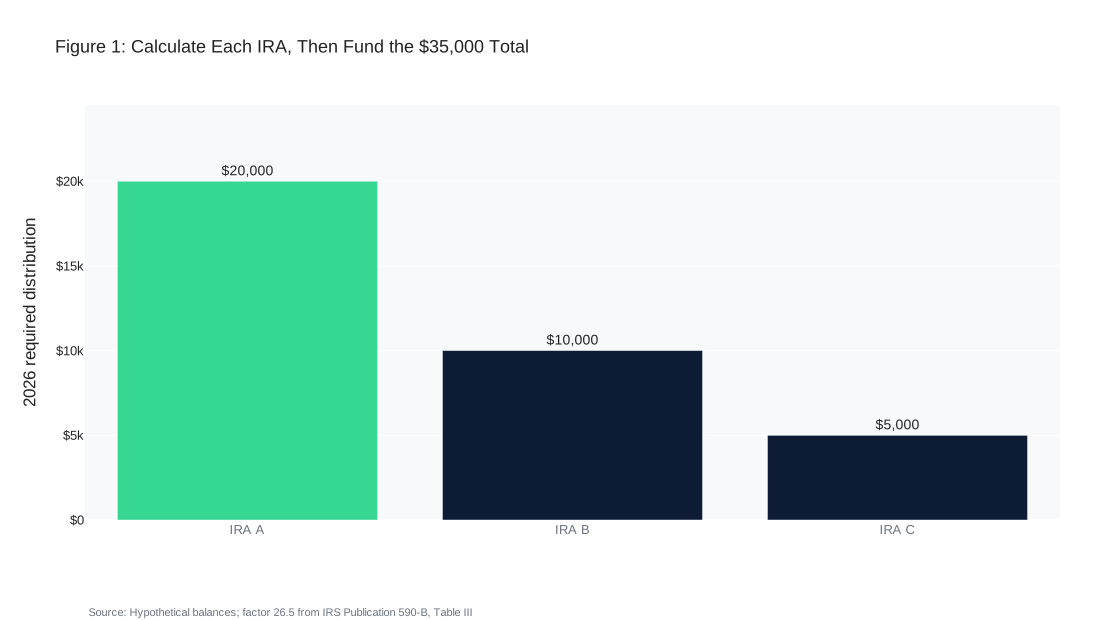
Consider a hypothetical 73-year-old in 2026 with three traditional IRAs. Assume their December 31, 2025 balances are $530,000, $265,000, and $132,500; the Uniform Lifetime Table applies; and no special adjustments are needed. The respective RMDs are $20,000, $10,000, and $5,000. Figure 1 shows how those separate calculations make a $35,000 aggregate obligation. The owner could withdraw $35,000 from the first IRA, spread it across all three, or choose another mix. The tax consequences of a larger withdrawal and the investments sold still deserve attention.1,2
Know which accounts cannot share the obligation
The aggregation permission has boundaries. An owner's 401(k) RMD generally must come from that 401(k); another plan or IRA cannot satisfy it. Multiple 403(b) accounts have their own aggregation rule. An inherited IRA does not join the beneficiary's own IRA pool. Inherited IRAs from different decedents also cannot be pooled with one another. Even where inherited accounts from the same decedent may be aggregated, the beneficiary rules and account terms must be checked separately.1,3
Roth IRAs and designated Roth accounts do not require lifetime RMDs for their original owner. They therefore do not provide an extra source from which to satisfy a traditional IRA RMD. A withdrawal above the current year's RMD also cannot be credited toward next year's requirement.4
Timing and tax treatment still matter
Most annual RMDs are due by December 31. A first RMD may be postponed until April 1 of the following year, but that can put two taxable distributions into one calendar year. RMD amounts generally cannot be rolled over or converted to a Roth IRA. If the annual minimum is missed, the excise tax is generally 25% of the shortfall, reduced to 10% when corrected within the statutory correction period; a waiver may be available for reasonable error.4
Aggregation solves an account administration question, not an income tax question. Before selecting a source IRA, we would map the year's other income, any charitable giving, tax withholding, and the cash or securities available in each account. A qualified charitable distribution may count toward an IRA RMD if it meets the applicable rules and is made directly from the IRA to an eligible charity. Coordinate the actual distribution and reporting with your CPA and custodian.5
I would begin with an inventory by owner and account type, verify each prior year end balance and divisor, calculate every RMD, and only then decide which eligible account should fund each obligation. That sequence is especially valuable when inherited accounts or employer plans sit beside personal IRAs. It gives us a clean audit trail and lets the withdrawal support the broader retirement income plan.
All my best,
Brandon VanLandingham, CFA, CMT, CFP
Founder / CIO
Citations
- IRS, "Retirement plan and IRA required minimum distributions FAQs," accessed September 18, 2026. https://www.irs.gov/retirement-plans/retirement-plan-and-ira-required-minimum-distributions-faqs
- IRS, Publication 590-B (2025), Appendix B, Uniform Lifetime Table, accessed September 18, 2026. https://www.irs.gov/publications/p590b
- Treasury and IRS, final required minimum distribution regulations, 89 FR 58886, IRA aggregation provisions, accessed September 18, 2026. https://www.irs.gov/irb/2024-33_IRB
- IRS, "RMD comparison chart (IRAs vs. defined contribution plans)," accessed September 18, 2026. https://www.irs.gov/retirement-plans/rmd-comparison-chart-iras-vs-defined-contribution-plans
- IRS, Publication 526 (2025), qualified charitable distributions, accessed September 18, 2026. https://www.irs.gov/publications/p526
Important Disclosures
This piece is educational. It is not legal, tax, or accounting advice and is not a recommendation to take or refrain from any specific action. Tax law is fact-specific and changes regularly. Please coordinate any decisions discussed here with your attorney, your CPA, and Perissos before acting.
Perissos Private Wealth Management is a Registered Investment Adviser ("RIA"). Registration as an investment adviser does not imply a certain level of skill or training, and the content of this communication has not been approved or verified by the United States Securities and Exchange Commission or by any state securities authority. Perissos Private Wealth Management renders individualized investment advice to persons in a particular state only after complying with the state's regulatory requirements, or pursuant to an applicable state exemption or exclusion. All investments carry risk, and no investment strategy can guarantee a profit or protect from loss of capital. Past performance is not indicative of future results.
The information contained in this newsletter is intended to provide general information about market themes. It is not intended to offer investment advice. Investment advice will only be given after a client engages our services by executing the appropriate investment services agreement. Information regarding investment products and services is given solely to provide education regarding our investment philosophy and our strategies. You should not rely on any information provided in making investment decisions.
Market data, articles and other content in this material are based on generally available information and are believed to be reliable. Perissos Private Wealth Management does not guarantee the accuracy of the information contained in this material.
Perissos Private Wealth Management will provide all prospective clients with a copy of our current Form ADV, Part 2A (Disclosure Brochure), Part 2B (Supplemental Brochures), and Part 3 (Client Relationship Summary) prior to commencing an advisory relationship. You can also view these documents at any time at adviserinfo.sec.gov or by contacting us requesting a copy.
Explore topics
Share this article
Last reviewed: September 18, 2026
Frequently Asked Questions
- Can you take all of your IRA RMD from one account?
- Often yes for your own traditional IRAs: each IRA's RMD is calculated separately, but the combined amount can usually be withdrawn from one or more eligible own IRAs.
- Can a 401(k) RMD be satisfied from an IRA?
- Generally no. A 401(k) RMD usually must be taken from that 401(k), while 403(b) accounts follow their own aggregation rule.
- What happens if an RMD is missed?
- The excise tax is generally 25% of the shortfall, but it may be reduced to 10% if corrected within the statutory correction period, and a waiver may be available for reasonable error.