

Inherited IRA Rules After the SECURE Act 2.0
Start with the beneficiary and the date of death
September 22, 2026
An inherited IRA can look like an ordinary retirement account on a statement, yet its withdrawal schedule may be entirely different. Before choosing a distribution, I would identify who inherited it, when the owner died, and whether the owner had reached the required beginning date. Those facts drive the rules that follow.1
The beneficiary categories matter
For deaths after 2019, many individual beneficiaries who are not "eligible designated beneficiaries" must empty the inherited IRA by the end of the tenth year after the owner's death. Eligible designated beneficiaries include a surviving spouse, the owner's minor child, a disabled or chronically ill individual, and an individual no more than ten years younger than the owner. These categories can allow life expectancy payments, subject to additional rules. A trust or estate requires separate analysis; naming one does not automatically make it an eligible designated beneficiary.1,2
A surviving spouse often has a choice to keep the IRA inherited or treat it as the spouse's own IRA. That decision can change the withdrawal schedule and should be weighed against the spouse's age, current income, and near-term cash needs. A nonspouse beneficiary generally cannot treat the account as their own or roll it into their own IRA, although a properly titled inherited IRA may be moved by trustee-to-trustee transfer.2
Ten years does not always mean ten years without withdrawals
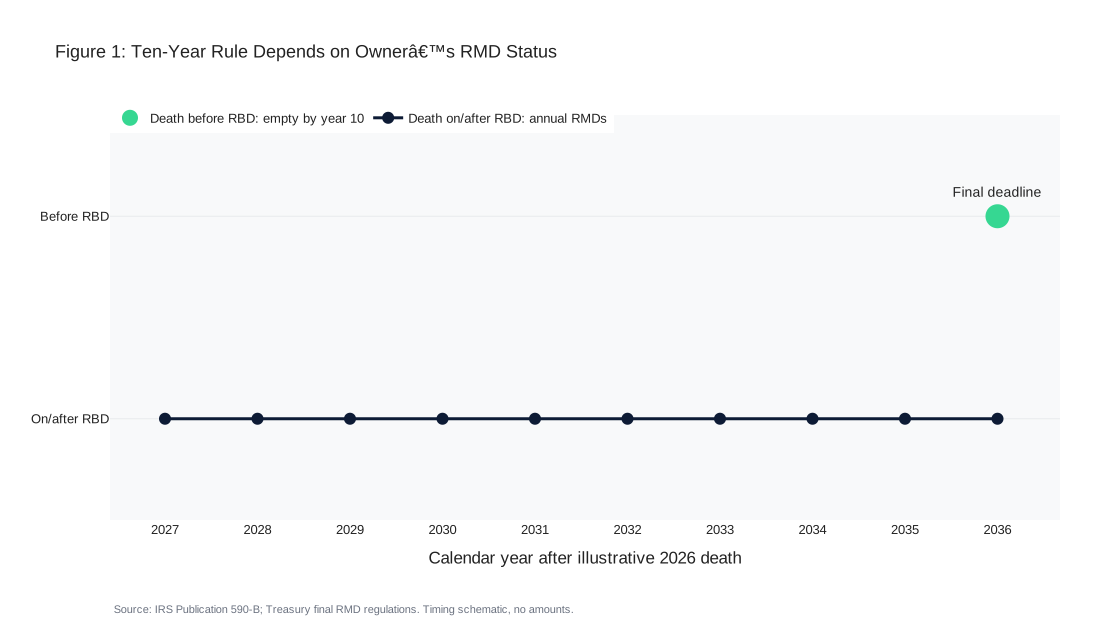
If the owner died before the required beginning date and the ordinary ten-year rule applies, no distribution is required in years one through nine, but the account must be emptied by year ten. If the owner died on or after that date, annual beneficiary RMDs generally apply during the ten-year period, along with the final emptying deadline. A beneficiary should verify the decedent's status and the applicable first-year rule rather than rely on the headline "ten-year rule."2,3
Figure 1 shows the distinction using an illustrative death in 2026. In both paths, year ten ends December 31, 2036. The annual-RMD path may require withdrawals in intervening years. The exact amount depends on the inherited balance, beneficiary age, and applicable life expectancy calculation; the chart deliberately shows timing rather than invented dollar amounts.2,3
Account type and paperwork can change the outcome
An inherited Roth IRA also has beneficiary distribution rules, even though its original owner had no lifetime RMD. Roth distributions are often tax-free, but the five-year earnings rule and the account's history still matter. Traditional IRA withdrawals are generally taxable to the extent the account has no basis. A beneficiary should preserve the deceased owner's records of nondeductible IRA contributions if basis exists.2
The beneficiary designation, account agreement, and any trust terms must be reviewed together. A missed deadline or improper transfer can be expensive. We would coordinate the beneficiary's distribution calendar with their CPA and, where a trust is involved, their estate attorney before requesting a custodian transaction.
Closing
The practical first step is a short file: date of death, owner's required beginning date, beneficiary category, IRA type, beneficiary form, account balance, and any basis records. From there we can calculate the required schedule and decide how distributions fit a multi-year tax and cash-flow plan.
All my best,
Brandon VanLandingham, CFA, CMT, CFP
Founder / CIO
Citations
- IRS, "Retirement topics — Beneficiary," accessed September 18, 2026. https://www.irs.gov/retirement-plans/plan-participant-employee/retirement-topics-beneficiary
- IRS, Publication 590-B (2025), "What if You Inherit an IRA?" and "IRA Beneficiaries," accessed September 18, 2026. https://www.irs.gov/publications/p590b
- Treasury and IRS, final required minimum distribution regulations, 89 FR 58886, accessed September 18, 2026. https://www.irs.gov/irb/2024-33_IRB
Important Disclosures
This piece is educational. It is not legal, tax, or accounting advice and is not a recommendation to take or refrain from any specific action. Tax law is fact-specific and changes regularly. Please coordinate any decisions discussed here with your attorney, your CPA, and Perissos before acting.
Perissos Private Wealth Management is a Registered Investment Adviser ("RIA"). Registration as an investment adviser does not imply a certain level of skill or training, and the content of this communication has not been approved or verified by the United States Securities and Exchange Commission or by any state securities authority. Perissos Private Wealth Management renders individualized investment advice to persons in a particular state only after complying with the state's regulatory requirements, or pursuant to an applicable state exemption or exclusion. All investments carry risk, and no investment strategy can guarantee a profit or protect from loss of capital. Past performance is not indicative of future results.
The information contained in this newsletter is intended to provide general information about market themes. It is not intended to offer investment advice. Investment advice will only be given after a client engages our services by executing the appropriate investment services agreement. Information regarding investment products and services is given solely to provide education regarding our investment philosophy and our strategies. You should not rely on any information provided in making investment decisions.
Market data, articles and other content in this material are based on generally available information and are believed to be reliable. Perissos Private Wealth Management does not guarantee the accuracy of the information contained in this material.
Perissos Private Wealth Management will provide all prospective clients with a copy of our current Form ADV, Part 2A (Disclosure Brochure), Part 2B (Supplemental Brochures), and Part 3 (Client Relationship Summary) prior to commencing an advisory relationship. You can also view these documents at any time at adviserinfo.sec.gov or by contacting us requesting a copy.
Explore topics
Share this article
Last reviewed: September 18, 2026
Frequently Asked Questions
- Does the 10-year rule always mean no withdrawals are required until year 10?
- No. If the original owner died on or after the required beginning date, annual beneficiary RMDs generally apply during years one through nine, and the account still must be emptied by the end of year 10.
- Who counts as an eligible designated beneficiary for an inherited IRA?
- Eligible designated beneficiaries generally include a surviving spouse, the owner's minor child, a disabled or chronically ill individual, and someone not more than 10 years younger than the owner. These categories may allow life-expectancy distributions un...
- Can a nonspouse beneficiary move an inherited IRA into their own IRA?
- Generally, no. A nonspouse beneficiary usually cannot treat the inherited account as their own or roll it into their own IRA, though a properly titled inherited IRA may be moved by trustee-to-trustee transfer.