

Roth Conversions in Your 60s: Why the Math Often Wins
The useful question is which dollars to convert, and when
September 19, 2026
The years between a final paycheck and required minimum distributions can offer a valuable planning window. A Roth conversion moves money from a traditional IRA to a Roth IRA and generally adds the taxable portion to income in the conversion year. In exchange, qualified Roth distributions can later be tax-free, and the original owner has no lifetime Roth IRA RMD. Whether the trade works depends on today's full tax cost versus the future taxes and flexibility it may avoid.1,2
Measure the cost of the next conversion dollar
For 2026, the federal 22% bracket for a married couple filing jointly runs from $100,800 to $211,400 of taxable income; the 24% bracket begins above $211,400. Those are marginal brackets, so crossing the line does not reprice all prior income.3
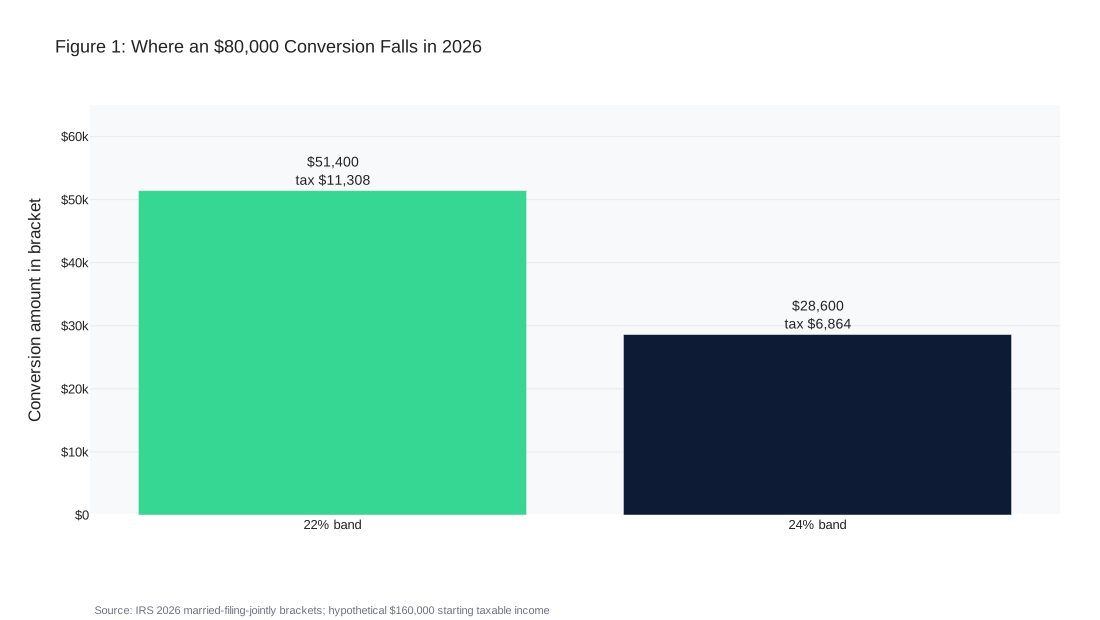
Suppose a hypothetical couple in their early 60s projects $160,000 of 2026 taxable income before any conversion, has a wholly pre-tax traditional IRA, and has no deductions, credits, surtaxes, or state tax changes caused by the conversion. There is $51,400 of 22% bracket room. Converting $80,000 would put $51,400 at 22% and $28,600 at 24%, for $18,172 of incremental federal income tax. Figure 1 breaks down that calculation. It is an illustration of marginal tax cost, not a projection of lifetime savings.3
Why the timing can be attractive
A conversion may help when current marginal tax cost is below the rate expected on later IRA withdrawals, when future RMDs may compress other income choices, or when a family wants more tax-free withdrawal capacity. Paying the tax from outside the IRA can preserve more of the converted balance, but it uses cash that might have another purpose. A long time horizon helps; a near-term need for the converted funds can weaken the case.
The answer can change if a conversion raises Medicare income-related premiums, affects credits, increases state tax, or interacts with capital gains and other income. Medicare generally uses tax return information from two years earlier to determine income-related premium adjustments. We would model those effects before picking an amount.4
Know the operational limits
A required minimum distribution is not eligible for Roth conversion; in an RMD year, take the required amount first. A conversion of pre-tax IRA money is taxable even if the transfer occurs directly between custodians. Traditional IRA basis can make part of a conversion nontaxable, but the aggregation and reporting rules must be respected. A conversion made after 2017 generally cannot be recharacterized back to a traditional IRA.1,2,5
This strategy may be a poor fit when the current marginal rate is unusually high, cash to pay the tax is scarce, the future tax rate is likely lower, or a near-term withdrawal would run into Roth qualification rules. Coordinate the tax return details with your CPA and the account transfer with the custodian.
Closing
I would compare several conversion amounts each year, including zero. The best amount often fills a useful tax band without triggering costs that exceed the longer-term benefit. Document the assumptions and revisit the decision annually as income, law, and retirement timing change.
All my best,
Brandon VanLandingham, CFA, CMT, CFP
Founder / CIO
Citations
- IRS, Publication 590-B (2025), Roth conversion and distribution rules, accessed September 18, 2026. https://www.irs.gov/publications/p590b
- IRS, "Retirement plan and IRA required minimum distributions FAQs," accessed September 18, 2026. https://www.irs.gov/retirement-plans/retirement-plan-and-ira-required-minimum-distributions-faqs
- IRS, "IRS releases tax inflation adjustments for tax year 2026," October 9, 2025, accessed September 18, 2026. https://www.irs.gov/newsroom/irs-releases-tax-inflation-adjustments-for-tax-year-2026-including-amendments-from-the-one-big-beautiful-bill
- Medicare, "How income affects your premiums," accessed September 18, 2026. https://www.medicare.gov/publications/11469-income-and-drug-premiums.pdf
- IRS, "Instructions for Forms 1099-R and 5498 (2026)," accessed September 18, 2026. https://www.irs.gov/instructions/i1099r
Important Disclosures
This piece is educational. It is not legal, tax, or accounting advice and is not a recommendation to take or refrain from any specific action. Tax law is fact-specific and changes regularly. Please coordinate any decisions discussed here with your attorney, your CPA, and Perissos before acting.
Perissos Private Wealth Management is a Registered Investment Adviser ("RIA"). Registration as an investment adviser does not imply a certain level of skill or training, and the content of this communication has not been approved or verified by the United States Securities and Exchange Commission or by any state securities authority. Perissos Private Wealth Management renders individualized investment advice to persons in a particular state only after complying with the state's regulatory requirements, or pursuant to an applicable state exemption or exclusion. All investments carry risk, and no investment strategy can guarantee a profit or protect from loss of capital. Past performance is not indicative of future results.
The information contained in this newsletter is intended to provide general information about market themes. It is not intended to offer investment advice. Investment advice will only be given after a client engages our services by executing the appropriate investment services agreement. Information regarding investment products and services is given solely to provide education regarding our investment philosophy and our strategies. You should not rely on any information provided in making investment decisions.
Market data, articles and other content in this material are based on generally available information and are believed to be reliable. Perissos Private Wealth Management does not guarantee the accuracy of the information contained in this material.
Perissos Private Wealth Management will provide all prospective clients with a copy of our current Form ADV, Part 2A (Disclosure Brochure), Part 2B (Supplemental Brochures), and Part 3 (Client Relationship Summary) prior to commencing an advisory relationship. You can also view these documents at any time at adviserinfo.sec.gov or by contacting us requesting a copy.
Explore topics
Share this article
Last reviewed: September 18, 2026
Frequently Asked Questions
- Why can Roth conversions be attractive in your 60s?
- The period after earned income ends and before required minimum distributions begin can create lower-tax years for some households. That may allow part of a traditional IRA to be converted at marginal rates that are lower than the rates expected on future w...
- Can a required minimum distribution be converted to a Roth IRA?
- No. In an RMD year, the required minimum distribution must generally be taken first, and that amount is not eligible for Roth conversion.
- What costs should be checked before choosing a conversion amount?
- Beyond federal tax brackets, a conversion can affect Medicare income-related premiums, state taxes, capital gains interactions, and available cash to pay the tax. Traditional IRA basis and reporting rules also matter when part of the account is after-tax.