

How Social Security Is Taxed (and How to Minimize It)
Coordinating withdrawals, deductions, and retirement income
September 10, 2026
A retirement withdrawal can create more taxable income than the amount withdrawn. When additional income causes more Social Security benefits to become taxable, the tax cost reaches beyond the withdrawal itself. For a household with several account types, that interaction belongs in the spending plan.
I would not make eliminating tax on Social Security the overriding goal. For many affluent retirees, the taxable portion is already at its maximum. The better question is whether the next withdrawal, capital gain, or Roth conversion improves the household's after-tax position over several years.
Taxable benefits are not a tax rate
IRS Publication 915 explains that up to 85% of Social Security benefits can be included in income. That does not mean the government takes 85% of the benefit. The included amount is taxed through the ordinary income-tax calculation, with the applicable deductions and rates.1,2
For most households, the starting measure is combined income: adjusted gross income before taxable Social Security, plus tax-exempt interest and half of Social Security benefits, with certain additional adjustments when applicable. Joint filers begin the benefit-tax calculation above $32,000, with the upper tier beginning above $44,000. For single filers, those figures are $25,000 and $34,000. Married people filing separately who lived together during the year face a different, less favorable rule.1,2
Municipal-bond interest generally belongs in this calculation even though it is exempt from regular federal income tax. A standard deduction or itemized deduction does not simply subtract from combined income. The distinction between income and deductions is essential when evaluating a proposed strategy.1
Watch the next dollar of income
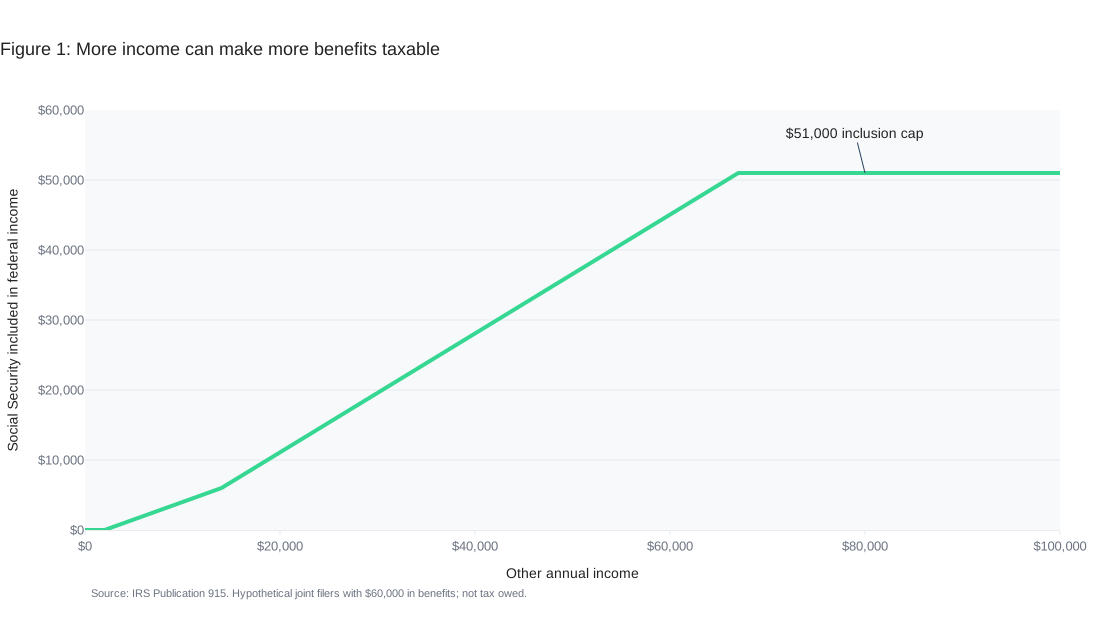
Consider a hypothetical married couple filing jointly with $60,000 of annual Social Security benefits. Assume their other income is fully taxable ordinary income, with no tax-exempt interest, special adjustments, or lump-sum benefit payments. Figure 1 shows the benefit amount included in federal income as other income rises. It does not show the tax owed.
With $40,000 of other income, combined income is $70,000 and taxable Social Security is $28,100. Increasing other income to $50,000 raises taxable Social Security to $36,600. The extra $10,000 therefore produces $18,500 of additional income before deductions: the withdrawal itself plus $8,500 of newly taxable benefits. These results apply the statutory formula to the stated assumptions.
This effect eventually stops. With sufficiently high other income, the taxable amount reaches $51,000, or 85% of the assumed $60,000 benefit. Once that cap is reached, another withdrawal cannot make additional Social Security taxable. Other tax effects may still matter, so a flat portion of the chart should not be read as a tax-free withdrawal opportunity.
Use account choice to manage the interaction
Qualified Roth IRA distributions are excluded from federal gross income. Taxable traditional IRA distributions and the taxable portion of Roth conversions generally increase it.4 That gives a household with both account types flexibility over the source of spending. The decision should account for future distributions, estate goals, and the value of preserving Roth assets, rather than automatically spending Roth money whenever it lowers this year's tax.
A Roth conversion can increase taxable benefits in the conversion year. It may still be useful if paying that tax now improves the longer-term plan. I would compare a series of measured conversions with leaving the account untouched, including the surviving spouse's future circumstances. A conversion that works only under an optimistic future-tax assumption needs closer scrutiny.
For a charitably inclined IRA owner who is at least 70½, a qualifying direct transfer from the IRA trustee to an eligible charity can keep otherwise taxable IRA income out of the return and can count toward an RMD. Annual limits, eligible-charity rules, documentation, and the interaction with deductible IRA contributions must be checked. An excluded qualified charitable distribution cannot also be claimed as an itemized charitable deduction.4 This is most useful when it funds giving the household already intends to do.
Keep the senior deduction and Medicare separate
The enhanced senior deduction is available for tax years 2025 through 2028 and can provide up to $6,000 for each eligible person age 65 or older. The deduction phases down above modified adjusted gross income of $75,000, or $150,000 for joint filers; married taxpayers must file jointly to claim it. Other eligibility requirements also apply.3
This deduction reduces taxable income; it does not repeal the Social Security inclusion formula. A household may owe less total tax while still reporting taxable Social Security. High-income households may receive little or none of the deduction, so it should be modeled rather than assumed.2,3
Medicare uses a different income measure for its income-related premium adjustments: adjusted gross income plus tax-exempt interest, generally drawn from the tax return two years earlier. A strategy affecting income should therefore be checked for premium consequences as well as income tax.5 Oklahoma excludes Social Security benefits from state income taxation, but that does not remove the federal calculation or mean every other retirement withdrawal is state-tax-free.6
Closing
Bring the expected Social Security benefit, account balances, projected withdrawals, planned charitable gifts, and anticipated investment gains into one annual tax projection. Our team can coordinate with your CPA to compare the available choices before withdrawals and conversions occur.
The goal is dependable spending with a sensible lifetime tax cost. Sometimes that means reducing taxable benefits. Sometimes it means accepting the current tax because another part of the plan becomes stronger.
All my best,
Brandon VanLandingham, CFA, CMT, CFP
Founder / CIO
Citations
- IRS, Publication 915, worksheet and benefit taxation. https://www.irs.gov/publications/p915 (accessed September 10, 2026).
- SSA, Must I pay taxes on Social Security benefits?. https://www.ssa.gov/faqs/en/questions/KA-02471.html (accessed September 10, 2026).
- IRS, Enhanced deduction for seniors. https://www.irs.gov/newsroom/check-your-eligibility-for-the-new-enhanced-deduction-for-seniors (accessed September 10, 2026).
- IRS, Publication 590-B. https://www.irs.gov/publications/p590b (accessed September 10, 2026).
- SSA, Medicare Premiums. https://www.ssa.gov/benefits/medicare/medicare-premiums.html (accessed September 10, 2026).
- Oklahoma Tax Commission, Income Tax FAQs. https://oklahoma.gov/tax/helpcenter/income-tax.html (accessed September 10, 2026).
Important Disclosures
This piece is educational. It is not legal, tax, or accounting advice and is not a recommendation to take or refrain from any specific action. Tax law is fact-specific and changes regularly. Please coordinate any decisions discussed here with your attorney, your CPA, and Perissos before acting.
Perissos Private Wealth Management is a Registered Investment Adviser ("RIA"). Registration as an investment adviser does not imply a certain level of skill or training, and the content of this communication has not been approved or verified by the United States Securities and Exchange Commission or by any state securities authority. Perissos Private Wealth Management renders individualized investment advice to persons in a particular state only after complying with the state's regulatory requirements, or pursuant to an applicable state exemption or exclusion. All investments carry risk, and no investment strategy can guarantee a profit or protect from loss of capital. Past performance is not indicative of future results.
The information contained in this newsletter is intended to provide general information about market themes. It is not intended to offer investment advice. Investment advice will only be given after a client engages our services by executing the appropriate investment services agreement. Information regarding investment products and services is given solely to provide education regarding our investment philosophy and our strategies. You should not rely on any information provided in making investment decisions.
Market data, articles and other content in this material are based on generally available information and are believed to be reliable. Perissos Private Wealth Management does not guarantee the accuracy of the information contained in this material.
Perissos Private Wealth Management will provide all prospective clients with a copy of our current Form ADV, Part 2A (Disclosure Brochure), Part 2B (Supplemental Brochures), and Part 3 (Client Relationship Summary) prior to commencing an advisory relationship. You can also view these documents at any time at adviserinfo.sec.gov or by contacting us requesting a copy.
Explore topics
Share this article
Last reviewed: September 12, 2026
Frequently Asked Questions
- When do Social Security benefits become taxable?
- For federal taxes, benefits can become partially taxable when combined income exceeds $25,000 for single filers or $32,000 for joint filers. The upper thresholds are $34,000 for single filers and $44,000 for joint filers.
- Does 85% taxable mean the government takes 85% of my Social Security?
- No. It means up to 85% of benefits may be included in taxable income, not that 85% of the benefit is taxed away. The included amount is then taxed under ordinary federal income tax rules.
- Can Roth withdrawals or charitable IRA transfers reduce Social Security taxation?
- Qualified Roth IRA distributions are generally excluded from federal gross income, so they may avoid increasing combined income. A qualified charitable distribution from an IRA can also keep eligible IRA income off the return while counting toward an RMD.