

Written and reviewed by Brandon VanLandingham, CFA, CMT, CFP® · Last updated September 11, 2026
For many retirees, the house is one of the largest assets on the balance sheet and the least connected to the income plan. That separation can create a strange result: a household may be wealthy on paper, yet still feel forced to sell investments, cut spending, or carry an uncomfortable cash reserve when markets are weak.
A reverse mortgage can turn part of that home equity into available cash without requiring monthly principal-and-interest payments. That does not make it free money. It is a loan, interest and fees generally increase the balance over time, and the home remains collateral. The right question is not whether reverse mortgages are good or bad. It is whether using one improves the household's complete plan after financing costs, housing intentions, estate goals, and portfolio risk are considered together.
What an HECM Actually Does
The Home Equity Conversion Mortgage, or HECM, is the reverse mortgage insured by the Federal Housing Administration. It is available through FHA-approved lenders. Borrowers generally must be at least age 62, have substantial equity, occupy the property as a principal residence, demonstrate the ability to pay ongoing property charges, and complete counseling with a HUD-certified counselor.1,2
The borrower keeps title to the home. Available proceeds depend in part on the age of the youngest borrower or eligible non-borrowing spouse, the interest rate, and the lesser of the home's appraised value, the applicable FHA limit, or the purchase price for an HECM used to buy a home. For 2026 case numbers, FHA's nationwide HECM maximum claim amount is $1,249,125. That is a ceiling used in the calculation, not a promise that a homeowner can borrow that amount.1,3
Proceeds may be structured in different ways, including a line of credit, scheduled advances, a lump sum, or a combination permitted by the loan terms. Existing liens generally must be paid at closing. During the first 12 months, federal rules also limit access to proceeds based on the initial principal limit and mandatory obligations.2
The Real Tradeoff Is Liquidity Versus Future Equity
Interest, mortgage-insurance charges, and financed costs are added to the balance. The amount owed therefore tends to rise while the homeowner's remaining equity tends to fall relative to owning the same house without the loan.4 This is the economic exchange: more usable liquidity today in return for less home equity later.
Figure 1 shows a deliberately simple illustration. Assume a $1,000,000 home, a $300,000 initial HECM balance, 3% annual home appreciation, and a 6.5% annual effective growth rate on the loan balance. After 15 years, the modeled home value is about $1.56 million and the modeled loan balance is about $772,000, leaving roughly $786,000 of home equity before selling costs. Without the loan, modeled equity equals the full home value. These are assumptions, not a quote or forecast, but they reveal why rate, borrowing amount, time horizon, and appreciation belong in the decision.
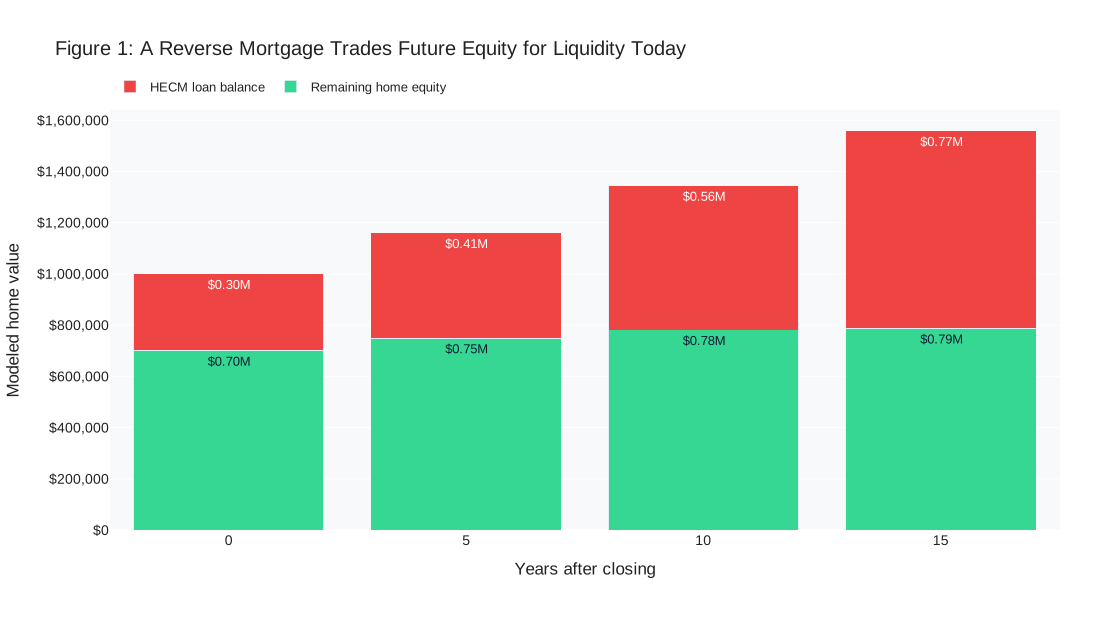
The comparison is incomplete if we ignore what the proceeds accomplish. If a line of credit prevents the sale of depressed investments, funds a needed home modification, replaces an expensive conventional mortgage, or supports a surviving spouse's spending plan, the liquidity may be worth more than the equity surrendered. If the cash simply accumulates in a low-yield account while the loan balance compounds at a higher rate, the economics are harder to defend.
When the Tool Can Fit
An HECM deserves serious analysis when a client expects to remain in the home for many years, has significant home equity, can reliably pay property taxes, insurance, maintenance, and association charges, and values liquidity more than maximizing the home's unencumbered value for heirs. It can also be useful when housing wealth is large relative to investable assets or when a household wants a contingent source of spending during a severe market decline.
The planning value is often optionality. A standby line can create another source of cash so the portfolio is not the only asset asked to fund every spending need. That does not mean the line should automatically be drawn. We should compare the HECM with downsizing, a conventional home-equity loan, a cash reserve, reduced spending, or a different portfolio withdrawal plan. Plan first, product second.
An HECM may be a poor fit when the homeowner expects to move soon, wants to preserve the house free of debt for family, cannot comfortably maintain the property charges, has a spouse or dependent whose occupancy rights are uncertain, or has enough liquid assets that the financing cost buys little additional resilience. High upfront costs can also be difficult to justify over a short holding period.
The Obligations Do Not Disappear
No required monthly principal-and-interest payment does not mean no required cash flow. The home must remain the principal residence, property taxes and homeowners insurance must be paid, and the property must be maintained. Failing those obligations can place the loan in default and lead to foreclosure.4
The loan generally becomes due when the last surviving borrower or eligible non-borrowing spouse dies, sells the home, or no longer occupies it as a principal residence. An absence of more than 12 consecutive months in a healthcare facility can trigger repayment when no co-borrower remains in the home.5 This matters in long-term-care planning: the same health event that creates a need for cash can also change whether the home continues to qualify as the borrower's principal residence.
Spousal status needs careful review before closing. A co-borrower and an eligible non-borrowing spouse do not have identical rights. An eligible non-borrowing spouse may be able to remain after the borrower dies or moves permanently to a healthcare facility, but only if HUD's conditions continue to be met, and loan advances generally stop during the deferral period.4
Build the Estate Plan Around the Debt
When the loan becomes due, the borrower or estate may sell the house and keep any value above the balance. Heirs who want to retain the property generally must arrange repayment. If the balance exceeds the home's value, CFPB explains that heirs may satisfy an HECM by selling the home for at least 95% of its appraised value; FHA mortgage insurance covers the remaining insured shortfall.6
That protection limits the repayment claim against the home, but it does not preserve the house for the family. Heirs need time, liquidity, and a shared understanding of the plan. The reverse mortgage should therefore be reflected in estate documents, housing conversations, liquidity planning, and instructions for the executor or trustee.
The Decision We Need to Make
Before proceeding, I would model at least three paths: keep the home without new debt, establish an HECM but draw only under defined conditions, and sell or downsize. Each path should show projected cash flow, portfolio withdrawals, taxes, housing costs, loan growth, future equity, survivor outcomes, and the effect of a long-term-care move.
We would then stress the variables that matter most: longevity, interest rates, home appreciation, market returns, spending, and the timing of a move. A lender's proposal supplies the product terms; our plan determines whether those terms solve a real problem. The attorney should confirm title and estate implications, the CPA should review any tax questions, and a HUD-approved counselor must provide the required independent counseling.
A reverse mortgage should not be treated as an emergency exit reserved for a plan that has already failed. Used deliberately, it can connect housing wealth to retirement spending and risk management. Used casually, it can consume future equity without materially improving the plan.
The takeaway is straightforward: decide what the home is supposed to do for you. If its job is to support lifetime housing and provide flexible liquidity, an HECM may earn a place in the analysis. If its job is to remain debt-free and pass intact to the next generation, the cost may be too high. Either way, the answer should come from a coordinated projection, not from a slogan.
All my best,
Brandon VanLandingham, CFA, CMT, CFP
Citations
- U.S. Department of Housing and Urban Development, "Home Equity Conversion Mortgages for Seniors," accessed September 4, 2026. https://www.hud.gov/hud-partners/single-family-hecmhome
- U.S. Department of Housing and Urban Development, "Programs of HUD: Home Equity Conversion Mortgages," accessed September 4, 2026. https://www.hud.gov/hudprograms
- U.S. Department of Housing and Urban Development, Mortgagee Letter 2025-22, "2026 Home Equity Conversion Mortgage Limits," December 11, 2025. https://www.hud.gov/sites/dfiles/hudclips/documents/2025-22hsgml.pdf
- Consumer Financial Protection Bureau, "You Have a Reverse Mortgage: Know Your Rights and Responsibilities," accessed September 4, 2026. https://files.consumerfinance.gov/f/documents/cfpb_reverse_mortgage_rights_responsibilities.pdf
- Consumer Financial Protection Bureau, "When Do I Have to Pay Back a Reverse Mortgage Loan?" accessed September 4, 2026. https://www.consumerfinance.gov/ask-cfpb/when-do-i-have-to-pay-back-a-reverse-mortgage-loan-en-236/
- Consumer Financial Protection Bureau, "With a Reverse Mortgage Loan, Can My Heirs Keep or Sell My Home After I Die?" last reviewed August 28, 2026. https://www.consumerfinance.gov/ask-cfpb/with-a-reverse-mortgage-loan-can-my-heirs-keep-or-sell-my-home-after-i-die-en-242/
Important Disclosures
This piece is educational. It is not legal, tax, or accounting advice and is not a recommendation to take or refrain from any specific action. Tax law is fact-specific and changes regularly. Please coordinate any decisions discussed here with your attorney, your CPA, and Perissos before acting.
Perissos Private Wealth Management is a Registered Investment Adviser ("RIA"). Registration as an investment adviser does not imply a certain level of skill or training, and the content of this communication has not been approved or verified by the United States Securities and Exchange Commission or by any state securities authority. Perissos Private Wealth Management renders individualized investment advice to persons in a particular state only after complying with the state's regulatory requirements, or pursuant to an applicable state exemption or exclusion. All investments carry risk, and no investment strategy can guarantee a profit or protect from loss of capital. Past performance is not indicative of future results.
The information contained in this newsletter is intended to provide general information about market themes. It is not intended to offer investment advice. Investment advice will only be given after a client engages our services by executing the appropriate investment services agreement. Information regarding investment products and services is given solely to provide education regarding our investment philosophy and our strategies. You should not rely on any information provided in making investment decisions.
Market data, articles and other content in this material are based on generally available information and are believed to be reliable. Perissos Private Wealth Management does not guarantee the accuracy of the information contained in this material.
Perissos Private Wealth Management will provide all prospective clients with a copy of our current Form ADV, Part 2A (Disclosure Brochure), Part 2B (Supplemental Brochures), and Part 3 (Client Relationship Summary) prior to commencing an advisory relationship. You can also view these documents at any time at adviserinfo.sec.gov or by contacting us requesting a copy.
Explore topics
Share this article
Last reviewed: September 5, 2026
Frequently Asked Questions
- What are the eligibility requirements for a Home Equity Conversion Mortgage (HECM)?
- Borrowers must generally be at least age 62, occupy the home as their primary residence, have significant equity, and complete a session with a HUD-certified counselor.
- What happens to the loan balance over time?
- Because no monthly principal or interest payments are required, interest and mortgage insurance charges are added to the balance, causing it to rise while home equity typically falls.
- Can heirs keep the home if the loan balance exceeds the value?
- Heirs may generally satisfy the debt by selling the home for at least 95% of its appraised value, or they must arrange for full repayment to retain the property.