

Written and reviewed by Brandon VanLandingham, CFA, CMT, CFP® · Last updated September 7, 2026
IRMAA is commonly called a Medicare tax, but it is an income-related addition to Part B and Part D premiums. The distinction matters because the charge is based on modified adjusted gross income, uses tiered thresholds, and can often be anticipated two years before the premium year. A small amount of extra income can move both spouses into the next tier for a full calendar year.
The goal is not to suppress income at any cost. A Roth conversion, business sale, or portfolio gain may improve the long-term plan even after IRMAA. The goal is to know the complete marginal cost before the transaction and avoid accidental threshold crossings that add little economic value.
How the 2026 Surcharge Works
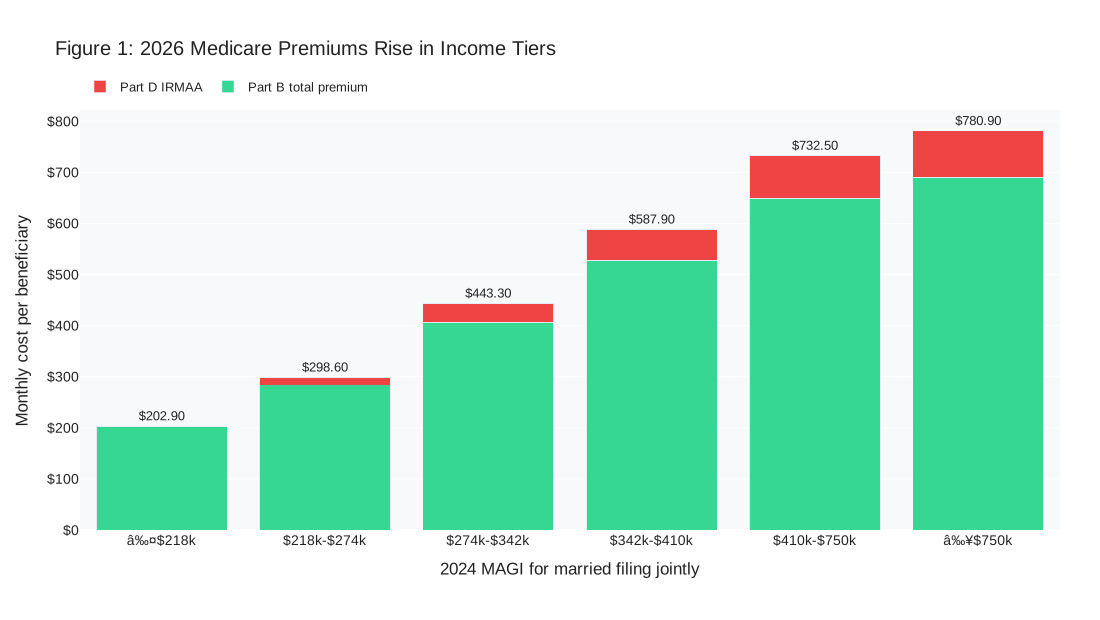
For 2026, the standard Part B premium is $202.90 per month. IRMAA adds $81.20 to $487.00 per month to Part B and $14.50 to $91.00 per month to the beneficiary's Part D plan premium, depending on income and filing status.1,2 Each enrolled spouse pays the adjustment separately.
The 2026 tiers for a single filer begin above $109,000 of modified adjusted gross income. For married couples filing jointly, they begin above $218,000. The higher joint thresholds are $274,000, $342,000, $410,000, and $750,000. Married taxpayers who lived together and filed separately face a compressed schedule.1
Figure 1 combines the 2026 Part B premium and Part D IRMAA for one beneficiary, before the underlying Part D plan premium. At the highest joint-filer tier, the combined amount is $780.90 per month per person, compared with $202.90 below the first threshold. For a married couple in the same tier, that difference is $13,872 for the year before either spouse's Part D plan premium.
The Two-Year Lookback
Social Security generally determines 2026 IRMAA from the most recent federal tax return supplied by the IRS. The 2026 SSA-44 identifies tax year 2024 as the base return and defines IRMAA modified adjusted gross income as adjusted gross income plus certain tax-exempt income.2,3 This means a transaction in 2024 can change Medicare premiums in 2026, even if the cash has already been spent or reinvested.
Tax-exempt municipal-bond interest is included in this Medicare calculation. Large traditional IRA distributions, Roth conversions, realized capital gains, business income, and taxable interest can also raise adjusted gross income. Qualified Roth distributions are generally not included in AGI, and a properly completed qualified charitable distribution can keep an eligible IRA gift out of income. The CPA should calculate the actual tax-return effect before implementation.
The lag creates a planning window. In 2026, our current decisions may affect 2028 premiums. A multi-year projection should therefore place taxable income, capital gains, charitable gifts, retirement distributions, and Medicare premiums on the same timeline.
Why the Thresholds Behave Like Cliffs
IRMAA is determined by brackets rather than a gradual percentage. Crossing a threshold by one dollar can place the beneficiary in the next monthly tier. For a married couple, the increase applies to each spouse with Part B or Part D coverage.
This does not mean every threshold should be defended. Suppose a larger Roth conversion causes $2,296.80 of additional annual IRMAA for a couple but reduces future required distributions, taxes, and survivor exposure by much more. The conversion may still be prudent. In contrast, realizing an avoidable gain in late December solely to rebalance a small position could create a surcharge disproportionate to the benefit.
Use the threshold as a decision input. Calculate the federal and state tax, net investment income tax when applicable, capital-gain interaction, IRMAA for both spouses, and the long-term benefit of the transaction. A Medicare tier is one cost in that comparison, not the planning objective.
Practical Ways to Reduce Accidental IRMAA
Begin with a tax projection before year-end. Aggregate wages, pensions, Social Security taxation, interest, dividends, capital gains, business or rental income, retirement distributions, and tax-exempt interest. Leave room for late mutual-fund distributions and required minimum distributions.
Coordinate large transactions across several years when the economics permit. Roth conversions can be divided among lower-income years. Concentrated-stock sales may be staged, though investment risk and tax rates can outweigh IRMAA. Charitable gifts of appreciated property may avoid a realized gain, and qualified charitable distributions can reduce IRA income for eligible donors. Capital losses may offset realized gains under the tax rules.
Asset location also matters over time. A portfolio that produces substantial taxable interest and gains every year can make IRMAA a recurring cost. Tax-deferred and tax-free accounts may reduce current MAGI, but contributions, conversions, withdrawals, basis, and required distributions must be planned together. Holding municipal bonds solely to avoid federal income tax does not avoid IRMAA because tax-exempt interest is added back for this purpose.2
Business owners should model sale structure, installment timing, compensation, and retirement-plan decisions well before closing. Estate and survivor planning also matters: after a spouse dies, the survivor may face single-filer IRMAA thresholds while retaining much of the household income.
When to Appeal Instead of Replan
An old tax return may no longer represent current income. Social Security Form SSA-44 permits a request to reduce IRMAA after specified life-changing events, including marriage, divorce or annulment, death of a spouse, work stoppage or reduction, loss of income-producing property beyond the person's control, loss of pension income, or certain employer settlement payments.3
The request requires evidence of the event and an estimate of reduced MAGI. Retirement is the common example: a client may have high wages on the lookback return but much lower income after work stops. File the request with Social Security and retain the supporting documents. A market decline by itself is not automatically a listed life-changing event; the facts must fit the form.
Also challenge factual errors. If Social Security used an amended, incorrect, or nonrepresentative return, follow the notice instructions and provide the appropriate tax documentation. An appeal is not a substitute for disagreeing with a correct application of the law.
The Decision We Need to Make
Each fall, project MAGI for the current year and the following two years. Place both spouses' Medicare enrollment, filing status, planned conversions, required distributions, gains, charitable gifts, business events, and potential life changes on the schedule. Then calculate the incremental tax and IRMAA at each threshold.
I would accept IRMAA when a transaction creates greater after-tax value or reduces a more serious future risk. I would avoid it when income can be shifted without harming the investment, tax, charitable, or estate plan. The CPA should confirm MAGI and return treatment, Social Security should decide any appeal, and our team should document why the chosen income level serves the multi-year plan.
IRMAA is expensive when it arrives as a surprise. It is manageable when treated as a known tiered cost in a two-year income plan. The most effective work often happens before the premium notice, when the timing and size of taxable transactions can still be changed.
Do not let the surcharge dictate every decision. Measure it, compare it with the benefit of the transaction, and coordinate the answer across taxes, investments, retirement income, and the surviving spouse's plan.
All my best,
Brandon VanLandingham, CFA, CMT, CFP
Citations
- Centers for Medicare & Medicaid Services, "2026 Medicare Parts A & B Premiums and Deductibles," November 14, 2025. https://www.cms.gov/newsroom/fact-sheets/2026-medicare-parts-b-premiums-deductibles
- Social Security Administration, "Premiums: Rules for Higher-Income Beneficiaries," accessed September 4, 2026. https://www.ssa.gov/benefits/medicare/medicare-premiums.html
- Social Security Administration, Form SSA-44, "Medicare Income-Related Monthly Adjustment Amount - Life-Changing Event," revised December 2025. https://www.ssa.gov/forms/ssa-44.pdf
- Social Security Administration, "Request to Lower an Income-Related Monthly Adjustment Amount," accessed September 4, 2026. https://www.ssa.gov/medicare/lower-irmaa
Important Disclosures
This piece is educational. It is not legal, tax, or accounting advice and is not a recommendation to take or refrain from any specific action. Tax law is fact-specific and changes regularly. Please coordinate any decisions discussed here with your attorney, your CPA, and Perissos before acting.
Perissos Private Wealth Management is a Registered Investment Adviser ("RIA"). Registration as an investment adviser does not imply a certain level of skill or training, and the content of this communication has not been approved or verified by the United States Securities and Exchange Commission or by any state securities authority. Perissos Private Wealth Management renders individualized investment advice to persons in a particular state only after complying with the state's regulatory requirements, or pursuant to an applicable state exemption or exclusion. All investments carry risk, and no investment strategy can guarantee a profit or protect from loss of capital. Past performance is not indicative of future results.
The information contained in this newsletter is intended to provide general information about market themes. It is not intended to offer investment advice. Investment advice will only be given after a client engages our services by executing the appropriate investment services agreement. Information regarding investment products and services is given solely to provide education regarding our investment philosophy and our strategies. You should not rely on any information provided in making investment decisions.
Market data, articles and other content in this material are based on generally available information and are believed to be reliable. Perissos Private Wealth Management does not guarantee the accuracy of the information contained in this material.
Perissos Private Wealth Management will provide all prospective clients with a copy of our current Form ADV, Part 2A (Disclosure Brochure), Part 2B (Supplemental Brochures), and Part 3 (Client Relationship Summary) prior to commencing an advisory relationship. You can also view these documents at any time at adviserinfo.sec.gov or by contacting us requesting a copy.
Sources
Explore topics
Share this article
Last reviewed: September 5, 2026
Frequently Asked Questions
- What is the lookback period for Medicare IRMAA?
- Social Security generally determines IRMAA surcharges based on the federal tax return from two years prior, meaning 2024 income levels typically dictate 2026 premiums.
- Does tax-exempt interest income trigger IRMAA?
- Yes, modified adjusted gross income for IRMAA includes tax-exempt municipal-bond interest, so these earnings are added back to your adjusted gross income during the calculation.
- Can I appeal an IRMAA surcharge if I have retired?
- You can request a premium reduction using Form SSA-44 if you experience a specific life-changing event, such as a work stoppage, work reduction, or death of a spouse.