

Written and reviewed by Brandon VanLandingham, CFA, CMT, CFP® · Last updated September 4, 2026
Few retirement products create stronger reactions than annuities.
Some retirees hear "guaranteed income" and feel immediate relief. Others hear "annuity" and think of complexity, surrender charges, commissions, and lost control. Both reactions can be understandable. The planning problem is that neither reaction answers the real question.
The better question is: what risk are we trying to transfer, and what are we giving up to transfer it?
An annuity is a contract with an insurance company. The SEC describes annuities as contracts designed for retirement or other long-term goals, where the buyer pays a lump sum or series of payments and the insurer agrees to make income payments immediately or in the future.1 That definition matters because an annuity is not simply a bond substitute or a magic yield product. It is an insurance contract, and the fit depends on the risk being insured.
Start With The Income Floor
I usually begin with the retiree's income floor. That means the spending that needs to be covered regardless of markets: housing, utilities, food, insurance premiums, taxes, basic transportation, and essential health care.
If Social Security, pensions, rental income, and other reliable sources already cover the income floor, an additional annuity may be unnecessary. The portfolio can then be managed for liquidity, growth, tax flexibility, charitable goals, and legacy planning.
If the income floor is not covered, annuity income may deserve a serious look. It can reduce the pressure on the portfolio to fund every essential bill and may help the retiree tolerate normal market volatility. The point is not to annuitize everything. The point is to decide whether a portion of the balance sheet should be converted into contractual income.
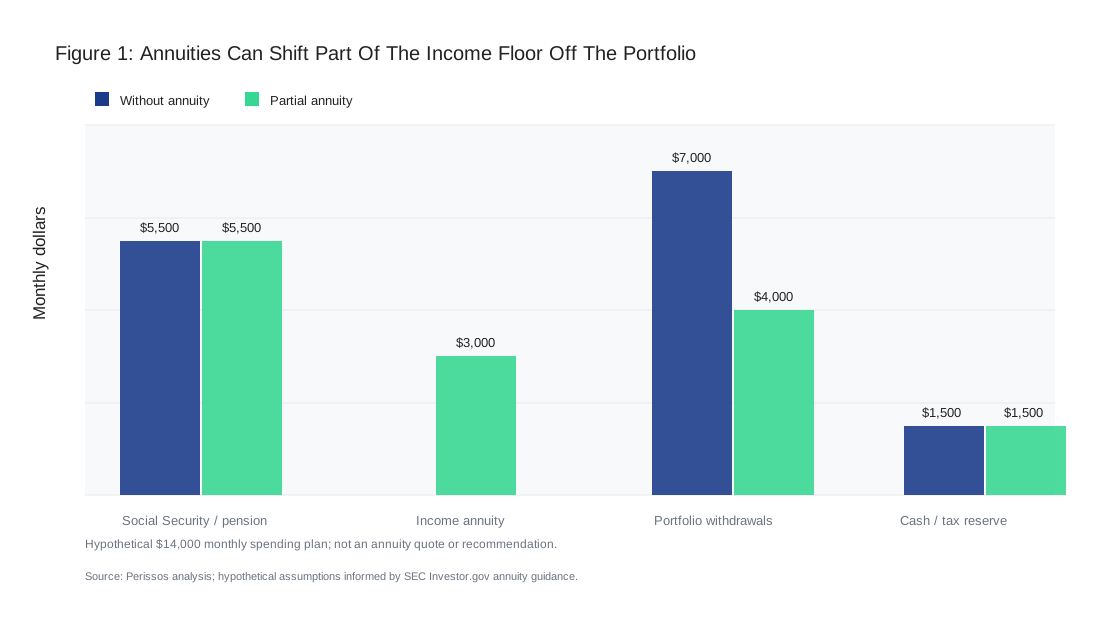
Figure 1 shows a hypothetical $14,000 monthly spending plan. In the first column, the retiree relies more heavily on portfolio withdrawals for core spending. In the second, a partial annuity helps fund the core floor and leaves the portfolio responsible for more discretionary and long-term spending. The example is a planning illustration, not a product recommendation.
The Case For Holding Annuities
Annuities can make sense when the retiree wants to insure longevity risk. Longevity risk is the risk of living long enough that portfolio withdrawals, inflation, health costs, and poor market timing become harder to manage.
That risk is not theoretical. The Social Security Administration's 2023 period life table, used in the 2026 Trustees Report, shows a 65-year-old male with 18.12 years of remaining life expectancy and a 65-year-old female with 20.66 years.2 Those are averages, not ceilings. Many healthy retirees, especially married couples, need a plan that can survive well into the 90s.
Annuities can also help when a retiree values simplicity. A monthly income stream can make the household budget feel less dependent on which account is sold, which bond matures, or what the market did last quarter. For some families, that behavioral benefit is real.
They may also fit when a surviving spouse would benefit from a simpler income structure. A plan that works while one spouse manages every detail may not work as well after incapacity or death. Contractual income can sometimes reduce operational complexity, though the details must be chosen carefully.
The Case Against Holding Annuities
The first reason not to buy an annuity is liquidity.
Once capital is committed, access can be limited, expensive, or unavailable depending on the contract. The SEC notes that annuity withdrawals or surrender can create adverse consequences such as surrender charges, taxes, penalties, contract adjustments, and reduced benefits.1 A retiree who may need capital for a home purchase, family assistance, a business opportunity, major health expense, or flexible charitable giving should be careful before locking up too much of the portfolio.
The second reason is complexity. Annuities are not one thing. They can be immediate or deferred, fixed, indexed, registered index-linked, or variable, and different contracts carry different risks, costs, regulators, and features.1 If the household cannot clearly explain what risk is being insured, when payments begin, how costs are charged, what happens at death, and what can go wrong, the decision is not ready.
The third reason is opportunity cost. A dollar used to buy an income annuity is a dollar not available for portfolio growth, tax-loss harvesting, Roth conversion funding, gifts, trust funding, or opportunistic rebalancing. That tradeoff may be acceptable, but it should be intentional.
Guarantees Need Due Diligence
The word "guaranteed" needs context.
Annuity guarantees are backed by the issuing insurance company's financial strength and claims-paying ability. The SEC specifically warns that if the insurance company has financial difficulties, it may not be able to pay.1 That does not mean retirees should dismiss annuities. It means carrier strength, contract terms, state insurance regulation, and guaranty-association limits all need to be part of the review.
Tax treatment also matters. IRS Publication 575 covers the taxation of pension and annuity income and explains that distributions may be fully or partly taxable depending on the taxpayer's investment in the contract and other facts.3 The after-tax income stream is what matters to the retirement plan, not the gross payment alone.
Who Should Consider Them
An annuity may be worth considering for retirees who have a long life expectancy, high anxiety about outliving assets, a meaningful gap between reliable income and essential spending, limited desire to manage investments late in life, or a spouse who would benefit from a simpler income plan.
It may also be useful when the rest of the plan remains liquid. In my view, the strongest annuity use cases tend to be partial. A retiree carves out enough capital to improve the income floor while keeping sufficient portfolio assets for inflation, emergencies, taxes, family, charitable giving, and estate planning.
An annuity may be a poor fit for retirees with short time horizons, serious liquidity needs, strong bequest goals, high tolerance for market-based withdrawals, or enough pension and Social Security income to cover the spending floor already. It may also be a poor fit when the contract is being used mainly to chase headline income instead of solve a specific risk.
The Perissos View
I do not think retirees should be either "pro-annuity" or "anti-annuity." That framing is too blunt.
The planning decision is whether the household should transfer part of its longevity or income-floor risk to an insurer, and whether the cost in liquidity, flexibility, complexity, and legacy value is acceptable. If the answer is yes, we then decide what type of annuity fits, how much capital to commit, when income should start, whose life should be covered, and how the contract coordinates with Social Security, pensions, RMDs, tax brackets, Medicare premiums, and estate goals.
This is also where plan first, product second matters. The annuity should be the implementation of a documented income decision, not the starting point. The client's CPA, attorney, and insurance professional should be involved when tax treatment, beneficiary designations, trust ownership, estate liquidity, or policy replacement issues are material.
Closing
The takeaway is that annuities are neither a retirement cure-all nor something to reject automatically.
They can be useful when the retiree needs more guaranteed income and understands the tradeoff. They can be harmful when they absorb too much liquidity, add needless complexity, or solve a problem the household does not actually have. The right question is not whether annuities are good or bad. The right question is what risk the retiree wants to transfer, and what flexibility they are willing to give up.
All my best,
Brandon VanLandingham, CFA, CMT, CFP
Citations
- SEC Investor.gov, "Annuities," retrieved August 29, 2026, https://www.investor.gov/introduction-investing/investing-basics/investment-products/annuities.
- Social Security Administration, "Actuarial Life Table," 2023 period life table as used in the 2026 Trustees Report, retrieved August 29, 2026, https://www.ssa.gov/oact/STATS/table4c6.html.
- Internal Revenue Service, Publication 575, "Pension and Annuity Income," retrieved August 29, 2026, https://www.irs.gov/pub/irs-pdf/p575.pdf.
Important Disclosures
This piece is educational. It is not legal, tax, or accounting advice and is not a recommendation to take or refrain from any specific action. Tax law is fact-specific and changes regularly. Please coordinate any decisions discussed here with your attorney, your CPA, and Perissos before acting.
Perissos Private Wealth Management is a Registered Investment Adviser ("RIA"). Registration as an investment adviser does not imply a certain level of skill or training, and the content of this communication has not been approved or verified by the United States Securities and Exchange Commission or by any state securities authority. Perissos Private Wealth Management renders individualized investment advice to persons in a particular state only after complying with the state's regulatory requirements, or pursuant to an applicable state exemption or exclusion. All investments carry risk, and no investment strategy can guarantee a profit or protect from loss of capital. Past performance is not indicative of future results.
The information contained in this newsletter is intended to provide general information about market themes. It is not intended to offer investment advice. Investment advice will only be given after a client engages our services by executing the appropriate investment services agreement. Information regarding investment products and services is given solely to provide education regarding our investment philosophy and our strategies. You should not rely on any information provided in making investment decisions.
Market data, articles and other content in this material are based on generally available information and are believed to be reliable. Perissos Private Wealth Management does not guarantee the accuracy of the information contained in this material.
Perissos Private Wealth Management will provide all prospective clients with a copy of our current Form ADV, Part 2A (Disclosure Brochure), Part 2B (Supplemental Brochures), and Part 3 (Client Relationship Summary) prior to commencing an advisory relationship. You can also view these documents at any time at adviserinfo.sec.gov or by contacting us requesting a copy.
Sources
Explore topics
Share this article
Last reviewed: August 29, 2026
Frequently Asked Questions
- What is a retirement income floor?
- The income floor consists of essential spending for housing, utilities, food, taxes, and healthcare that must be covered regardless of market performance. If Social Security and pensions do not cover these costs, an annuity may be used to bridge the gap.
- How does longevity risk impact annuity decisions?
- Longevity risk is the possibility of outliving one's assets; with life expectancies often reaching into the 90s, annuities can provide a hedge by offering contractual income that continues for life. This is particularly relevant for healthy retirees or coup...
- What are the primary disadvantages of holding an annuity?
- The main drawbacks include reduced liquidity due to surrender charges, increased complexity of contract terms, and the opportunity cost of losing capital that could otherwise be used for portfolio growth or legacy goals. Additionally, guarantees are subject...