

Inflation in Retirement: How to Build a TIPS Ladder
Match future spending to inflation-adjusted Treasury payments
September 24, 2026
A fixed dollar payment can feel dependable while gradually buying less. If a household needs $50,000 today, the same purchases would cost about $67,196 ten years from now under an assumed 3% annual inflation rate. That is a compounding illustration, not an inflation forecast. It explains why retirement planning needs to address purchasing power as well as account balances.
A ladder of Treasury Inflation-Protected Securities, or TIPS, can help fund a defined sequence of expenses in inflation-adjusted terms. The practical task is to match cash flows to spending dates while preserving enough liquidity for surprises. I would build that schedule before deciding how many bonds to purchase. A ladder can support part of retirement; it does not resolve every spending, tax, or longevity risk.
Understand what changes with inflation
TIPS are Treasury securities whose principal adjusts with inflation and deflation. Their coupon rate is fixed, but interest is paid every six months on the adjusted principal. At maturity, Treasury pays the higher of adjusted principal or original principal. New TIPS are issued with terms of 5, 10, and 30 years.1
The adjustment uses the non-seasonally adjusted Consumer Price Index for All Urban Consumers, with daily index ratios used to determine adjusted principal. The calculation incorporates an approximate three-month lag.2,3 Your household's experience can differ from the index, particularly if its spending mix is unusual. BLS explicitly cautions that a population average need not match a particular family's inflation.4
The maturity floor protects original principal. It does not guarantee recovery of any higher price paid to buy a security in the secondary market. Purchase price, accrued interest, and previously accumulated inflation adjustments require attention. Treasury's pricing explanation distinguishes the bond's coupon from the yield implied by its purchase price.1,5
Define the spending the ladder will cover
Begin with essential expenses in today's dollars and subtract dependable income, allowing for whether that income adjusts with inflation. A fixed pension and an income stream with cost-of-living adjustments should not be modeled identically. Identify a specific gap for each year, including planned purchases and the taxes associated with the account supplying the cash. Our discussion of retirement budgeting provides a starting point for that inventory.
Next, choose the funding horizon. A ladder for a transition period has a different purpose from a ladder intended to support most of a long retirement. Keep immediate spending cash outside the schedule so that a payment due before a maturity does not force a sale. Decide separately how the years beyond the last rung will be funded.
Avoid sizing the ladder from a round portfolio percentage. If the goal is a particular expense, the relevant output is dollars available on the required dates. Its resulting portfolio weight then needs to fit the family's remaining growth, liquidity, and legacy objectives. If funding the entire target consumes too much capital, revise the target explicitly rather than quietly assuming a higher return elsewhere.
Count coupons before sizing each rung
Suppose a hypothetical ladder must provide $50,000 per year for five years, measured in starting-date purchasing power before taxes. Assume five securities with year-end maturities in years one through five and a 1% annual coupon paid semiannually. Normalize current index ratios to one for the illustration. Count coupons when received and principal at maturity; ignore trading costs, tax, indexation lag, deflation floors, and minimum purchase increments.
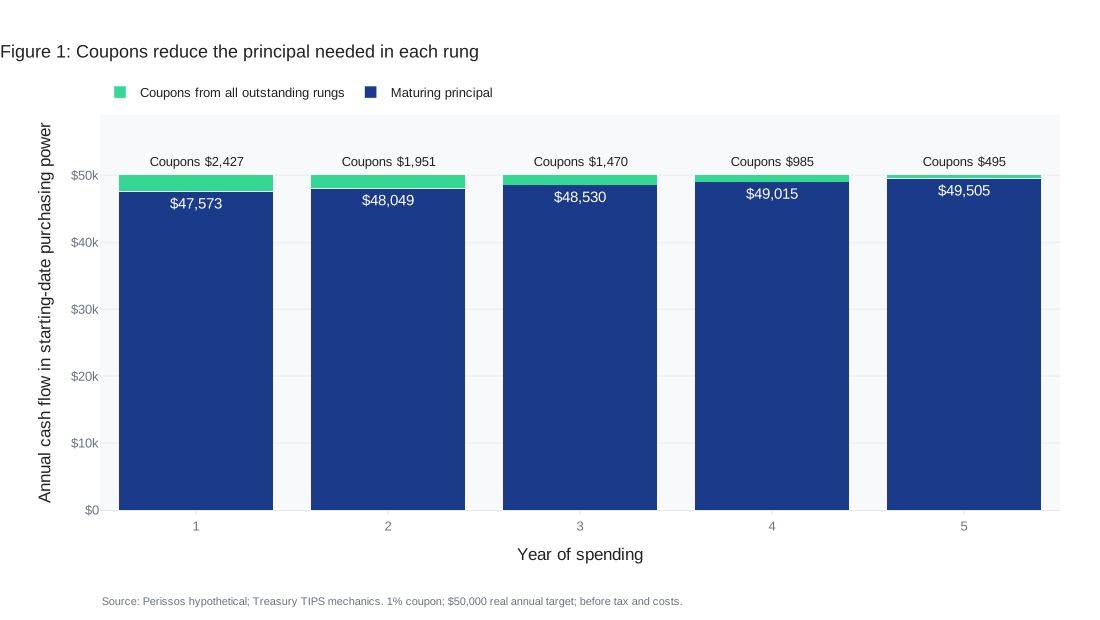
Work backward. In year five, only the final bond remains. About $49,505 of principal plus $495 of annual coupons provides $50,000. Year four also receives coupons from the year-five bond, so its own principal requirement is smaller. Continue backward across the ladder instead of buying $50,000 of principal for every year and overlooking the coupon income.
Figure 1 shows the resulting annual cash flows. Year one receives about $47,573 of principal and $2,427 of coupons from all outstanding rungs. Year three receives about $48,530 of principal and $1,470 of coupons. Every year's combined payment is $50,000 in the model's real units, with rounding to the nearest dollar.
These are hypothetical cash-flow amounts, not a list of actual bonds or their market prices. They illustrate why later maturities influence earlier funding needs. An executable schedule must use each security's actual coupon, index ratio, payment dates, price, and available purchase increments. Half-year receipts also need a spending plan; an annual total alone does not guarantee that money arrives before each bill.
Turn the schedule into a purchase plan
Create a dated cash-flow worksheet that identifies every security, its original face amount, adjusted principal, coupon dates, maturity date, and total purchase cost. Existing securities can be purchased in the secondary market, which may be necessary when filling nearer maturities; Treasury's new-issue terms do not supply a fresh one-year TIPS at auction.1,6
For each year, add the coupons from all bonds still outstanding to the principal that matures. Compare the sum with that year's target. Then resolve shortfalls and excess cash. A missing maturity date may require a cash reserve or another security with different inflation exposure; disclose that compromise rather than describing the schedule as a perfect match.
Use actual settlement costs when judging affordability. A quoted price alone is not a complete funding requirement when accrued interest and the inflation adjustment enter settlement. Compare available real yields and execution costs, and retain the worksheet used to approve the trade. A real yield can be negative; a positive coupon does not by itself establish a positive inflation-adjusted investment return.1,5
Choose the account with the tax bill in mind
In a taxable account, increases in inflation-adjusted principal generally create original issue discount income for federal tax purposes during the year, even though that principal has not yet been paid in cash. Basis increases as the income is recognized. Coupon interest is also reportable, and deflation adjustments have specific rules.7 A ladder built to fund spending can therefore require a separate reserve for taxes along the way.
Treasury interest and TIPS inflation adjustments are exempt from state and local income taxes.6 That treatment should not be extended automatically to every gain from selling a security or to distributions from a retirement account. Inside a traditional IRA, annual investment earnings are generally deferred, but taxable distributions follow IRA rules. Qualified Roth IRA withdrawals receive different treatment.8
Ask the CPA to compare account locations using the household's expected tax position. Avoid treating $50,000 of pretax ladder receipts as $50,000 available to spend after tax. For a retiree subject to required distributions, coordinate the IRA's cash calendar with those obligations. The account decision can change the amount that needs to be purchased to support the same living expenses.
Know which risks remain
TIPS can decline in market value before maturity. The pricing relationship means that a rise in required real yields lowers the present value of the remaining real cash flows, all else equal. An early sale can therefore realize a loss even while principal is being adjusted for inflation.3,5 A maturity-based plan is useful only if the household can actually hold the relevant bonds until the spending dates.
A conventional TIPS fund also differs from an individual-bond ladder. Its portfolio and share price change over time; the fund does not generally promise a specified principal payment on your chosen retirement spending date. Bond funds can lose value as interest rates change.9 The appropriate structure depends on whether the objective is a dated payment schedule or ongoing portfolio exposure.
Finally, a finite ladder ends. It cannot provide lifetime payments simply because it contains government securities. Families comparing a ladder with pension income should evaluate survivor provisions and longevity protection as well as cash amounts; our memo on pension lump sums versus monthly annuities develops those tradeoffs. A ladder can be a poor fit for highly uncertain near-term spending, a need for frequent sales, or a plan that cannot fund the years after it expires.
Approve the cash-flow schedule before the trades
Review the proposed schedule with the investment adviser and CPA, including purchase cost, taxes, cash timing, and the funding plan after the final maturity. Stress-test expenses rising faster than CPI and an unexpected need to sell. Once implemented, reconcile actual payments annually and direct maturities toward their intended spending purpose. That operating discipline gives the ladder a defined role in retirement and makes its limits visible before the money is committed.
All my best,
Brandon VanLandingham, CFA, CMT, CFP
Founder / CIO
Citations
- TreasuryDirect, Treasury Inflation-Protected Securities.
- TreasuryDirect, TIPS/CPI Data.
- Treasury, Uniform Offering Circular, 31 CFR Part 356, Appendix C, inflation-protected securities investment considerations.
- Bureau of Labor Statistics, Consumer Price Index Frequently Asked Questions.
- TreasuryDirect, Understanding Pricing and Interest Rates.
- TreasuryDirect, Comparison of TIPS and Series I Savings Bonds.
- IRS, Publication 1212, Inflation-Indexed Debt Instruments.
- IRS, Publication 590-B, Distributions from Individual Retirement Arrangements.
- SEC Investor.gov, Bond Funds and Income Funds.
Important Disclosures
This piece is educational. It is not legal, tax, or accounting advice and is not a recommendation to take or refrain from any specific action. Tax law is fact-specific and changes regularly. Please coordinate any decisions discussed here with your attorney, your CPA, and Perissos before acting.
Perissos Private Wealth Management is a Registered Investment Adviser ("RIA"). Registration as an investment adviser does not imply a certain level of skill or training, and the content of this communication has not been approved or verified by the United States Securities and Exchange Commission or by any state securities authority. Perissos Private Wealth Management renders individualized investment advice to persons in a particular state only after complying with the state's regulatory requirements, or pursuant to an applicable state exemption or exclusion. All investments carry risk, and no investment strategy can guarantee a profit or protect from loss of capital. Past performance is not indicative of future results.
The information contained in this newsletter is intended to provide general information about market themes. It is not intended to offer investment advice. Investment advice will only be given after a client engages our services by executing the appropriate investment services agreement. Information regarding investment products and services is given solely to provide education regarding our investment philosophy and our strategies. You should not rely on any information provided in making investment decisions.
Market data, articles and other content in this material are based on generally available information and are believed to be reliable. Perissos Private Wealth Management does not guarantee the accuracy of the information contained in this material.
Perissos Private Wealth Management will provide all prospective clients with a copy of our current Form ADV, Part 2A (Disclosure Brochure), Part 2B (Supplemental Brochures), and Part 3 (Client Relationship Summary) prior to commencing an advisory relationship. You can also view these documents at any time at adviserinfo.sec.gov or by contacting us requesting a copy.
Explore topics
Share this article
Last reviewed: September 18, 2026
Frequently Asked Questions
- What is a TIPS ladder in retirement planning?
- A TIPS ladder is a series of Treasury Inflation-Protected Securities with different maturity dates designed to provide inflation-adjusted cash flows for planned retirement expenses. It can help cover defined spending years, but it does not solve every tax,...
- Why do coupons matter when building a TIPS ladder?
- Coupons from later-maturing TIPS can help fund earlier-year spending, so buying the same principal amount for every year may overstate how much is needed. A proper schedule counts both coupon payments and maturing principal on the dates cash is required.
- Are TIPS better held in taxable or retirement accounts?
- In taxable accounts, inflation adjustments to TIPS principal generally create federal taxable income before the principal is paid out, which can require separate tax liquidity. In IRAs, annual investment earnings are generally deferred, but future distribut...