

Written and reviewed by Brandon VanLandingham, CFA, CMT, CFP® · Last updated August 29, 2026
Cash deserves more attention than it usually gets.
For high-net-worth families, the cash reserve may include operating cash, tax reserves, charitable reserves, home-project money, business-sale proceeds, or a bridge fund for retirement income. The question is not simply, "Where is the highest yield today?" The better question is, "Which cash tool best matches the timing, tax treatment, liquidity need, and administrative complexity of this money?"
Two common options are Treasury bills and money market funds. Both can be useful. They are not interchangeable.
What Treasury Bills Do Well
TreasuryDirect says Treasury bills are sold in terms ranging from four weeks to 52 weeks. Bills are sold at a discount or at par, and the investor receives face value at maturity. The interest is the difference between the purchase price and the face value, and interest is paid when the bill matures.1
That structure is simple. If a household knows it needs cash in 13 weeks, 26 weeks, or 52 weeks, a T-bill can be matched to that date. The investor can usually hold the bill to maturity and let the cash arrive on schedule.
TreasuryDirect also notes that Treasury bill interest is subject to federal tax but not state or local tax.1 That state-tax treatment can matter for clients in higher-tax states, though the after-tax comparison depends on the client's actual state, bracket, account type, and whether an alternative cash product also holds Treasury obligations.
The main drawback is administration. A T-bill ladder has maturity dates, reinvestment decisions, settlement mechanics, and potentially less same-day flexibility than a sweep or money market fund. A bill can be sold before maturity, but then price and liquidity matter.
What Money Market Funds Do Well
Investor.gov describes money market funds as mutual funds that invest in liquid, short-term debt securities, cash, and cash equivalents. They generally fall into government, tax-exempt, and prime categories.2 Many investors use them to store cash or as an alternative to bank savings vehicles, and money market funds are generally redeemable on demand on any business day at net asset value.2
That makes money market funds operationally convenient. They can be useful for cash that may be needed quickly, cash that is moving in and out of accounts, or cash that needs to sit in a brokerage account while other planning work is underway.
The tradeoff is that a money market fund is still an investment product. Investor.gov notes that money market fund shares are not FDIC-guaranteed like bank accounts, fees vary by fund, and stable net asset value funds can still face rare situations where they reprice below $1.00 per share.2 Institutional prime and institutional tax-exempt money market funds use a floating NAV.2
In plain English: money market funds are useful cash tools, but they are not the same thing as a bank deposit and not the same thing as owning an individual Treasury bill to maturity.
The Current Rate Context
The rate comparison changes constantly, so the decision should use current data.
On August 21, 2026, Treasury's daily bill-rate table showed coupon-equivalent yields of 3.71% for 4-week bills, 3.81% for 13-week bills, 3.92% for 26-week bills, and 4.02% for 52-week bills.3 Figure 1 translates those quoted yields into rough annualized income on a hypothetical $500,000 cash reserve.
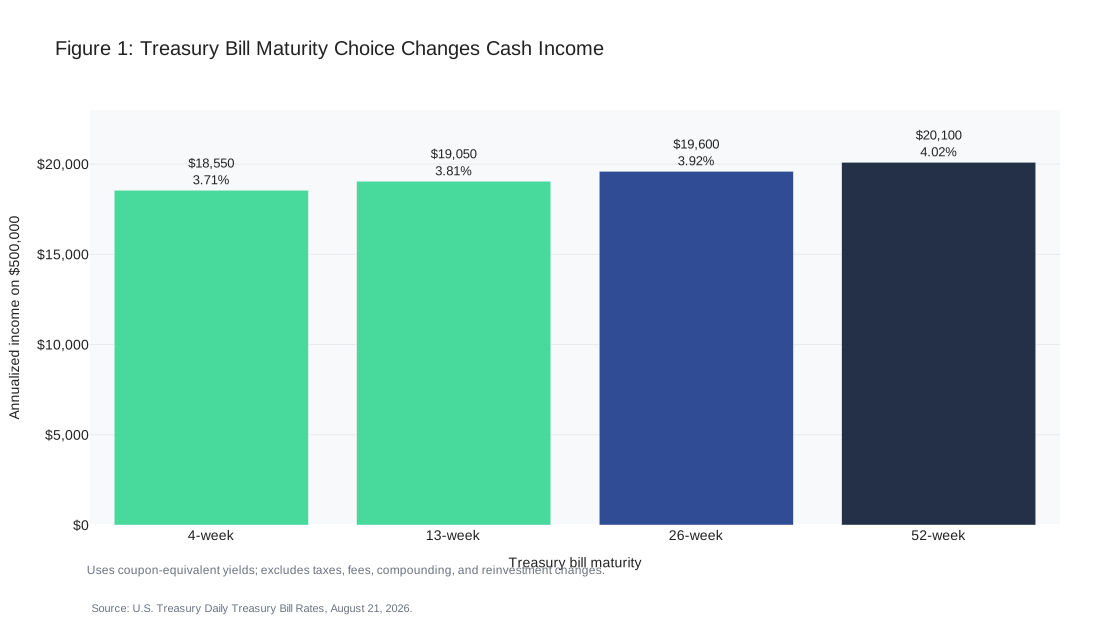
This is not a forecast and not a recommendation to buy any specific bill. It simply shows why the maturity decision matters. The highest quoted bill yield on a given day may not be the best fit if the money is needed sooner, if rates change, or if the administrative burden is not worth the incremental income.
The Decision Framework
I usually start with the job of the cash.
If the money is true operating cash, convenience may matter more than squeezing out every basis point. A high-quality government money market fund, insured bank deposit, or brokerage sweep may be more practical.
If the money has a known date, T-bills become more interesting. Examples include a quarterly estimated tax payment, a home renovation payment due in six months, a known charitable grant, or a retirement paycheck reserve that can be laddered.
If the money is long-term portfolio capital, it probably should not be called a cash reserve at all. Holding too much in cash can create reinvestment risk and inflation risk. The SEC's asset allocation guidance emphasizes that the right mix of stocks, bonds, and cash depends on time horizon and risk tolerance.4 A cash reserve should be sized around its purpose, not around today's yield.
Who May Prefer Each Tool
T-bills may fit clients who value date-specific maturity, state-tax exemption on Treasury interest, and direct exposure to U.S. Treasury obligations. They may be especially useful for known spending windows or laddered reserves.
Money market funds may fit clients who value daily liquidity, simplicity, sweep-account convenience, and less need to manage individual maturities. They can be a better operational fit for variable cash needs.
Neither tool is ideal for every dollar. A large household may use both: money market funds for the checking-account-like reserve and T-bills for known liabilities.
The Perissos View
The right cash structure should be boring, documented, and connected to the rest of the plan.
For each cash reserve, I want to know the amount, purpose, time horizon, tax treatment, account location, liquidity requirement, and reinvestment rule. I also want to know what should happen when the reserve becomes too large or too small.
This should be coordinated with the client's CPA when estimated taxes, state-tax treatment, trust accounting, business cash, or charitable timing is involved. Cash looks simple, but the wrong cash decision can still create tax drag, missed liquidity, or unnecessary administrative work.
Closing
The takeaway is not that Treasury bills are better than money market funds, or that money market funds are better than Treasury bills. The takeaway is that cash has jobs.
Use money market funds when convenience and daily access are the priority. Use T-bills when maturity matching and Treasury-specific tax treatment are important. Use both when the plan calls for both. The cash reserve should support the plan, not become a pile of money with no rules.
All my best,
Brandon VanLandingham, CFA, CMT, CFP
Founder / CIO
Citations
- TreasuryDirect, "Treasury Bills," retrieved August 22, 2026, https://www.treasurydirect.gov/marketable-securities/treasury-bills/.
- SEC Investor.gov, "Money Market Funds," retrieved August 22, 2026, https://www.investor.gov/introduction-investing/investing-basics/investment-products/mutual-funds-and-exchange-traded-5.
- U.S. Department of the Treasury, "Daily Treasury Bill Rates," August 21, 2026 data, retrieved August 22, 2026, https://home.treasury.gov/resource-center/data-chart-center/interest-rates/TextView?type=daily_treasury_bill_rates&field_tdr_date_value=2026.
- SEC Investor.gov, "Asset Allocation and Diversification," retrieved August 22, 2026, https://www.investor.gov/introduction-investing/getting-started/asset-allocation.
Important Disclosures
This piece is educational. It is not legal, tax, or accounting advice and is not a recommendation to take or refrain from any specific action. Tax law is fact-specific and changes regularly. Please coordinate any decisions discussed here with your attorney, your CPA, and Perissos before acting.
Perissos Private Wealth Management is a Registered Investment Adviser ("RIA"). Registration as an investment adviser does not imply a certain level of skill or training, and the content of this communication has not been approved or verified by the United States Securities and Exchange Commission or by any state securities authority. Perissos Private Wealth Management renders individualized investment advice to persons in a particular state only after complying with the state's regulatory requirements, or pursuant to an applicable state exemption or exclusion. All investments carry risk, and no investment strategy can guarantee a profit or protect from loss of capital. Past performance is not indicative of future results.
The information contained in this newsletter is intended to provide general information about market themes. It is not intended to offer investment advice. Investment advice will only be given after a client engages our services by executing the appropriate investment services agreement. Information regarding investment products and services is given solely to provide education regarding our investment philosophy and our strategies. You should not rely on any information provided in making investment decisions.
Market data, articles and other content in this material are based on generally available information and are believed to be reliable. Perissos Private Wealth Management does not guarantee the accuracy of the information contained in this material.
Perissos Private Wealth Management will provide all prospective clients with a copy of our current Form ADV, Part 2A (Disclosure Brochure), Part 2B (Supplemental Brochures), and Part 3 (Client Relationship Summary) prior to commencing an advisory relationship. You can also view these documents at any time at adviserinfo.sec.gov or by contacting us requesting a copy.
Sources
Explore topics
Share this article
Frequently Asked Questions
- Are Treasury bills exempt from state income taxes?
- Yes, interest earned on U.S. Treasury bills is generally subject to federal income tax but is exempt from state and local taxes, which may benefit investors in high-tax jurisdictions.
- How do money market funds differ from bank deposits?
- Money market funds are investment products that seek to maintain a stable net asset value, but they are not FDIC-insured and involve different risks than traditional bank savings accounts.
- When should an investor choose a T-bill over a money market fund?
- Treasury bills are often preferred when matching a specific future spending date or seeking state tax exemptions, whereas money market funds offer greater operational convenience and daily liquidity.