

Written and reviewed by Brandon VanLandingham, CFA, CMT, CFP® · Last updated October 16, 2026
Private Equity Allocations for $5M+ Households
Set the liquidity budget before choosing the fund
October 16, 2026
A household can have more than $5 million and still have very little room for private equity. The reason is simple: net worth does not tell us which dollars can remain unavailable while the family pays taxes, supports retirement spending, or helps children. I would start with those obligations before discussing an allocation percentage.
Private equity can make sense when a family has a long investment horizon, sufficient liquid resources, and a clear reason to own businesses through a private manager. It does not become necessary when wealth crosses a particular threshold. The planning question is whether a specific investment improves the household's opportunity set enough to justify its cost, complexity, and loss of flexibility.
Understand what you are committing to
A conventional private-equity fund pools investor capital to acquire interests in businesses. Strategies can involve control acquisitions or minority investments. The SEC's private-equity overview describes long holding periods and restrictions on withdrawals. These are investments to evaluate over the life of the fund, with no assurance of a profitable exit.1
In a drawdown structure, you commit an amount and the manager requests portions over time. The SEC's explanation of private-fund capital commitments distinguishes that process from contributing all capital at inception. An unfunded commitment is therefore a future funding obligation, even though it has not yet become an investment on your account statement.2
The offering documents determine the mechanics. Ask counsel to explain the investment period, extension rights, transfer restrictions, default provisions, and any ability to recall distributions. Obtain the actual funding notice requirements. A proposed schedule from the manager should inform planning, but I would not treat it as a promise that calls cannot arrive sooner.
Also distinguish the legal eligibility test from suitability. The SEC's accredited-investor bulletin explains that one individual qualification route requires net worth exceeding $1 million, excluding the primary residence, with additional rules for related debt. Other routes exist, and some funds impose additional eligibility requirements. Passing an access test does not establish that an investment fits your spending needs.3
Size the obligation against spendable assets
Consider a hypothetical household with $5 million of investable assets, excluding its home and business. Assume $4.5 million is liquid, $500,000 is an existing private-equity investment, and another $500,000 is committed but uncalled. The family also reserves $600,000 for identified spending and taxes. These are selected assumptions, not a recommended allocation or an actual client case.
Figure 1 shows what happens under an intentionally simple liquidity stress. Starting with $4.5 million liquid, reserve the $600,000 first. If the entire liquid pool then loses 20%, it falls to $3.6 million. Funding the $500,000 call leaves $3.1 million liquid; preserving the spending reserve leaves $2.5 million available for other decisions. The initial amount available after reserving both spending and the commitment was $3.4 million. This is a capacity test, not a forecast, and it excludes returns after the shock, taxes on asset sales, and changes in the private holding's value.
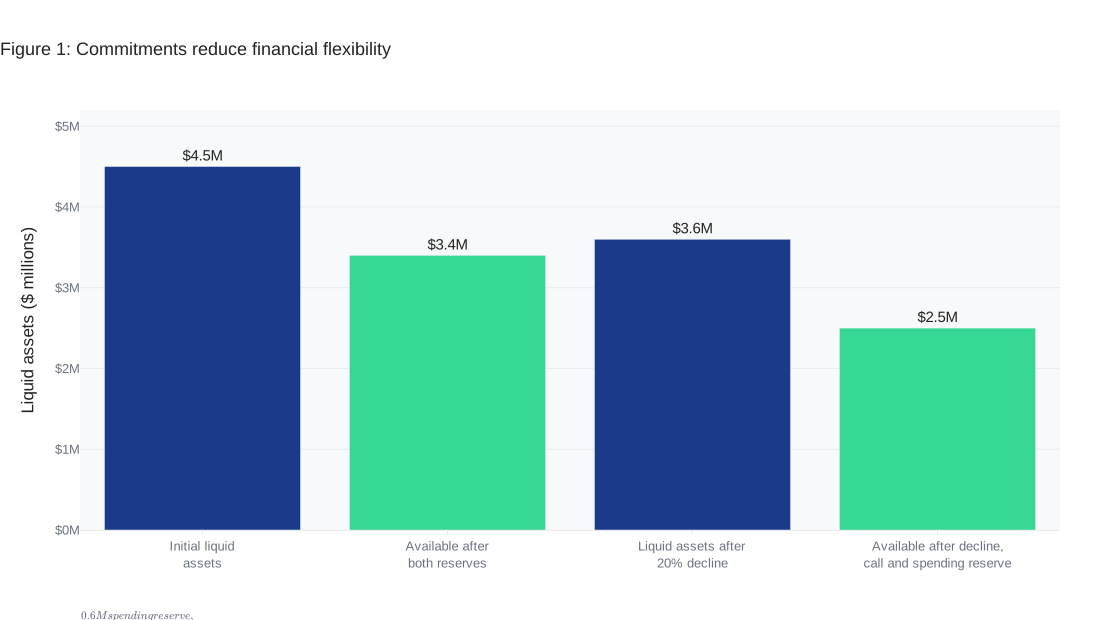
The distinction matters: a call converts liquid money into a private investment; it is not automatically an economic loss. But it reduces flexibility at exactly the time the family may prefer to avoid selling public assets. A household with the same net worth but a large operating business and modest brokerage assets could face a very different constraint.
Our discussion of now, soon, and later money provides a useful starting point for assigning spending obligations. Keep the commitment reserve separate from funds already promised to another purpose. A reserve cannot simultaneously pay a capital call and fund a home purchase.
Look through the label to the business risk
The SEC describes private equity's use of leverage and active involvement in portfolio companies.2 For planning purposes, I would ask what economic exposures the household already owns. An executive with employer stock and a business owner awaiting a sale may already depend heavily on corporate earnings and favorable financing conditions. Adding private companies does not automatically balance those exposures.
Review strategy, geography, industry, company size, and debt separately. Ask whether different funds actually diversify the underlying businesses or simply provide several managers with similar exposures. Also ask how a weak exit environment would affect the expected timing of distributions. Model a period with no proceeds arriving, rather than assuming one fund's exits will pay another fund's calls.
Reported values deserve a separate discussion from available cash. I would request the valuation policy, independent audit arrangements, and a reconciliation between realized proceeds and remaining estimated value. A statement that changes infrequently does not, by itself, establish that the businesses have low economic risk. This distinction complements our broader discussion of the limits of portfolio models.
Make the manager explain the economics
The SEC identifies fees, expenses, and conflicts as central diligence issues.1 Request a dollar-based explanation of the full fee arrangement: which base is charged, which expenses flow through, how incentive compensation is calculated, and how affiliated transactions are handled. Do not assume that a headline management fee captures the total cost.
I would also separate three questions when reviewing performance: how much cash investors contributed, how much cash they received, and how much value remains unsold. Ask for results after fees and for the cash-flow dates supporting any annualized return. Compare those results with a feasible liquid alternative using the same timing. A persuasive headline should survive that examination without relying on selective examples.
Manager evaluation should extend to decision-making continuity. Who approved the investments responsible for the record? Who remains responsible now? What happens if a key decision-maker leaves? Read the governing provisions with counsel and record the conclusions. The objective is to understand the partnership you are entering before your ability to leave becomes limited.
Plan the tax work and the exit from ownership
For a fund taxed as a partnership, the IRS explains partnership pass-through reporting: income and losses pass to partners, and partners receive Schedule K-1 information. Cash distributions and taxable allocations are different concepts; the tax projection needs the actual allocation information, not just deposits in a bank account.4
Before subscribing, have your CPA review expected reporting, possible additional state filings, estimated-tax funding, and the proposed account or entity. Ask the estate attorney whether the intended owner is consistent with transfer restrictions and succession documents. Designate someone who can receive notices and fund obligations if the primary decision-maker becomes incapacitated. These administrative details belong in the allocation decision because someone must maintain them for the investment's duration.
Decide what would make you decline
Private equity may fit a family whose essential spending and foreseeable obligations are covered independently, whose investment horizon tolerates delayed proceeds, and whose diligence identifies a credible strategy at acceptable terms. It is a poor fit when success requires distributions to arrive on schedule, when the family needs a near-term exit, or when the commitment would force dependence on borrowing during stress.
Before signing, document the maximum total private exposure, the unfunded-commitment reserve, the stress assumptions, and the funding source for the next call. Review existing commitments before adding a new vintage. If those steps leave little room, reduce the proposed commitment or decline it. The ability to invest privately is an option; maintaining control of the household's cash flow is an obligation.
All my best,
Brandon VanLandingham, CFA, CMT, CFP
Founder / CIO
Citations
- SEC Investor.gov, Private Equity Funds. Retrieved October 16, 2026.
- SEC, Starting a Private Fund. Retrieved October 16, 2026.
- SEC Investor.gov, Accredited Investors — Updated Investor Bulletin. Retrieved October 16, 2026.
- IRS, Partnerships. Retrieved October 16, 2026.
Important Disclosures
This piece is educational. It is not legal, tax, or accounting advice and is not a recommendation to take or refrain from any specific action. Tax law is fact-specific and changes regularly. Please coordinate any decisions discussed here with your attorney, your CPA, and Perissos before acting.
Perissos Private Wealth Management is a Registered Investment Adviser ("RIA"). Registration as an investment adviser does not imply a certain level of skill or training, and the content of this communication has not been approved or verified by the United States Securities and Exchange Commission or by any state securities authority. Perissos Private Wealth Management renders individualized investment advice to persons in a particular state only after complying with the state's regulatory requirements, or pursuant to an applicable state exemption or exclusion. All investments carry risk, and no investment strategy can guarantee a profit or protect from loss of capital. Past performance is not indicative of future results.
The information contained in this newsletter is intended to provide general information about market themes. It is not intended to offer investment advice. Investment advice will only be given after a client engages our services by executing the appropriate investment services agreement. Information regarding investment products and services is given solely to provide education regarding our investment philosophy and our strategies. You should not rely on any information provided in making investment decisions.
Market data, articles and other content in this material are based on generally available information and are believed to be reliable. Perissos Private Wealth Management does not guarantee the accuracy of the information contained in this material.
Perissos Private Wealth Management will provide all prospective clients with a copy of our current Form ADV, Part 2A (Disclosure Brochure), Part 2B (Supplemental Brochures), and Part 3 (Client Relationship Summary) prior to commencing an advisory relationship. You can also view these documents at any time at adviserinfo.sec.gov or by contacting us requesting a copy.
Explore topics
Share this article
Last reviewed: October 16, 2026
Frequently Asked Questions
- Does having $5 million automatically justify a private equity allocation?
- No. The key issue is whether liquid assets can cover spending, taxes, and capital calls over a long holding period, not whether net worth crosses a threshold.
- Why do unfunded commitments matter in private equity planning?
- An unfunded commitment is a future obligation to supply capital when the manager issues a call. It may not appear as an investment yet, but it can still reduce a household’s liquidity flexibility.
- What is a practical first step before selecting a private equity fund?
- Set a liquidity budget that separates spending reserves, tax needs, and committed capital from assets available for new investments. That helps test whether the household can withstand market stress and delayed distributions.