

Written and reviewed by Brandon VanLandingham, CFA, CMT, CFP® · Last updated October 15, 2026
Bond Yields Explained: Coupon, Yield-to-Maturity, and Duration
Reading a bond quote through the lens of your spending plan
October 15, 2026
A bond can pay a 4% coupon, offer a yield above 5%, and still lose money if you sell it next year. Those statements can all be true. They describe different parts of the investment: the cash the issuer promises, the return implied by your purchase price, and the price someone else might pay before maturity. Understanding the distinction matters when bonds are supposed to fund retirement spending rather than create another source of uncertainty.
I start with the obligation the money must meet. A bond intended to pay a known bill has a different assignment from a bond held for long-term diversification. The highest quoted yield is not automatically the best choice for either assignment. We need to connect the quote to the cash flows, the risks, and the date the household expects to use the money.
Coupon tells you the promised cash payment
For a conventional fixed-rate bond, the coupon rate applies to face value. An assumed $100,000 face-value bond with a 4% coupon pays $4,000 annually, commonly divided into two payments. Paying more or less than $100,000 for that bond does not change its contractual coupon dollars. Repayment depends on the issuer meeting its obligations, and any call provision can change how long the investment lasts.1,2
Suppose the same bond costs $95,000 before accrued interest and transaction costs. Its current yield is $4,000 divided by $95,000, or approximately 4.21%. That ratio describes annual coupon income relative to price. It leaves out the $5,000 difference between purchase price and face value, the timing of repayment, and what happens to interest received along the way.1
That omission matters for a spending plan. A household cannot spend an anticipated maturity gain every month unless it draws from another source or sells assets. Conversely, a high-coupon bond purchased above face value may deliver generous cash payments while part of its purchase premium gradually disappears as maturity approaches. Treating all coupon income as economically spendable can overstate what the portfolio earns.
Yield to maturity incorporates the purchase price
FINRA explains yield to maturity as the discount rate that equates a bond's scheduled payments to its price. It combines coupon cash flows with repayment at maturity. It assumes those contractual payments arrive as scheduled; taxes and trading costs need separate attention. The figure is an internal rate of return, not a promise about the value of your account at some earlier date.1
For an illustration, assume our $100,000 face-value bond has five years remaining, pays $2,000 every six months, and costs $95,000 exactly on a coupon date. Solving for the discount rate gives a yield to maturity of approximately 5.15%, quoted on a semiannual bond-equivalent basis. The 4% coupon, 4.21% current yield, and 5.15% yield to maturity answer different questions. These are hypothetical calculations, not current market quotes.
The distinction becomes even clearer if the household spends every coupon. The purchase still has a calculable internal rate of return, but the household will not accumulate the same terminal wealth as an investor who reinvests every payment at that yield. Future reinvestment rates are unknown. If the issuer defaults or the investor sells early, the realized outcome can depart substantially from the original quote.1,2
Duration describes sensitivity before maturity
Maturity is a date. Duration measures how sensitive a bond's price is to a change in yield. For a small yield change, modified duration provides a first approximation: percentage price change is roughly negative duration multiplied by the yield change. A duration of seven implies about a 7% price decline for a one-percentage-point yield increase, before accounting for curvature and other influences.3
The regulator's explanation of duration and interest-rate risk also distinguishes measures used for bonds with changing cash flows. Callable securities require particular care because their expected repayment timing can shift when rates move. Duration is useful, but it is not a complete risk score and does not measure the chance of default.3
Figure 1 shows exact repricing of two hypothetical bonds when yields change immediately. Both begin at $100,000 with 4% coupons and 4% yields, pay semiannually, and have no call option or default. If yields rise to 5%, the two-year bond falls to approximately $98,119, while the ten-year bond falls to approximately $92,205. Neither result includes accrued income, taxes, fees, or elapsed time. The longer commitment produces a much larger price response.
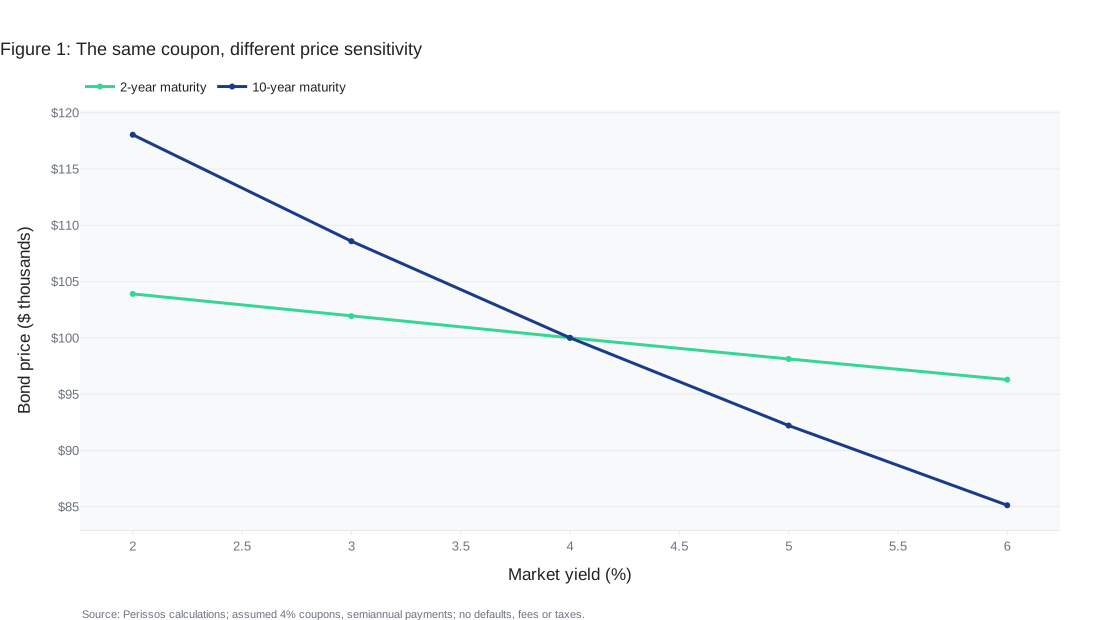
This is why I would hesitate to fund a near-term purchase with a long-duration bond simply because its quoted yield is attractive. The investor may be able to hold to maturity in theory, yet need to sell in practice. Our discussion of matching bond maturities to retirement cash needs develops that planning connection.
A higher yield can pay you for a risk you do not want
Credit risk, liquidity risk, and call risk deserve separate review. The SEC's corporate-bond guide explains why promised payments and actual investor outcomes can differ. A credit rating is useful evidence, but the borrower, financial condition, repayment priority, and ability to sell remain relevant. A bond is not cash merely because its interest payment is fixed.2
For callable bonds, compare yield to maturity with yields to applicable call dates. Yield to worst identifies the lowest relevant contractual yield under the quoted redemption assumptions. It does not describe the worst imaginable loss: default and an unfavorable early sale can produce worse outcomes. A premium purchase is especially worth examining because an early call can return less principal than the investor paid.1,2
Bond funds add another layer. An ordinary ongoing fund owns a changing portfolio; buying shares does not give the investor a single contractual maturity date for the entire holding. Its quoted income or portfolio yield should not be mistaken for a guaranteed total return. The SEC notes that even government-bond funds can lose money when interest rates change.4
Put the quote into a written purchase decision
Before committing money, identify the spending date, maximum tolerable price fluctuation, and account in which the bond will sit. Then compare securities with similar maturity, credit quality, call terms, and liquidity. Ask for the all-in purchase price, accrued interest, coupon dollars, yield to maturity, yield to worst where applicable, and duration. A favorable number has limited meaning without the assumptions beside it.
For emergency reserves or a purchase that cannot be postponed, our comparison of Treasury bills and money market funds is a more useful starting point than reaching for a longer maturity. For longer-term money, a household may reasonably accept more duration, provided the cash reserve and portfolio design make that commitment workable.
Finally, coordinate the after-tax comparison with your CPA when tax treatment materially affects the choice. We should document why the selected bond fits the plan, what would cause us to sell it, and which cash flows the household can actually spend. That written decision is more durable than buying whichever security happens to display the largest yield today.
All my best,
Brandon VanLandingham, CFA, CMT, CFP
Founder / CIO
Citations
- FINRA, Understanding Bond Yield and Return. Retrieved October 3, 2026.
- SEC Investor.gov, What Are Corporate Bonds?. Retrieved October 3, 2026.
- FINRA, Duration—What an Interest Rate Hike Could Do to Your Bond Portfolio. Retrieved October 3, 2026.
- SEC Investor.gov, Bond Funds and Income Funds. Retrieved October 3, 2026.
Important Disclosures
This piece is educational. It is not legal, tax, or accounting advice and is not a recommendation to take or refrain from any specific action. Tax law is fact-specific and changes regularly. Please coordinate any decisions discussed here with your attorney, your CPA, and Perissos before acting.
Perissos Private Wealth Management is a Registered Investment Adviser ("RIA"). Registration as an investment adviser does not imply a certain level of skill or training, and the content of this communication has not been approved or verified by the United States Securities and Exchange Commission or by any state securities authority. Perissos Private Wealth Management renders individualized investment advice to persons in a particular state only after complying with the state's regulatory requirements, or pursuant to an applicable state exemption or exclusion. All investments carry risk, and no investment strategy can guarantee a profit or protect from loss of capital. Past performance is not indicative of future results.
The information contained in this newsletter is intended to provide general information about market themes. It is not intended to offer investment advice. Investment advice will only be given after a client engages our services by executing the appropriate investment services agreement. Information regarding investment products and services is given solely to provide education regarding our investment philosophy and our strategies. You should not rely on any information provided in making investment decisions.
Market data, articles and other content in this material are based on generally available information and are believed to be reliable. Perissos Private Wealth Management does not guarantee the accuracy of the information contained in this material.
Perissos Private Wealth Management will provide all prospective clients with a copy of our current Form ADV, Part 2A (Disclosure Brochure), Part 2B (Supplemental Brochures), and Part 3 (Client Relationship Summary) prior to commencing an advisory relationship. You can also view these documents at any time at adviserinfo.sec.gov or by contacting us requesting a copy.
Explore topics
Share this article
Last reviewed: October 10, 2026
Frequently Asked Questions
- What is the difference between a bond’s coupon and its yield to maturity?
- Coupon is the bond’s contractual interest payment based on face value, while yield to maturity reflects coupon payments plus the difference between purchase price and principal repaid at maturity. They answer different questions about income and return.
- Why can a bond lose value even if it keeps paying interest?
- A bond’s market price can fall when prevailing yields rise, especially for longer-duration bonds. You may still receive scheduled coupon payments, but selling before maturity can lock in a loss.
- What does duration tell an investor about a bond?
- Duration estimates how sensitive a bond’s price is to interest-rate changes before maturity. For small yield changes, a duration of 7 suggests roughly a 7% price decline if yields rise by 1 percentage point.