

Written and reviewed by Brandon VanLandingham, CFA, CMT, CFP® · Last updated October 14, 2026
Municipal Bonds for Oklahoma Residents: Are They Still Worth It?
Comparing after-tax income without overlooking credit and concentration
October 14, 2026
Municipal bonds can still earn a place in an Oklahoma investor's taxable portfolio. Whether they belong in yours depends on the income you keep after taxes, the risks you accept, and the alternatives available for the same spending horizon. A tax exemption is valuable only when it improves that overall comparison. It cannot rescue an unattractive price or make a weak borrower dependable.
For a high-income household, the appeal is straightforward: eligible municipal interest can escape federal income tax, and qualifying Oklahoma obligations can also receive state exemption. But an investor should not infer the tax treatment from the issuer's address alone. I would rather spend time verifying the security and comparing alternatives than build a portfolio around a broad promise of tax-free income.
Confirm which taxes the bond actually avoids
Interest on qualifying state and local obligations generally receives federal income-tax exemption. Not every municipal issue qualifies, and certain private-activity interest can enter the alternative minimum tax calculation. The IRS investment-income guidance also explains that market discount and capital gains can create taxable income even when the bond's coupon is exempt. “Tax-free bond” is therefore an incomplete description of the investment.1
Oklahoma adds a separate classification. The Oklahoma Tax Commission's municipal-bond guide distinguishes state obligations, eligible local obligations issued after July 1, 2001, and older issues with differing treatment. The local-obligation exemption excludes financing for nonprofit-corporation projects. It generally classifies interest from other states' municipal obligations as taxable in Oklahoma, subject to specified exceptions. Review the actual obligation and applicable guidance with your CPA; do not assume every Oklahoma-related issue qualifies.2
For 2026, Oklahoma's top individual marginal income-tax rate is 4.5%, following the legislated reduction. That is a marginal rate on additional taxable income, not the percentage every resident pays on all income. The state's legislative summary supplies the effective year and revised brackets.3
Compare what remains after tax
Consider a hypothetical Oklahoma resident whose additional taxable interest faces a 35% federal marginal rate, the full 3.8% net investment income tax, and a 4.5% Oklahoma marginal rate. Assume no incremental federal deduction for state tax, no alternative minimum tax, and no other tax interactions. These assumptions describe an illustration, not a tax-return projection or a statement that every high-net-worth household faces these rates.3,4
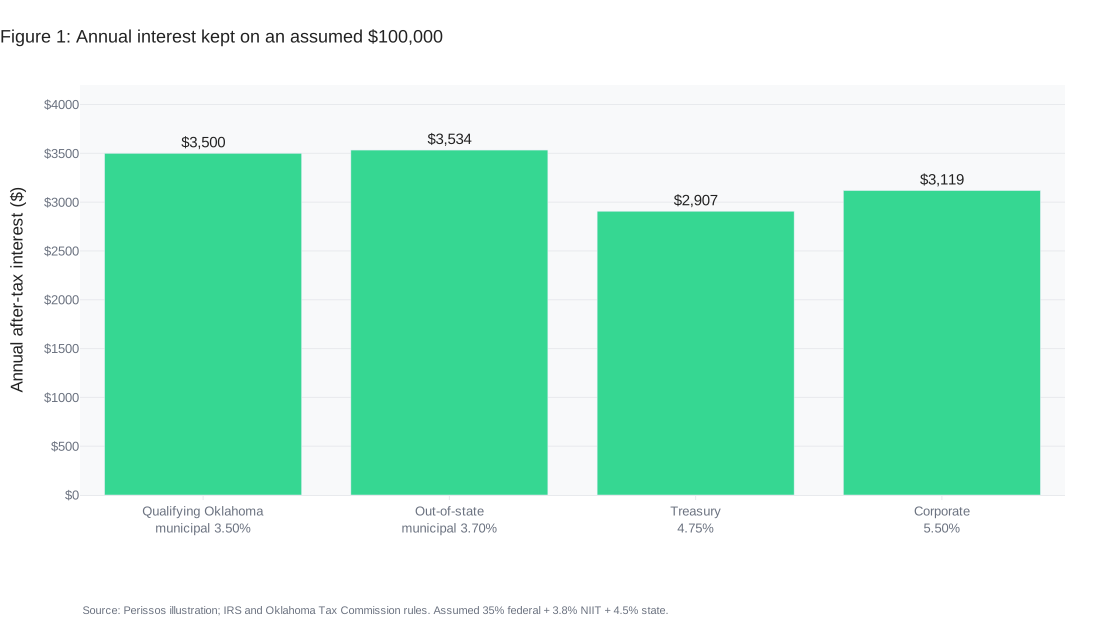
Suppose four otherwise comparable par instruments offer the following assumed annual yields: a qualifying Oklahoma municipal bond at 3.50%, an out-of-state municipal bond at 3.70%, a Treasury at 4.75%, and a fully taxable corporate bond at 5.50%. Assume the two municipal coupons are federally exempt, only the Oklahoma municipal coupon is state-exempt, and Treasury interest is state-exempt. All taxable interest in this example is subject to the assumed federal surtax. These are invented comparison inputs, not available offers.1,2,4
Figure 1 shows the resulting annual after-tax interest on $100,000. The Oklahoma municipal produces $3,500. The out-of-state municipal produces about $3,534 after state tax. The Treasury produces $2,907 after federal taxes, and the corporate bond produces about $3,119 after federal and state taxes. A larger pretax yield does not necessarily produce more spendable income. Equally, an Oklahoma tax exemption does not automatically defeat a higher-yielding national alternative.
For the fully exempt 3.50% yield, the equivalent fully taxable yield under these assumptions is 3.50% divided by one minus 43.3%, or approximately 6.17%. Against a Treasury, whose interest avoids state tax, the relevant equivalent yield is only about 5.72%. Using the same tax-equivalent yield against every type of bond would distort the decision.
Tax-equivalent yield is a filter, not a purchase instruction
The comparison above intentionally removes credit differences, call options, price premiums, transaction costs, and maturity differences. Actual bonds rarely line up so neatly. If a municipal bond has a much longer duration or weaker repayment source than the taxable alternative, its after-tax advantage may simply compensate for taking more risk. Compare yield to worst when call provisions are relevant and ask whether quoted yields include the price you will actually pay.
The SEC's municipal-bond bulletin emphasizes credit, interest-rate, and concentration risks. General-obligation debt and revenue-backed debt can depend on different repayment resources. A familiar local issuer is not automatically financially stronger than an unfamiliar one elsewhere, and a portfolio containing several bond names can still depend on closely related economic conditions.5
For an Oklahoma business owner, the household may already rely on the state through business income, commercial property, employment, or a primary residence. Concentrating the bond portfolio in the same geography deserves an explicit reason. The hypothetical national municipal in Figure 1 retains slightly more income despite its state tax. I would treat that result as permission to compare widely, rather than as a recommendation to buy either security.
The account and the rest of the tax return matter
Municipal interest is generally excluded from net investment income for the 3.8% federal surtax, while taxable interest ordinarily enters that calculation. The tax itself applies to the lesser of net investment income or the relevant excess modified adjusted gross income; it is not automatically charged on every investment dollar. Our article on what triggers the net investment income tax explains that broader interaction.4
Medicare uses a different definition of income. Social Security includes tax-exempt interest in modified adjusted gross income for income-related Medicare premiums. Moving from taxable interest to municipal interest does not simply make that income disappear from the Medicare calculation. The actual premium effect depends on the household's overall income and applicable measurement year.6
An IRA also changes the economics. If interest already grows inside a tax-deferred retirement account, the current federal income-tax exemption that supports municipal pricing may provide little additional benefit. Compare available yields and the account's distribution treatment before choosing the holding. Our discussion of building a tax-diversified retirement portfolio puts that asset-location decision into a household framework.1
Decide with a current quote and a household projection
Municipals may fit a taxable investor in a high marginal bracket who values predictable income, can hold through price fluctuations, and has sufficient diversification. They may be a poor fit for emergency reserves, a lower-bracket investor receiving little tax benefit, or a household already heavily exposed to a narrow group of issuers. The balance can change after retirement, a business sale, relocation, or a year of unusually large deductions.
Before buying, obtain the offering document, identify the repayment source and call schedule, and verify state and federal tax classifications. Have the CPA model the actual marginal treatment, including surtaxes and any state-tax deduction interaction. Then compare after-tax yields across matched maturities and risk levels. Fees and trading spreads should be visible in that comparison, especially if the expected tax advantage is small.
I would document the minimum after-tax advantage needed to justify additional credit or concentration risk, along with a limit on exposure to any issuer or related group. If the best available municipal does not clear that standard, the plan can hold another type of bond. The purpose of tax-aware investing is to improve the household's result, and that sometimes means accepting taxable income from the more suitable investment.
All my best,
Brandon VanLandingham, CFA, CMT, CFP
Founder / CIO
Citations
- IRS, Publication 550: Investment Income and Expenses, current available publication for 2025 returns; continuing bond-tax mechanics. Retrieved October 3, 2026.
- Oklahoma Tax Commission, Oklahoma Municipal Tax Exempt Bonds. Retrieved October 3, 2026.
- Oklahoma Tax Commission, Summary of 2025 Tax Legislation, HB 2764 and tax-year 2026 brackets. Retrieved October 3, 2026.
- IRS, Net Investment Income Tax Questions and Answers. Retrieved October 3, 2026.
- SEC Investor.gov, Municipal Bonds: Asset Allocation, Diversification, and Risk. Retrieved October 3, 2026.
- Social Security Administration, Medicare Premiums. Retrieved October 3, 2026.
Important Disclosures
This piece is educational. It is not legal, tax, or accounting advice and is not a recommendation to take or refrain from any specific action. Tax law is fact-specific and changes regularly. Please coordinate any decisions discussed here with your attorney, your CPA, and Perissos before acting.
Perissos Private Wealth Management is a Registered Investment Adviser ("RIA"). Registration as an investment adviser does not imply a certain level of skill or training, and the content of this communication has not been approved or verified by the United States Securities and Exchange Commission or by any state securities authority. Perissos Private Wealth Management renders individualized investment advice to persons in a particular state only after complying with the state's regulatory requirements, or pursuant to an applicable state exemption or exclusion. All investments carry risk, and no investment strategy can guarantee a profit or protect from loss of capital. Past performance is not indicative of future results.
The information contained in this newsletter is intended to provide general information about market themes. It is not intended to offer investment advice. Investment advice will only be given after a client engages our services by executing the appropriate investment services agreement. Information regarding investment products and services is given solely to provide education regarding our investment philosophy and our strategies. You should not rely on any information provided in making investment decisions.
Market data, articles and other content in this material are based on generally available information and are believed to be reliable. Perissos Private Wealth Management does not guarantee the accuracy of the information contained in this material.
Perissos Private Wealth Management will provide all prospective clients with a copy of our current Form ADV, Part 2A (Disclosure Brochure), Part 2B (Supplemental Brochures), and Part 3 (Client Relationship Summary) prior to commencing an advisory relationship. You can also view these documents at any time at adviserinfo.sec.gov or by contacting us requesting a copy.
Explore topics
Share this article
Last reviewed: October 10, 2026
Frequently Asked Questions
- Are Oklahoma municipal bonds always exempt from both federal and state income tax?
- No. Federal exemption generally applies to qualifying state and local obligations, but some private-activity bonds can affect AMT, and Oklahoma state treatment depends on the specific obligation and issuance rules.
- How should Oklahoma investors compare municipal bonds with Treasuries or corporate bonds?
- Compare after-tax income rather than headline yield alone, then evaluate credit quality, call features, maturity, and concentration risk. A higher pretax yield may still leave less spendable income after taxes.
- Do municipal bonds reduce Medicare income-related premium calculations?
- Not necessarily. Tax-exempt interest can still be included in the income measure used for Medicare IRMAA, so switching to municipal bonds does not automatically remove income from that calculation.