

Written and reviewed by Brandon VanLandingham, CFA, CMT, CFP® · Last updated August 31, 2026
A bond ladder is not exciting, and that is part of its value.
For a retiree with a $2 million or larger portfolio, the income problem is rarely solved by chasing the highest current yield. The real problem is matching future cash needs with assets that mature when the cash is needed, while keeping the rest of the portfolio invested for taxes, inflation, growth, and estate goals.
That is where a bond ladder can earn its place. It is not a magic shield against loss. It is a structure: a series of bonds or Treasury securities with staggered maturity dates. As each rung matures, the retiree can use the proceeds for spending, taxes, gifting, or reinvestment.
What A Ladder Actually Does
The SEC describes a bond as a debt security. When an investor buys a bond, the investor lends money to the issuer, and the issuer promises interest during the life of the bond and repayment of principal at maturity.1 A ladder simply organizes those maturity dates.
For example, a retiree might build a ladder with securities maturing each year for the next five years. The first rung may fund next year's portfolio paycheck. The second rung may fund year two. Later rungs give the portfolio time to recover from market volatility before more growth assets need to be sold.
That does not mean every retiree needs five years of bonds. The right ladder length depends on spending, Social Security, pension income, risk tolerance, tax bracket, portfolio size, and whether the household has large known expenses. But the purpose should be clear: the ladder exists to fund planned cash needs, not to decorate the portfolio with more fixed income.
Why It Matters More In A Larger Plan
High-net-worth retirees often have multiple accounts, taxable investments, charitable intent, concentrated stock, private investments, trusts, real estate, or business-sale proceeds. Those assets may create wealth, but they do not always create clean monthly liquidity.
A bond ladder can bring order to that complexity. It can identify which dollars are intended for near-term spending and which dollars are intended for long-term growth. It can also reduce the pressure to sell equities or illiquid assets during a bad market.
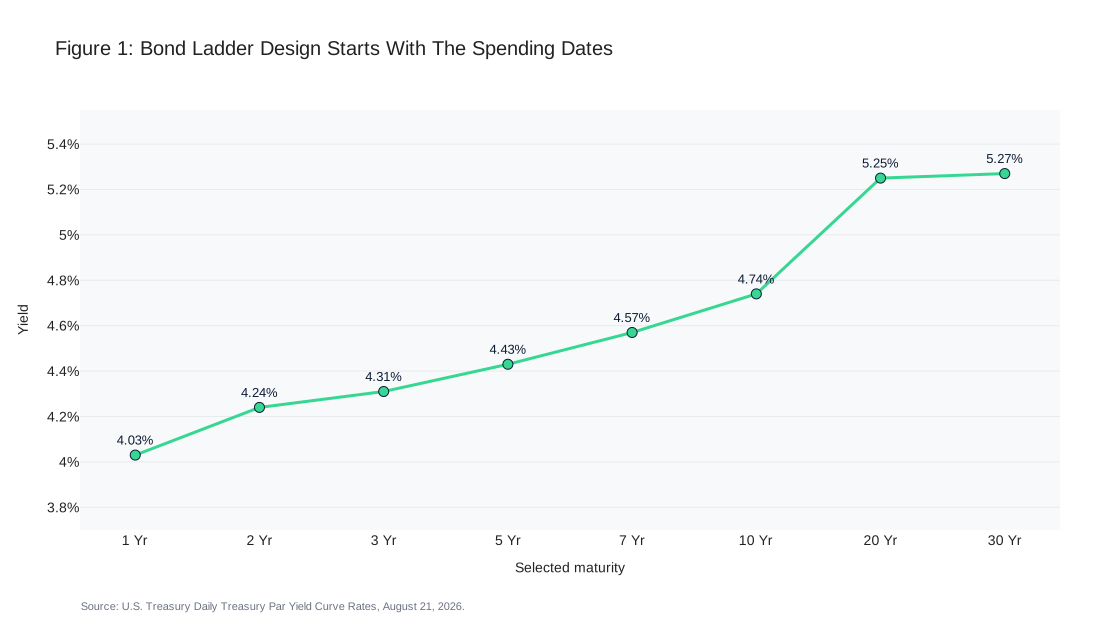
Figure 1 shows the U.S. Treasury par yield curve on August 21, 2026. The one-year Treasury rate was 4.03%, the five-year rate was 4.43%, the ten-year rate was 4.74%, and the thirty-year rate was 5.27%.2 The point of the chart is not that a retiree should buy every maturity shown. The point is that different maturities carry different yields and different risks. A ladder should be built around the plan's spending dates first, then evaluated against the available yield curve.
The Tradeoff: Certainty Of Maturity, Not Certainty Of Price
One of the most useful features of individual bonds is that a held-to-maturity structure can make future cash flow more visible. But that does not eliminate bond risk.
The SEC notes that if bonds are held to maturity, the investor receives face value plus interest, subject to the issuer's ability to pay. If sold before maturity, the bond may be worth more or less than face value, and rising rates can force an older lower-coupon bond to be sold at a discount.1 That matters because retirees sometimes think a bond ladder means there is no downside. The better framing is that the ladder gives the client more control over timing.
Credit risk still matters. Call risk still matters. Inflation still matters. Liquidity still matters. A ladder built with weak credits, callable bonds, or mismatched maturities can create a false sense of safety.
Individual Bonds Versus Bond Funds
Bond funds are not wrong. In many portfolios, they are useful. They provide diversification, professional management, and daily liquidity. But they do not mature on a date certain in the same way an individual bond does.
Investor.gov notes that bond funds are subject to risks including credit risk, interest-rate risk, and prepayment risk, and that funds holding longer maturities are generally more exposed to interest-rate risk than funds holding shorter maturities.3 A retiree who needs a known dollar amount in a known year may prefer the explicit maturity schedule of individual bonds or Treasuries for that portion of the plan.
The best answer is often not either/or. A household may use individual bonds or Treasuries for the first several years of planned withdrawals, and bond funds for broader fixed-income exposure beyond that cash-flow window.
When A Ladder Is A Poor Fit
A ladder is a poor fit when the retiree does not have a clear spending target. Without a target, the ladder can become random bond collecting.
It may also be a poor fit when the account size is too small to diversify properly, when trading costs or spreads are material, when the retiree needs daily liquidity, or when the client is likely to sell the bonds before maturity. A ladder can also be inefficient if it is built inside the wrong account or ignores future RMDs, Roth conversion opportunities, charitable giving, or estate liquidity needs.
Most importantly, a bond ladder should not become an excuse to abandon long-term growth. Retirement can last decades. A ladder can help fund near-term cash flow, but it does not replace the need to plan for inflation and longevity.
The Perissos View
I like bond ladders when they have a job description.
The job may be to fund three years of portfolio withdrawals. It may be to set aside taxes from a business sale. It may be to create liquidity before Social Security begins. It may be to protect a planned gift, a home purchase, or a known family obligation.
The design should be documented: amount, account, maturity dates, security type, credit standard, reinvestment rule, and what happens if markets move sharply. The ladder should also be coordinated with the client's CPA when taxable interest, municipal interest, RMDs, Roth conversions, or estimated tax payments are relevant.
Closing
The takeaway is that a bond ladder is not a return forecast. It is a cash-flow tool.
For a $2 million or larger retirement plan, that tool can be valuable because it turns part of the portfolio into a scheduled source of liquidity. Used well, it helps the retiree avoid forced selling, clarifies how near-term spending will be funded, and leaves the rest of the plan free to focus on growth, taxes, and legacy.
All my best,
Brandon VanLandingham, CFA, CMT, CFP
Founder / CIO
Citations
- SEC Investor.gov, "Bonds - FAQs," retrieved August 22, 2026, https://www.investor.gov/introduction-investing/investing-basics/investment-products/bonds-or-fixed-income-products/bonds.
- U.S. Department of the Treasury, "Daily Treasury Par Yield Curve Rates," August 21, 2026 data, retrieved August 22, 2026, https://home.treasury.gov/resource-center/data-chart-center/interest-rates/TextView?type=daily_treasury_yield_curve&field_tdr_date_value=2026.
- SEC Investor.gov, "Bond Funds and Income Funds," retrieved August 22, 2026, https://www.investor.gov/introduction-investing/investing-basics/glossary/bond-funds-and-income-funds.
Important Disclosures
This piece is educational. It is not legal, tax, or accounting advice and is not a recommendation to take or refrain from any specific action. Tax law is fact-specific and changes regularly. Please coordinate any decisions discussed here with your attorney, your CPA, and Perissos before acting.
Perissos Private Wealth Management is a Registered Investment Adviser ("RIA"). Registration as an investment adviser does not imply a certain level of skill or training, and the content of this communication has not been approved or verified by the United States Securities and Exchange Commission or by any state securities authority. Perissos Private Wealth Management renders individualized investment advice to persons in a particular state only after complying with the state's regulatory requirements, or pursuant to an applicable state exemption or exclusion. All investments carry risk, and no investment strategy can guarantee a profit or protect from loss of capital. Past performance is not indicative of future results.
The information contained in this newsletter is intended to provide general information about market themes. It is not intended to offer investment advice. Investment advice will only be given after a client engages our services by executing the appropriate investment services agreement. Information regarding investment products and services is given solely to provide education regarding our investment philosophy and our strategies. You should not rely on any information provided in making investment decisions.
Market data, articles and other content in this material are based on generally available information and are believed to be reliable. Perissos Private Wealth Management does not guarantee the accuracy of the information contained in this material.
Perissos Private Wealth Management will provide all prospective clients with a copy of our current Form ADV, Part 2A (Disclosure Brochure), Part 2B (Supplemental Brochures), and Part 3 (Client Relationship Summary) prior to commencing an advisory relationship. You can also view these documents at any time at adviserinfo.sec.gov or by contacting us requesting a copy.
Sources
Explore topics
Share this article
Last reviewed: August 22, 2026
Frequently Asked Questions
- How does a bond ladder differ from a bond fund for retirees?
- While bond funds offer professional management and diversification, individual bond ladders provide a specific maturity date to meet known cash needs. This allows a retiree to receive a predictable principal repayment at a set time, assuming the issuer does...
- What are the primary risks associated with bond ladders?
- Bond ladders are subject to credit risk, interest rate risk, and inflation risk. If a bond is sold before its maturity date, its value may be higher or lower than the original purchase price depending on current market rates.
- How many years of spending should a bond ladder cover?
- The ideal ladder length depends on individual factors like risk tolerance, tax brackets, and other income sources like Social Security. Many high-net-worth plans use ladders to cover three to five years of projected withdrawals to buffer against equity mark...