

Written and reviewed by Brandon VanLandingham, CFA, CMT, CFP® · Last updated October 3, 2026
Modern Portfolio Theory Has Real Limits — Here's What HNW Investors Use Instead
Connect portfolio mathematics to the decisions your household must fund
October 8, 2026
A portfolio can look efficient on a chart and still be poorly matched to the family that owns it. A business owner may need cash for an unexpected capital call. A retiree may need withdrawals during a market decline. An investor with substantial embedded gains may face a tax bill simply to reach the allocation a model recommends.
Modern portfolio theory offers a useful starting point for diversification. The mistake is asking it to serve as a complete financial plan. When I refer to what high-net-worth investors can use instead, I mean a broader decision process built around their obligations, resources, and ability to adapt. It retains portfolio mathematics while requiring the investment recommendation to work outside the spreadsheet.
Keep the insight; examine the inputs
Mean-variance analysis evaluates combinations of investments using expected returns, volatility, and correlations. An efficient portfolio offers the highest expected return for a specified level of modeled risk, or the lowest modeled risk for a specified expected return. Those conclusions depend on the inputs. CFA Institute's principles of asset allocation discuss estimation error, concentrated allocations, and approaches to addressing these limitations.1
An optimizer cannot independently determine whether an optimistic return assumption is reasonable. Small input changes can produce materially different weights. Constraints and more conservative estimates can help, but they introduce judgments that should be visible. Ask what happens when expected returns are lower, correlations differ, or a favored asset class becomes less attractive.
Diversification itself remains valuable. The SEC's asset-allocation guidance emphasizes time horizon, risk tolerance, and spreading investments across and within asset classes.2 A critique of a model is not a reason to replace a diversified portfolio with a concentrated conviction. Nor does adding more fund names necessarily add meaningful diversification if their holdings overlap.
A household has more than one definition of risk
Volatility measures variability. It does not tell a family whether an upcoming obligation can be paid. A temporary decline in long-term assets and an inability to fund next month's expenses are different problems. FINRA's discussion of investment risk distinguishes risks including liquidity, inflation, and business risk.3
For planning purposes, I would separate the emotional discomfort of a falling balance from the financial damage of being forced to sell. A family may tolerate market fluctuations psychologically but have little capacity for losses because a large purchase is imminent. Another household may have ample financial capacity yet repeatedly abandon its strategy during uncomfortable markets. Both conditions belong in the allocation discussion.
The household balance sheet matters as well. A local business, real estate, employment income, debt, and guarantees may create exposures absent from the brokerage statement. CFA Institute's overview distinguishes asset-only, liability-relative, and goals-based allocation and incorporates nonfinancial assets and liabilities.4 Applying that distinction, an Oklahoma business owner whose income depends on one industry should examine whether the investment portfolio adds more of the same economic exposure.
The same returns can fund different retirements
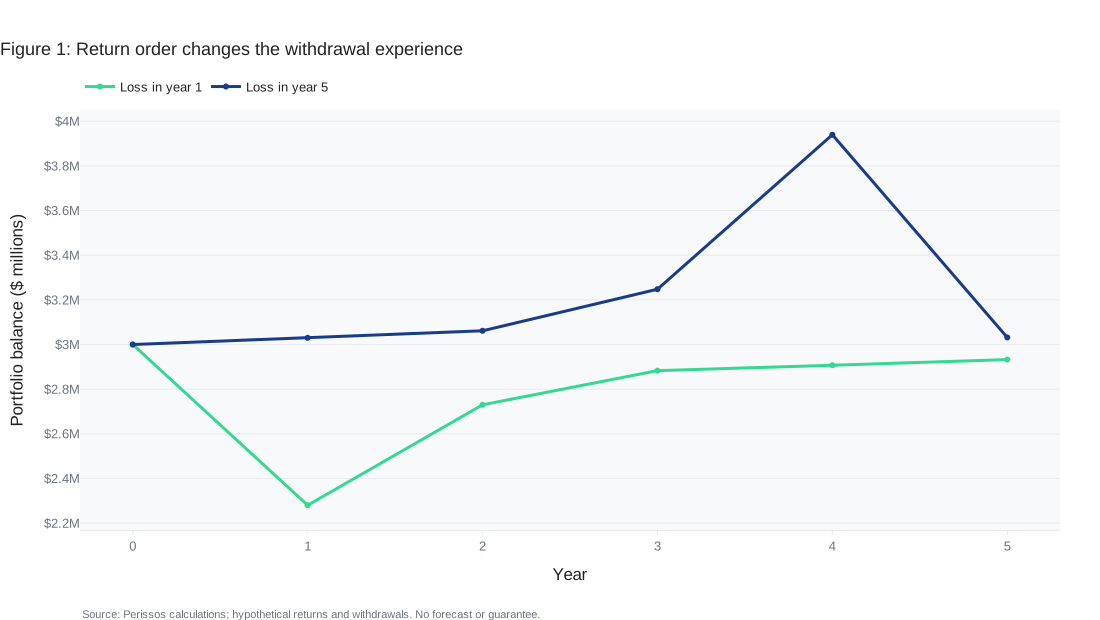
Consider an illustration, not a forecast: a $3 million portfolio funds a $120,000 withdrawal at each year-end for five years. One return sequence is minus 20%, plus 25%, plus 10%, plus 5%, and plus 5%. The second uses those exact returns in reverse order. Each annual return is assumed net of investment expenses. Withdrawals represent the entire cash requirement, including any taxes. There are no contributions or inflation adjustments.
Without withdrawals, both sequences finish at $3,638,250. With withdrawals, the early-loss sequence finishes at approximately $2,932,508; the late-loss sequence finishes at $3,031,650. Both distribute $600,000, yet the remaining balances differ by about $99,143. The calculation applies each annual return to the opening balance and then subtracts the withdrawal. Reversing returns changes when money leaves the compounding process.
Figure 1 shows the paths, including the sharp final-year decline in the late-loss sequence. This is not evidence that either path is safe or that a particular manager can deliver the more favorable order. It demonstrates why a return average cannot describe a withdrawal experience. Different timing, inflation, taxes, or cash flows would change the result.
Build around obligations before optimizing the remainder
Begin with the amounts and dates the household needs to fund. Separate essential expenses from optional purchases and gifts. Subtract dependable outside income to estimate the portfolio's cash requirement. Then identify which assets are available when those payments come due. An asset that requires a favorable sale or uncertain distribution should not receive the same planning treatment as cash already available.
This suggests assigning near-term obligations to appropriately liquid resources and considering growth investments over a longer horizon. The exact reserve should follow the household's spending flexibility and other income. More cash can reduce pressure to sell during a decline, but it can also reduce long-term growth and lose purchasing power. A reserve is a tradeoff to model, not free protection.
The rest of the portfolio still needs coherent diversification. A collection of separate goal accounts can accidentally duplicate exposures or leave the household with too much cash. Review the combined allocation, total fees, and access to funds. Our discussion of active drawdown management in retirement connects liquidity and spending decisions with a written investment process.
Stress the decisions, not just the allocation
I would examine several difficult conditions: an early decline, disappointing returns for an extended period, a large unplanned expense, and a delayed business sale. These are selected planning scenarios rather than predictions. The point is to identify which decisions change and how soon. If a plan works only when every assumption cooperates, a more attractive optimization chart does not solve the problem.
Our guide to stress-testing a retirement plan with Monte Carlo analysis explains why modeled probabilities need assumptions and an action plan attached. Add scenario analysis to understand the consequences behind the percentages. Ask whether a spending reduction would affect vacations or essential care, and whether the proposed reserve could actually fund the modeled interruption.
More elaborate risk measures can improve the analysis, but they still rely on assumptions. Neither downside-focused optimization nor tactical adjustments eliminate losses. Frequent changes also require a realistic assessment of trading costs, taxes, and the possibility of selling before a recovery. A strategy should be judged against a credible simpler alternative, using comparable costs and constraints.
Decide how much complexity the household needs
A broadly diversified portfolio with a sensible rebalancing policy may be enough for an investor with a long horizon, straightforward finances, and no unusual liquidity demands. Additional structures earn their place when they address a documented problem. Illiquid investments, complicated hedges, and frequent trading should not be added merely because the household has substantial assets.
Before changing the portfolio, ask for a written connection between each proposed change and a household obligation. Document the spending requirement, acceptable concentration, liquidity reserve, and circumstances that trigger review. Coordinate the tax consequences of a transition with the CPA and ownership or trust restrictions with the attorney. A theoretically appealing destination can be expensive to reach, so compare a gradual transition with an immediate one.
The final decision should specify what the family can fund, what uncertainty it accepts, and what it will change if conditions deteriorate. I want the allocation, the withdrawal plan, and the response rules to tell the same story. That gives the household something practical to follow when actual markets depart from the assumptions.
All my best,
Brandon VanLandingham, CFA, CMT, CFP
Founder / CIO
Citations
- CFA Institute, Principles of Asset Allocation (2026 curriculum). Retrieved October 3, 2026.
- SEC Investor.gov, Asset Allocation and Diversification. Retrieved October 3, 2026.
- FINRA, Risk. Retrieved October 3, 2026.
- CFA Institute, Overview of Asset Allocation (2026 curriculum). Retrieved October 3, 2026.
Important Disclosures
This piece is educational. It is not legal, tax, or accounting advice and is not a recommendation to take or refrain from any specific action. Tax law is fact-specific and changes regularly. Please coordinate any decisions discussed here with your attorney, your CPA, and Perissos before acting.
Perissos Private Wealth Management is a Registered Investment Adviser ("RIA"). Registration as an investment adviser does not imply a certain level of skill or training, and the content of this communication has not been approved or verified by the United States Securities and Exchange Commission or by any state securities authority. Perissos Private Wealth Management renders individualized investment advice to persons in a particular state only after complying with the state's regulatory requirements, or pursuant to an applicable state exemption or exclusion. All investments carry risk, and no investment strategy can guarantee a profit or protect from loss of capital. Past performance is not indicative of future results.
The information contained in this newsletter is intended to provide general information about market themes. It is not intended to offer investment advice. Investment advice will only be given after a client engages our services by executing the appropriate investment services agreement. Information regarding investment products and services is given solely to provide education regarding our investment philosophy and our strategies. You should not rely on any information provided in making investment decisions.
Market data, articles and other content in this material are based on generally available information and are believed to be reliable. Perissos Private Wealth Management does not guarantee the accuracy of the information contained in this material.
Perissos Private Wealth Management will provide all prospective clients with a copy of our current Form ADV, Part 2A (Disclosure Brochure), Part 2B (Supplemental Brochures), and Part 3 (Client Relationship Summary) prior to commencing an advisory relationship. You can also view these documents at any time at adviserinfo.sec.gov or by contacting us requesting a copy.
Explore topics
Share this article
Last reviewed: October 3, 2026
Frequently Asked Questions
- Why is Modern Portfolio Theory not enough for many high-net-worth households?
- It helps frame diversification, but it does not fully capture taxes, liquidity needs, concentrated business exposure, or the timing of withdrawals. Those real-world factors can materially affect whether a portfolio supports household obligations.
- What should investors evaluate before optimizing the rest of a portfolio?
- Start with the amounts and dates the household must fund, then match near-term obligations to appropriately liquid resources. After that, review the remaining portfolio for diversification, fees, and access to funds.
- How does sequence risk change retirement withdrawal outcomes?
- When withdrawals occur during early market losses, more assets leave the portfolio before recovery, which can reduce ending wealth. In the example, two identical return sets in reverse order produced about a $99,143 difference after five years.