

Written and reviewed by Brandon VanLandingham, CFA, CMT, CFP® · Last updated October 12, 2026
I-Bonds vs. TIPS: Which Inflation Hedge Belongs in Your Plan?
Choosing between a savings reserve and marketable inflation protection
October 12, 2026
I-Bonds and Treasury Inflation-Protected Securities both respond to inflation, but they ask very different things of the investor. I-Bonds limit how much you can buy and when you can redeem. TIPS can accommodate larger allocations and can be sold in the market, but their prices fluctuate. The useful comparison begins with when you need the money and how much you need to protect.
I would not choose between them by putting the latest I-Bond rate next to a TIPS yield and selecting the larger number. Those figures measure different things over different periods. A savings reserve that you may use in several years calls for a different decision from a substantial retirement obligation due over the next decade. In some households, the two securities can serve complementary roles.
The I-Bond rate has two moving parts
An I-Bond combines a fixed rate that stays with that issue and an inflation component that resets for each six-month earning period. The combined rate can change as inflation changes. Treasury's formula prevents the composite rate from falling below zero, although deflation can offset some or all of a positive fixed-rate component. The bond does not have a daily secondary-market trading price.1,2
For bonds issued from May 1 through October 31, 2026, Treasury announced a 4.26% annualized composite rate, including a 0.90% fixed rate. The 4.26% applies to the first six months after issue, not to the bond's entire life and not necessarily to the full first year. The Treasury rate announcement is the appropriate reference for this issue window.3
For context, an assumed $10,000 purchase earning 4.26% annualized for six months accrues about $213 during that period before taxes and any applicable redemption penalty. That is six months of earnings, not a $426 guaranteed first-year result. The next earning period depends on the next applicable inflation adjustment. Do not multiply an introductory annualized rate across a multiyear plan.
Access to I-Bond money follows a timetable
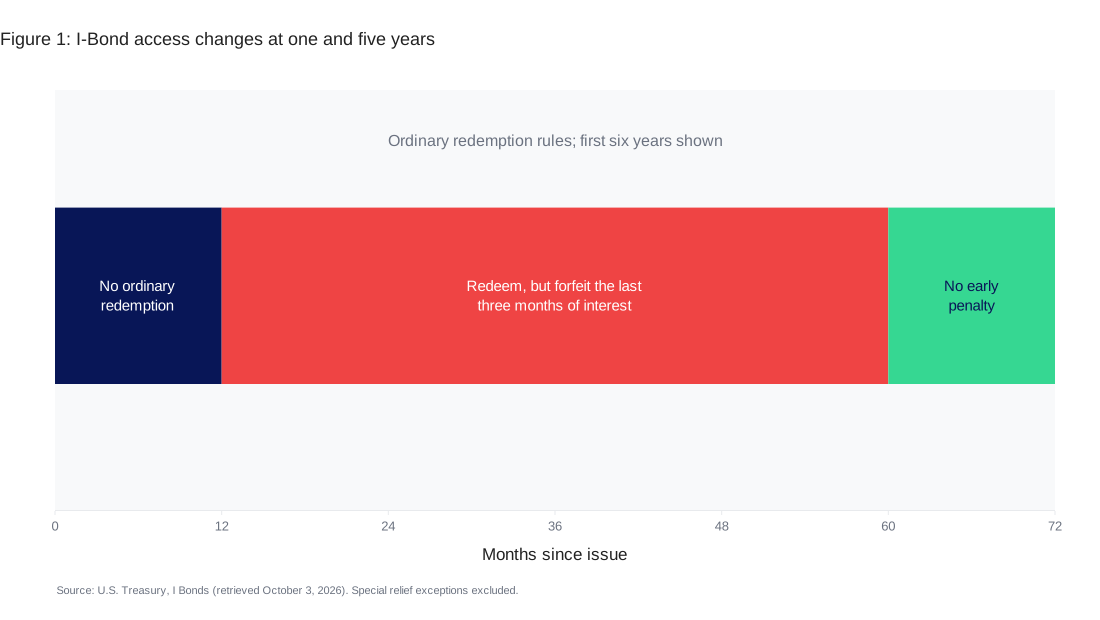
Under ordinary rules, you cannot redeem an I-Bond during the first twelve months. After that, redemption before five years forfeits the last three months of interest. Once five years have elapsed, that early-redemption interest penalty ends. I-Bonds earn interest for up to thirty years, unless redeemed sooner.1
Figure 1 shows the ordinary redemption timetable through the first six years. The first year is a lockup. The next four years permit redemption with an interest penalty, and the period beginning at the fifth anniversary permits redemption without that penalty. These are different forms of access, and none should be confused with a checking-account balance available for an unexpected bill tomorrow.
That makes newly purchased I-Bonds a poor home for the first layer of emergency savings. A household can build an older I-Bond reserve over time, but each new purchase starts its own clock. Our article on Treasury bills and money market funds for cash reserves addresses the separate job of readily available cash. Keep that job funded before committing money to a redemption restriction.
Purchase limits matter more as the portfolio grows
The standard electronic I-Bond purchase limit is $10,000 per Social Security number per calendar year. Thus, two eligible spouses with unused limits can ordinarily purchase a combined $20,000 in their own names during a calendar year. That is 2% of an assumed $1 million portfolio, or 0.4% of an assumed $5 million portfolio. The calculations show scale, not a recommended allocation.1,5
The former ability to buy additional paper I-Bonds with a tax refund ended January 1, 2025. Older paper bonds remain a separate ownership and redemption matter. Entity and gift registrations have their own requirements; they should not be treated as a casual way to multiply a household's limit. Verify the ownership, delivery, and tax consequences before using a more elaborate arrangement.3,5
I-Bonds can therefore be useful for incremental saving while being insufficient for a large inflation-protection project. A household seeking to protect several hundred thousand dollars of future spending cannot assume it can establish the entire position immediately under the ordinary individual purchase limits. An available investment should be sized for what it can actually accomplish.
TIPS offer scale with market-price risk
TIPS are marketable securities. Their principal adjusts with inflation or deflation, and their fixed coupon rate applies to that adjusted principal. Treasury pays the interest semiannually. At maturity, the investor receives the larger of adjusted principal or original principal. That floor does not guarantee recovery of a premium paid to buy an existing bond.4
Treasury's comparison of TIPS and I-Bonds identifies the fundamental liquidity difference: TIPS can trade in the secondary market, while I-Bonds cannot. TIPS also permit much larger purchases than the ordinary annual I-Bond limit. Their practical role can therefore include a substantial schedule of retirement cash flows rather than only a modest savings reserve.5
Marketability is not price stability. Selling TIPS before maturity exposes the investor to the market price at that time; a higher required real yield can reduce that price. A matched maturity can help address a known spending date, but a long-dated TIPS holding should not be selected on the assumption that it will always be worth the amount paid when cash is needed.4
Our discussion of constructing a retirement TIPS ladder explains the cash-flow application. Account custody, settlement timing, and any transfer requirements should be checked before a purchase. The ability to sell an instrument in the market does not mean every account provides identical or immediate access.
Tax timing can change which security fits
I-Bond interest is subject to federal income tax but exempt from state and local income taxes. Owners can generally defer federal reporting until redemption, another taxable disposition, or final maturity, or choose annual reporting. Treasury's savings-bond tax guidance describes these alternatives. A reporting choice should be coordinated with the CPA rather than made from the account balance alone.6
In contrast, taxable-account TIPS investors generally report interest and inflation-related increases in principal annually. The inflation increase can create federal taxable income before the additional principal is received in cash. TIPS income is also exempt from state and local income taxes. The household may need outside cash for the tax bill; holding the security in a retirement account introduces that account's separate tax and distribution rules.5
Deferral is useful, but it can accumulate a future tax event. Before redeeming a large, long-held I-Bond position, estimate the interest that will become reportable and its interaction with the rest of that year's income. The better choice depends on the household's expected tax years, cash needs, and administrative capacity, not simply on which security postpones the most tax today.
Assign a job before placing the order
I-Bonds may suit money that can remain untouched for at least the initial lockup, especially when the investor values freedom from daily market-price swings and can work within the purchase limit. TIPS may suit larger inflation-linked allocations and spending schedules when the investor accepts interim price changes and has selected an appropriate maturity. Neither is a substitute for a complete liquidity plan.
Write down the amount, earliest spending date, required access, account location, and tax-reporting approach. For an existing I-Bond, record its issue date and fixed rate before replacing it. For a TIPS purchase, review the real yield, adjusted purchase amount, and maturity cash flow. Then confirm that the remaining portfolio can support an unexpected need without forcing an unfavorable redemption or sale. That is the comparison that turns inflation protection into a usable planning decision.
All my best,
Brandon VanLandingham, CFA, CMT, CFP
Founder / CIO
Citations
- U.S. Treasury, I Bonds. Retrieved October 3, 2026.
- U.S. Treasury, I Bonds Interest Rates. Retrieved October 3, 2026.
- U.S. Treasury, May 1, 2026 Savings-Bond Rate Announcement. Retrieved October 3, 2026.
- U.S. Treasury, Treasury Inflation-Protected Securities. Retrieved October 3, 2026.
- U.S. Treasury, Comparison of TIPS and Series I Savings Bonds. Retrieved October 3, 2026.
- U.S. Treasury, Tax Information for EE and I Bonds. Retrieved October 3, 2026.
Important Disclosures
This piece is educational. It is not legal, tax, or accounting advice and is not a recommendation to take or refrain from any specific action. Tax law is fact-specific and changes regularly. Please coordinate any decisions discussed here with your attorney, your CPA, and Perissos before acting.
Perissos Private Wealth Management is a Registered Investment Adviser ("RIA"). Registration as an investment adviser does not imply a certain level of skill or training, and the content of this communication has not been approved or verified by the United States Securities and Exchange Commission or by any state securities authority. Perissos Private Wealth Management renders individualized investment advice to persons in a particular state only after complying with the state's regulatory requirements, or pursuant to an applicable state exemption or exclusion. All investments carry risk, and no investment strategy can guarantee a profit or protect from loss of capital. Past performance is not indicative of future results.
The information contained in this newsletter is intended to provide general information about market themes. It is not intended to offer investment advice. Investment advice will only be given after a client engages our services by executing the appropriate investment services agreement. Information regarding investment products and services is given solely to provide education regarding our investment philosophy and our strategies. You should not rely on any information provided in making investment decisions.
Market data, articles and other content in this material are based on generally available information and are believed to be reliable. Perissos Private Wealth Management does not guarantee the accuracy of the information contained in this material.
Perissos Private Wealth Management will provide all prospective clients with a copy of our current Form ADV, Part 2A (Disclosure Brochure), Part 2B (Supplemental Brochures), and Part 3 (Client Relationship Summary) prior to commencing an advisory relationship. You can also view these documents at any time at adviserinfo.sec.gov or by contacting us requesting a copy.
Explore topics
Share this article
Last reviewed: October 10, 2026
Frequently Asked Questions
- When are I-Bonds generally more useful than TIPS?
- I-Bonds can fit a limited savings reserve when the money is not needed for at least 12 months. Their annual purchase limits and early-redemption rules make them less suitable for large or immediate spending needs.
- Why can TIPS be a better fit for larger inflation-protection goals?
- TIPS are marketable Treasury securities that can accommodate larger allocations than the standard $10,000 annual I-Bond limit per person. They can also be sold before maturity, although market prices may be higher or lower than purchase price.
- How do taxes differ between I-Bonds and TIPS in a taxable account?
- I-Bond interest is generally deferred for federal tax purposes until redemption or maturity unless annual reporting is elected. TIPS investors in taxable accounts generally report both interest and inflation-related principal increases each year.