

Written and reviewed by Brandon VanLandingham, CFA, CMT, CFP® · Last updated October 28, 2026
Hedge Funds in 2026: Worth the Fees?
The strategy must earn its place after costs, liquidity limits, and household obligations.
October 23, 2026
An invitation to invest in a hedge fund can make the decision feel settled before the analysis begins. Access sounds valuable. A sophisticated strategy sounds reassuring. Neither tells us whether the investment improves your financial plan. My starting question is more ordinary: What job would this fund do, and what would we otherwise own with the same dollars?
For a family approaching retirement, an investment that cannot reliably fund withdrawals belongs in a different category from a cash reserve. For a business owner, another strategy exposed to credit conditions may add less diversification than its name suggests. The right answer in 2026 remains fund-specific. I would pay a substantial fee only for a credible capability that remains useful after its full cost and constraints.
Start with the strategy, not the label
A hedge fund is a private pooled investment vehicle. Depending on its structure, participation requires accredited-investor or qualified-purchaser eligibility. Strategies may use borrowing, short selling, and derivatives; the word “hedge” does not promise protection. The SEC’s hedge-fund overview explains these distinctions.1
I would ask a manager to describe the proposed return source without leaning on a strategy label. Which risk is being accepted? Who is on the other side of the trade? Why should the opportunity survive competition? What would make the approach fail? A convincing explanation should connect the investment process to a plausible economic reason for earning money.
Then identify what the allocation replaces. If it replaces stocks, compare its contribution to growth and losses. If it replaces bonds, examine whether it can support spending when markets are stressed. Comparing every hedge fund with a stock index misses the assignment; excusing every disappointing result as “diversification” avoids accountability. Establish the relevant comparison before investing.
Translate the fee schedule into dollars
Management fees and incentive fees serve different purposes. A management charge can apply even when the investment loses money. Incentive charges depend on the contract; high-water marks and hurdles can restrict when they are earned. Redemption restrictions and valuation practices also require attention.1 The IRS’s Hedge Fund Basics training material illustrates common management-fee and profit-allocation structures, but it is educational material, not binding tax authority.2
Consider a deliberately simplified one-year example. Assume a $1 million starting investment, a 10% gross investment return, a management charge equal to 2% of starting capital, and an incentive charge of 20% of positive profit remaining after that management charge. Assume no hurdle, prior losses, other expenses, contributions, withdrawals, or taxes. These are illustration inputs, not a quotation or an estimate of current industry pricing.
Gross profit is $100,000. The management charge consumes $20,000. The incentive charge is $16,000, leaving the investor $64,000, or 6.4%. Under a second hypothetical schedule of 1% and 10%, the same gross profit leaves $81,000, or 8.1%. Figure 1 shows how these two assumed schedules change the result across several gross returns. It isolates fee mechanics; it does not imply that the cheaper fund can produce the same investments or gross results.
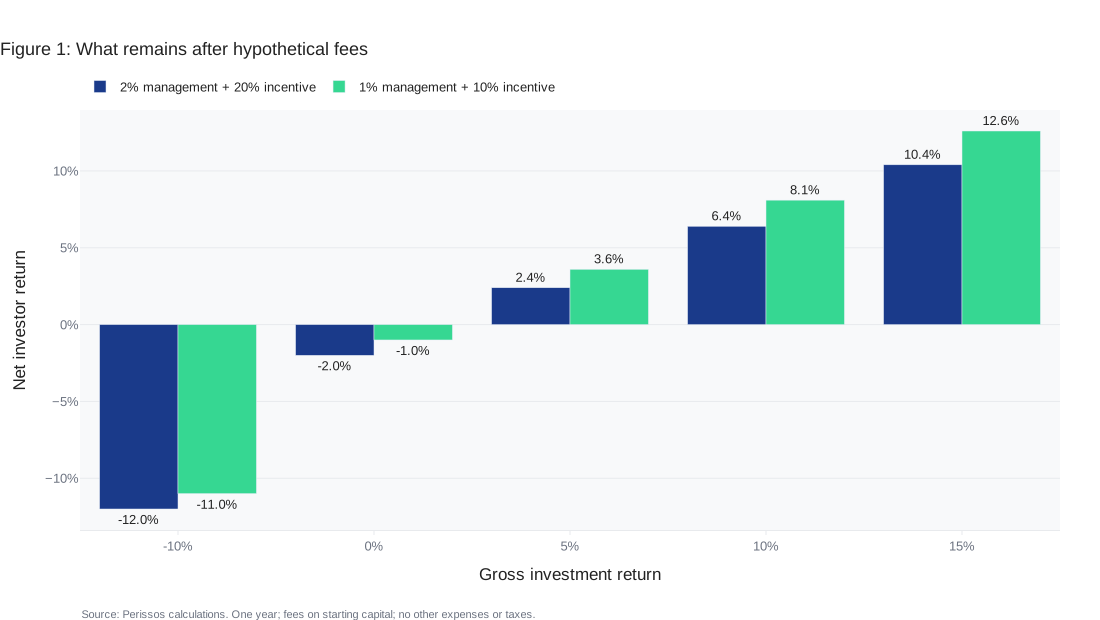
At a zero gross return, the first schedule leaves a 2% loss and the second a 1% loss. At a negative 10% gross return, the corresponding losses are 12% and 11%. The asymmetry matters: an incentive fee can disappear in a losing year while the management charge remains. Actual calculations may use different asset bases, accrual periods, expense allocations, and loss-recovery provisions. Obtain a worked example using the specific documents before comparing proposals.
The practical question is how much additional value must survive those charges. Ask for every expense borne directly or indirectly by investors, including any additional investment vehicle. Have the manager reconcile reported gross performance to the return available to the proposed share class. A favorable headline fee is not enough if the rest of the expense schedule is unclear.
Liquidity has three separate dimensions
The assets a fund holds, the financing it uses, and your right to redeem are separate issues. The Office of Financial Research’s hedge-fund liquidity framework distinguishes investment liquidity, financing demands, and investor redemptions. Funding pressure can arise through margin calls or maturing debt even when a portfolio appears diversified.3
Translate that into a household stress test. Suppose your business needs cash at the same time the fund delays withdrawals and public stocks decline. Which assets would you sell? Would the resulting sale interfere with retirement spending, a property purchase, or a tax payment? The relevant limit is the amount you can leave invested through an unfavorable sequence, not the largest subscription you can afford today.
As discussed in Private Equity Allocations for $5M+ Households, private investments belong inside a household liquidity budget. The mechanics differ across private equity and hedge funds, but the planning discipline carries over: do not assign the same dollars both to long-term investing and near-term obligations.
For retirement assets, connect that budget to What 'Active Drawdown Management' Actually Means. A potentially useful diversifier still needs a funding plan around it. I would size the position assuming the least convenient contractual redemption outcome, then ask whether the household remains comfortable.
Investigate the business behind the returns
A performance presentation is the beginning of diligence. Ask who calculates asset values, who holds assets, who audits the financial statements, and how disagreements are resolved. Obtain the offering documents, audited statements, and a clear account of related-party arrangements. The SEC specifically cautions investors to understand difficult-to-value holdings and independent valuation sources.1
I would also examine the manager’s explanation of losing periods. Were losses consistent with the stated process? Did borrowing or concentration change? Were favorable results concentrated in a few positions? Can the team explain why a repeat is plausible without presenting a selected historical period as a forecast? These are review questions, not accusations. A manager worth a long-term commitment should welcome a coherent standard of evaluation.
Ask for the actual investor experience after all charges and compare it with any simulated or reconstructed history. Request enough information to separate market exposure from the manager’s decisions. If the evidence cannot support that distinction, reduce confidence in the claim that higher fees buy unusual skill. Complexity should increase the burden of explanation.
Decide what would justify staying invested
The strongest candidate is a household with adequate liquid reserves, a clearly identified portfolio need, and the ability to evaluate and hold a particular strategy through disappointing periods. A poor candidate is someone seeking a substitute for guaranteed income, near-term cash, or a simple portfolio they can understand without ongoing oversight. Eligibility is an access test, not a suitability conclusion.
Before subscribing, ask your CPA to review the proposed entity, expected reporting, income character, and cash needed for potential tax obligations. Have legal counsel review material redemption and ownership provisions when needed. Do not infer an after-tax outcome from a pre-tax performance chart or assume that every fund structure produces the same reporting. The account and entity need to fit the household, not just the strategy.
Finally, write a short investment rationale: the job, the funded allocation, the relevant comparison, the liquidity assumption, and the evidence that would prompt review. A personnel change, unexplained valuation issue, or departure from the stated process should receive attention independent of recent returns. If we cannot explain why this particular fund improves the plan after fees, keeping the money in a simpler allocation is a complete decision.
All my best,
Brandon VanLandingham, CFA, CMT, CFP
Founder / CIO
Citations
- SEC Investor.gov, Hedge Funds. Retrieved October 23, 2026.
- IRS, Hedge Fund Basics, updated February 5, 2025. Training material, not legal authority. Retrieved October 23, 2026.
- Office of Financial Research, Investor liquidity by horizon. Retrieved October 23, 2026. Figure 1 uses author-selected assumptions and reproducible calculations, not external return data.
Important Disclosures
This piece is educational. It is not legal, tax, or accounting advice and is not a recommendation to take or refrain from any specific action. Tax law is fact-specific and changes regularly. Please coordinate any decisions discussed here with your attorney, your CPA, and Perissos before acting.
Perissos Private Wealth Management is a Registered Investment Adviser ("RIA"). Registration as an investment adviser does not imply a certain level of skill or training, and the content of this communication has not been approved or verified by the United States Securities and Exchange Commission or by any state securities authority. Perissos Private Wealth Management renders individualized investment advice to persons in a particular state only after complying with the state's regulatory requirements, or pursuant to an applicable state exemption or exclusion. All investments carry risk, and no investment strategy can guarantee a profit or protect from loss of capital. Past performance is not indicative of future results.
The information contained in this newsletter is intended to provide general information about market themes. It is not intended to offer investment advice. Investment advice will only be given after a client engages our services by executing the appropriate investment services agreement. Information regarding investment products and services is given solely to provide education regarding our investment philosophy and our strategies. You should not rely on any information provided in making investment decisions.
Market data, articles and other content in this material are based on generally available information and are believed to be reliable. Perissos Private Wealth Management does not guarantee the accuracy of the information contained in this material.
Perissos Private Wealth Management will provide all prospective clients with a copy of our current Form ADV, Part 2A (Disclosure Brochure), Part 2B (Supplemental Brochures), and Part 3 (Client Relationship Summary) prior to commencing an advisory relationship. You can also view these documents at any time at adviserinfo.sec.gov or by contacting us requesting a copy.
Explore topics
Share this article
Last reviewed: October 23, 2026
Frequently Asked Questions
- How should investors judge whether a hedge fund is worth the fees in 2026?
- Start by defining the fund’s job in the portfolio and what it would replace. Then compare expected diversification, liquidity limits, and net-of-fee results rather than relying on the hedge fund label alone.
- Why do liquidity limits matter with hedge funds?
- Liquidity risk has at least three dimensions: the fund’s underlying assets, its financing demands, and the investor’s redemption rights. A fund can look diversified yet still create stress if household cash needs arrive during a withdrawal delay or market d...
- What do fees do to hedge fund returns?
- Fees can materially reduce investor outcomes even in positive years because management charges may apply regardless of performance. In the article’s simplified example, a 10% gross return fell to 6.4% under a 2% and 20% fee structure.