

Written and reviewed by Brandon VanLandingham, CFA, CMT, CFP® · Last updated November 6, 2026
Transfer-on-Death Deeds for Oklahoma Real Estate
A simple transfer can still require a careful handoff
November 06, 2026
A transfer-on-death deed can be a practical way to leave Oklahoma real estate to a chosen beneficiary while retaining ownership during life. Its appeal is simplicity. Its weakness is that families can mistake a recorded beneficiary designation for a complete estate plan and overlook the work required after the owner dies.
I would evaluate the deed as one part of a property succession plan. Who should own the property, who should manage it, and who will carry out the required filings? Those questions matter more than finding the shortest document. This memo addresses Oklahoma law as reviewed on October 31, 2026; property in another state requires its own legal review.
What the deed changes, and what it leaves alone
Oklahoma's Nontestamentary Transfer of Property Act, Sections 1251 through 1258, allows a record owner to designate beneficiaries for an interest in real estate. The owner retains control during life, and the transfer operates at death subject to statutory requirements. Covered interests can include surface and mineral interests, structures, and fixtures. The deed must satisfy execution and recording requirements before death.1
This is different from adding a child as a present co-owner. A TOD beneficiary does not acquire the same current ownership position merely by being named. The owner can generally continue to sell or encumber the property. A later will does not revoke the TOD designation; changes require the statutory process, including appropriate recording.1
That retained control can fit an owner who wants to keep making housing decisions but knows who should receive the property eventually. It does not solve incapacity management. If the owner cannot sign a sale document, arrange repairs, or handle a lender, the family still needs an appropriate authority structure. The deed identifies a future recipient; it does not appoint a lifetime financial decision-maker.
Start with title, not with a downloaded form
Have an Oklahoma attorney review the current recorded deed and legal description before preparing a new instrument. The street address alone does not establish the precise interest being transferred. Confirm whether the owner holds the entire parcel, a fractional share, a mineral interest, or property subject to someone else's rights.
Joint ownership deserves particular attention. The Act contains specific rules for joint tenancy, so a TOD designation should not be assumed to defeat a surviving joint tenant's rights. Existing mortgages and other encumbrances also require review. A beneficiary designation is not a mechanism for making the property free of debt.1
Ask counsel to coordinate the deed with homestead and spousal rights, existing trusts, and any prior beneficiary deeds. Have the attorney confirm the required signatures, acknowledgment, witnesses, and recording office for the actual transaction. Keep the returned recorded instrument and its recording information in the estate file. Signing a form without verifying recordation leaves the most important implementation question unanswered.
For a family with multiple parcels, make a property schedule. Identify the county, current title, intended recipient, debt, insurance contact, and location of the recorded documents for each interest. Our discussion of real estate inside and outside the portfolio can help connect those ownership decisions with household liquidity and concentration.
The beneficiary has a deadline after death
For a current death, the beneficiary must record the acceptance affidavit and required related documents in the county where the property is located within nine months of the grantor's death. Failure causes the interest to revert to the deceased grantor's estate. Current Section 1252 requires each accepting designated beneficiary to act for that beneficiary's own interest; one beneficiary generally cannot accept for another. The statute addresses an authorized person's acceptance for a legal entity and special treatment of certain older affidavits.1
This deadline remains important in 2026. House Bill 3500 proposed changing the process, but the official legislative history records a veto on May 12, 2026. The governor's veto explanation also describes the existing nine-month requirement. A proposed bill's effective-date language should not be treated as an enacted extension.2,3
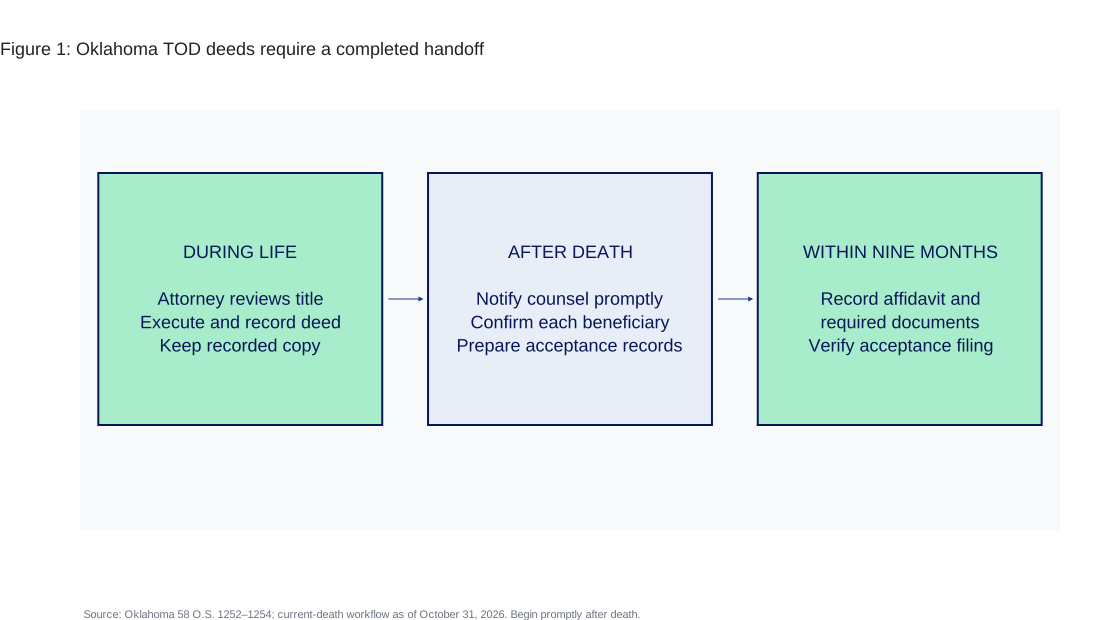
Figure 1 shows the workflow: proper recording during life, prompt action after death, and completed acceptance recording within the statutory window. It is a process chart rather than a suggested waiting schedule. The goal is to begin early enough to obtain death records, confirm the legal description, and resolve questions about the beneficiary or title without a last-minute filing.
The person maintaining the estate file should know who will contact counsel when the owner dies. Each beneficiary should receive clear instructions about the deed and where records are kept. A family conversation is useful even though lifetime notice to the beneficiary is not required by the Act. A perfectly drafted designation is vulnerable if no one knows it exists.1
Choose recipients who can actually own together
Leaving equal shares to several children may feel fair but can create a difficult operating arrangement. One may want to sell, another may want to live in the house, and another may be unable to pay property expenses. The deed does not itself provide a comprehensive agreement about rent, maintenance, sale timing, or a sibling buyout.
Before choosing that structure, discuss who will pay taxes and insurance during the transition and how the property will be valued if one heir buys out the others. Consider whether other assets can provide liquidity or balance inheritances. A property-rich estate with little cash can place pressure on beneficiaries even when the legal transfer is straightforward.
Outright ownership may also be a poor fit for a minor, a beneficiary receiving means-tested benefits, or someone who needs ongoing financial management. A trust or another arrangement may better express the intended safeguards, subject to counsel's review. An owner wanting a surviving spouse to use a home while preserving it for children from another marriage needs more analysis than simply listing multiple names.
Ask what happens if a beneficiary dies first, disclaims, or cannot complete acceptance. The Act contains lapse and other transfer rules, but a family should not rely on an assumed substitution. Review those scenarios with counsel and update the documents after a death or material change in family relationships.1
Keep transfer mechanics separate from tax outcomes
Avoiding probate does not by itself eliminate income tax, estate administration expenses, or potential claims affecting property. For federal basis purposes, inherited property generally receives a basis tied to date-of-death fair market value, subject to exceptions and alternate-valuation rules. IRS Publication 551 explains inherited-property basis. The CPA should determine the treatment of the actual interest and preserve appropriate valuation records.4
Do not substitute the county's assessed value or a remembered purchase price for that analysis. Improvements, ownership shares, prior gifts, and special property characteristics can matter. If an heir expects to sell soon, arrange the tax and title review before committing to a closing date. The transfer document, acceptance filing, sale contract, and tax reporting need to describe the same ownership facts.
Build the handoff before recording
Bring the current title documents and beneficiary objectives to the attorney, then compare the proposed deed with the rest of the estate documents every Oklahoma family needs. Confirm how incapacity, assets outside the deed, and ongoing support for dependents will be handled.
After recording, retain evidence of completion and create written instructions for the post-death filing. Name a responsible contact and a backup; do not leave the task assigned vaguely to “the family.” Review the arrangement when property is refinanced or sold, a beneficiary dies, or family needs change. The decision is complete when the intended beneficiary can understand both what is being transferred and what must happen to receive it.
All my best,
Brandon VanLandingham, CFA, CMT, CFP
Founder / CIO
Citations
- Oklahoma Statutes, Title 58, Sections 1251–1258 (retrieved October 31, 2026).
- Oklahoma Legislature: HB 3500, 2026 history (retrieved October 31, 2026).
- Governor of Oklahoma: 2026 Veto List (retrieved October 31, 2026).
- IRS Publication 551 (retrieved October 31, 2026).
Important Disclosures
This piece is educational. It is not legal, tax, or accounting advice and is not a recommendation to take or refrain from any specific action. Tax law is fact-specific and changes regularly. Please coordinate any decisions discussed here with your attorney, your CPA, and Perissos before acting.
Perissos Private Wealth Management is a Registered Investment Adviser ("RIA"). Registration as an investment adviser does not imply a certain level of skill or training, and the content of this communication has not been approved or verified by the United States Securities and Exchange Commission or by any state securities authority. Perissos Private Wealth Management renders individualized investment advice to persons in a particular state only after complying with the state's regulatory requirements, or pursuant to an applicable state exemption or exclusion. All investments carry risk, and no investment strategy can guarantee a profit or protect from loss of capital. Past performance is not indicative of future results.
The information contained in this newsletter is intended to provide general information about market themes. It is not intended to offer investment advice. Investment advice will only be given after a client engages our services by executing the appropriate investment services agreement. Information regarding investment products and services is given solely to provide education regarding our investment philosophy and our strategies. You should not rely on any information provided in making investment decisions.
Market data, articles and other content in this material are based on generally available information and are believed to be reliable. Perissos Private Wealth Management does not guarantee the accuracy of the information contained in this material.
Perissos Private Wealth Management will provide all prospective clients with a copy of our current Form ADV, Part 2A (Disclosure Brochure), Part 2B (Supplemental Brochures), and Part 3 (Client Relationship Summary) prior to commencing an advisory relationship. You can also view these documents at any time at adviserinfo.sec.gov or by contacting us requesting a copy.
Frequently Asked Questions
- Does an Oklahoma transfer-on-death deed give the beneficiary ownership right away?
- No. The owner generally keeps full control during life, including the ability to sell or encumber the property, while the beneficiary's interest takes effect only at death if statutory requirements are met.
- What deadline applies after the owner dies?
- For a current death, the beneficiary must record the acceptance affidavit and related documents in the county where the property is located within nine months of the grantor's death or the interest reverts to the estate.
- Does a transfer-on-death deed replace incapacity planning?
- No. A TOD deed names a future recipient of real estate, but it does not appoint someone to manage the property if the owner becomes unable to act during life.