

Written and reviewed by Brandon VanLandingham, CFA, CMT, CFP® · Last updated November 3, 2026
Power of Attorney: Financial vs. Healthcare Documents
Give the right people the authority to carry out your wishes
November 03, 2026
A family medical emergency can create two decisions at once: what care should be provided and how to pay for it. The person authorized to speak with physicians may not be the person authorized to move money, sign financial documents, or manage a property. Having someone you trust is essential; giving that person the right authority is a separate step.
I would review financial and healthcare powers of attorney together while keeping their jobs distinct. The objective is a workable handoff during incapacity, with enough authority to act and enough guidance to protect your wishes. This memo addresses Oklahoma planning as of October 31, 2026, including an enacted healthcare-law change that does not take effect until 2027.
Financial authority covers the tasks you actually grant
A financial power of attorney names an agent to act for the principal within the document's authority. Oklahoma's Uniform Power of Attorney Act, beginning at Section 3001 of Title 58, expressly excludes powers to make healthcare decisions. A broad financial document should therefore not be assumed to answer treatment questions.1
The Act makes a power durable unless it expressly ends upon incapacity. Durability means authority can continue through incapacity; it does not mean unlimited authority or permanent authority after death. Under the Act, a power generally becomes effective when executed unless it specifies a later date or event, and it terminates at the principal's death.1
The practical review starts with tasks. Could the agent pay insurance premiums, handle a taxable investment account, arrange a property repair, or work with the accountant? What about a business interest, retirement account, or digital record? Ask the attorney to translate each important household responsibility into an actual grant of authority and any applicable limitations.
Some powers deserve explicit discussion rather than broad boilerplate. Oklahoma requires specific grants for actions such as making gifts, changing beneficiary designations, or creating, amending, revoking, or terminating an inter vivos trust. Other agreements and legal restrictions can still limit an expressly granted power.1 A family should decide consciously whether these powers are needed and how their use will be supervised.
Healthcare authority addresses treatment and preferences
Under the current Oklahoma framework, a healthcare power of attorney appoints an agent for healthcare decisions within its scope. The Oklahoma Human Services healthcare POA form illustrates the distinction: its default activation follows an attending physician's determination of inability to decide, with an option for immediate authority.2
The same form explains that it does not authorize withholding or withdrawal of life-sustaining treatment, nutrition, or hydration except as permitted through the Oklahoma Advance Directive Act; it separately permits authorization to sign a do-not-resuscitate consent. Do not assume that a healthcare POA, advance directive, and DNR instruction are interchangeable. Have counsel and your clinician explain how the documents work together for your circumstances.2
Treatment preferences deserve more than a signature. Discuss what recovery would mean to you, which burdens you would find unacceptable, and whom you want included in conversations. Your agent needs enough understanding to apply your values when the precise medical situation is not described in a form. The agent should be comfortable asking physicians questions and communicating decisions under pressure.
The financial agent then needs a way to support that care within the authority granted. Paying for home assistance, managing a residence, and keeping premiums current can become urgent while a healthcare agent is focused on treatment. Our article on funding long-term care without insurance helps connect those responsibilities to the household's available resources.
Account for the coming Oklahoma transition
Oklahoma enacted House Bill 1687, the Uniform Health Care Decisions Act of 2026. The enrolled legislation sets an effective date of July 1, 2027. The official legislative record shows gubernatorial approval in May 2026, and the House's announcement confirms the future effective date.3,4
For a document review today, separate the current legal framework from the framework that will apply when the new law takes effect. Do not discard existing signed documents or wait to create needed authority simply because a new law has been enacted. Ask your Oklahoma attorney which existing provisions remain suitable, whether revisions should be made now, and when to schedule a transition review.
This timing distinction also matters when using online forms. A recently posted summary may describe the new law without making clear that it is not yet effective. Give counsel the actual document, signing date, and intended use. The question is whether the instrument works for you under the applicable law, not whether its heading contains the newest terminology.
Information access is another piece of the handoff
An effective healthcare agent is generally a personal representative for HIPAA purposes within the relevant authority. HHS explains that covered providers generally must allow personal representatives access to protected health information, subject to legal limits and exceptions. A HIPAA personal-representative explanation helps distinguish authority to act from simply being a relative.5
A separate information-release authorization may be useful for people you want involved in communications, even when they are not your decision-making agent. Review its recipients and scope with counsel and the provider. Access to information does not itself mean authority to consent to treatment, and being listed as an emergency contact should not be treated as a substitute for an appointment.
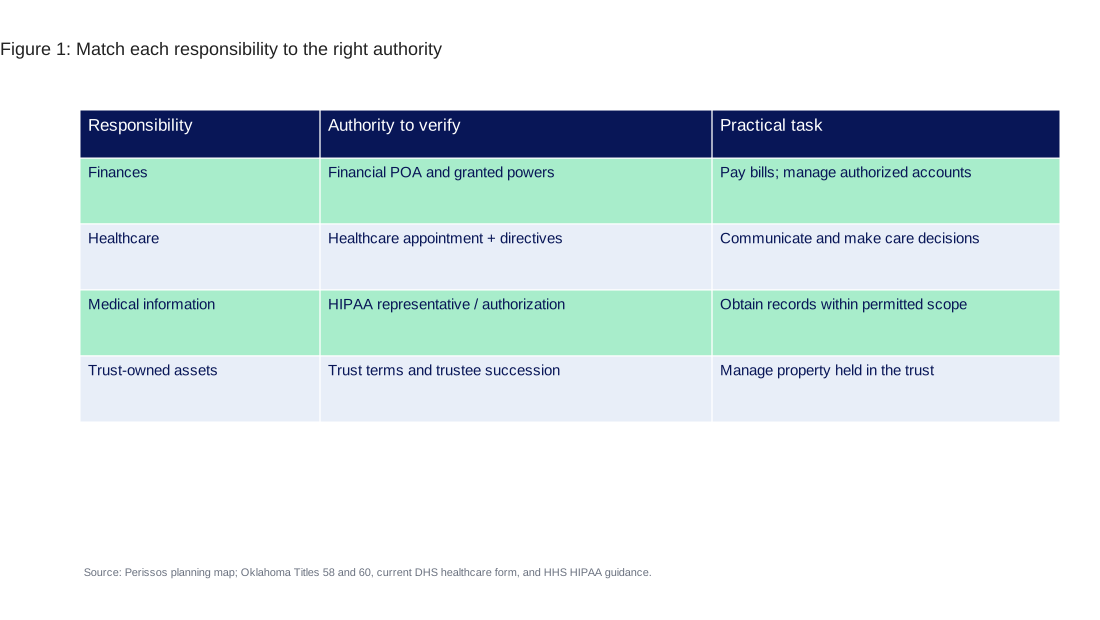
Figure 1 maps the roles across finances, healthcare, information access, and trust assets. It is a planning guide, not a grant of authority. One person may fill several roles, but each role must be established by the applicable document or law. The visual is useful for finding a missing appointment before the family needs to use it.
Choose people for the job and build accountability
The best financial agent may be organized, reliable with records, and willing to consult professionals. The best healthcare agent may be calm in a hospital and able to carry out wishes that relatives find difficult. Those may be the same person, but they need not be. Choosing different people requires an explicit communication plan so care decisions and funding decisions support each other.
Name successors and discuss availability before signing. An out-of-state child may be capable but hard to reach; two equally loved children may disagree. Ask counsel how coagents would act, what happens if one cannot serve, and how disagreements would be handled. Avoid creating a structure that requires cooperation from people who cannot work together reliably.
For financial oversight, arrange a recordkeeping process, a list of professional contacts, and a method for reviewing transactions consistent with privacy and the legal documents. An agent should not treat the principal's money as family money available for informal borrowing. Clear boundaries protect both the principal and the person agreeing to serve.
Test the documents before an emergency
Provide the appropriate copies to financial institutions and healthcare providers while you can answer questions. Ask what verification or activation evidence they would require. A springing power may preserve a desired boundary but require proof of the triggering event; an immediately effective power may simplify access but requires confidence in the agent from the outset.1
Federal agencies can have separate authorization procedures. For tax representation, the IRS distinguishes a power of attorney from information-only authorization and explains eligibility and Form 2848 requirements. Coordinate those needs with the CPA rather than assuming a general state-law document automatically covers every federal interaction.6
Finally, compare these appointments with your trustee and executor arrangements and the broader estate documents every Oklahoma family needs. Keep a current contact sheet, accessible signed copies, and a review date for the 2027 healthcare transition. The practical test is whether the intended person can identify the authority, obtain the necessary information, and carry out the next decision when you cannot.
All my best,
Brandon VanLandingham, CFA, CMT, CFP
Founder / CIO
Citations
- Oklahoma Statutes, Title 58, Uniform Power of Attorney Act (retrieved October 31, 2026).
- Oklahoma Human Services: Health Care Power of Attorney (retrieved October 31, 2026).
- Oklahoma HB 1687 enrolled legislation (retrieved October 31, 2026).
- Oklahoma Legislature: HB 1687 history (retrieved October 31, 2026).
- HHS: Personal Representatives (retrieved October 31, 2026).
- IRS: Power of Attorney and Other Authorizations (retrieved October 31, 2026).
Important Disclosures
This piece is educational. It is not legal, tax, or accounting advice and is not a recommendation to take or refrain from any specific action. Tax law is fact-specific and changes regularly. Please coordinate any decisions discussed here with your attorney, your CPA, and Perissos before acting.
Perissos Private Wealth Management is a Registered Investment Adviser ("RIA"). Registration as an investment adviser does not imply a certain level of skill or training, and the content of this communication has not been approved or verified by the United States Securities and Exchange Commission or by any state securities authority. Perissos Private Wealth Management renders individualized investment advice to persons in a particular state only after complying with the state's regulatory requirements, or pursuant to an applicable state exemption or exclusion. All investments carry risk, and no investment strategy can guarantee a profit or protect from loss of capital. Past performance is not indicative of future results.
The information contained in this newsletter is intended to provide general information about market themes. It is not intended to offer investment advice. Investment advice will only be given after a client engages our services by executing the appropriate investment services agreement. Information regarding investment products and services is given solely to provide education regarding our investment philosophy and our strategies. You should not rely on any information provided in making investment decisions.
Market data, articles and other content in this material are based on generally available information and are believed to be reliable. Perissos Private Wealth Management does not guarantee the accuracy of the information contained in this material.
Perissos Private Wealth Management will provide all prospective clients with a copy of our current Form ADV, Part 2A (Disclosure Brochure), Part 2B (Supplemental Brochures), and Part 3 (Client Relationship Summary) prior to commencing an advisory relationship. You can also view these documents at any time at adviserinfo.sec.gov or by contacting us requesting a copy.
Frequently Asked Questions
- What is the difference between a financial power of attorney and a healthcare power of attorney?
- A financial power of attorney authorizes an agent to handle money, property, and other granted financial tasks. A healthcare power of attorney authorizes an agent to make medical decisions within the document’s scope.
- Does a durable financial power of attorney in Oklahoma include healthcare decisions?
- No. Oklahoma’s Uniform Power of Attorney Act excludes authority to make healthcare decisions, so a separate healthcare document is typically needed.
- Should Oklahoma families wait to sign documents because of the 2027 healthcare law change?
- No. The article notes that Oklahoma’s Uniform Health Care Decisions Act of 2026 does not take effect until July 1, 2027, so existing planning should be reviewed under current law rather than postponed.