

Written and reviewed by Brandon VanLandingham, CFA, CMT, CFP® · Last updated November 4, 2026
Revocable vs. Irrevocable Trusts: A Plain-English Comparison
Match control, tax treatment, and administration to the job
November 04, 2026
A family can need a trust without needing to give away control of its wealth. Another family may have a clear reason to transfer assets permanently, but still need a structure for paying bills and managing investments during incapacity. Those are different jobs. Choosing between a revocable and irrevocable trust starts with the job, not with which label sounds more sophisticated.
I would begin by separating three questions: who can change the arrangement, who pays income tax, and whose estate includes the assets at death. The answers do not always move together. A trust can be irrevocable while its creator remains responsible for income taxes, and probate avoidance does not itself establish an estate-tax saving.
A revocable trust organizes assets you still control
A revocable living trust typically lets the creator amend or revoke it during life while legally competent. The creator often serves as the initial trustee, with a successor named to manage trust property when the governing terms permit. Oklahoma's trust statute, including Section 175.41, addresses revocability and limited circumstances for revocation of other trusts. The actual document and applicable law control.1
The practical attraction is continuity. A properly funded trust can provide management of its assets during incapacity and transfer them under its terms at death. Assets held in the trust generally avoid probate, but property left outside it may still require estate administration. The Oklahoma Bar Association's discussion of wills and trusts explains the role of funding and the continuing need for a coordinated estate plan.2
For example, a family might want a successor to manage a taxable investment account, arrange property expenses, and make distributions under a written standard. The trust should describe who takes over, what evidence is needed, and how the successor is replaced. A document that names a person but gives no workable transition process can leave the family with administrative problems at precisely the wrong time.
A revocable trust generally does not remove its creator's assets from the taxable estate or shield those assets from that person's creditors. Its value is often organizational rather than tax-driven. Retained ownership powers and applicable creditor law matter; simply changing the account registration does not erase the economic rights the owner still has.1,3
An irrevocable trust commits assets to a different arrangement
An irrevocable trust generally does not give its creator a unilateral right to take everything back. That does not mean no provision can ever change. Governing terms, consent requirements, court authority, and state law may provide limited routes to modification or termination. None should be treated as a guaranteed escape from an unsuitable transfer.1
This structure may fit a family that wants ongoing management for heirs, protection appropriate to a beneficiary's circumstances, or a carefully designed transfer-tax strategy. It may be a poor fit when the creator could need the transferred assets for retirement, business obligations, or care. Before funding it, model the household's remaining resources under disappointing investment and spending outcomes.
Trustee selection is part of the economics. A capable trustee must apply distribution standards, keep records, manage conflicts, and work with tax and legal advisers. Administrative fees and reporting demands can outweigh a modest expected benefit. A family member may understand the beneficiaries but lack time or impartiality; a professional fiduciary may offer continuity but impose costs and a more formal process.
Creditor protection is especially dependent on structure and jurisdiction. A trust for someone else is not equivalent to a trust funded for your own continuing benefit. Oklahoma law addresses spendthrift interests and creditors, with exceptions and separate provisions for different arrangements. An attorney should evaluate existing claims and retained rights before any transfer is described as protective.1
Income tax follows ownership rules, not the label
The IRS treats a revocable trust as a grantor trust for federal income-tax purposes. Certain irrevocable trusts are also grantor trusts because specified powers or interests remain with the grantor or another deemed owner. In those cases, the deemed owner generally reports the relevant income, deductions, and credits. The IRS trust questions and answers explain that distinction.3
A non-grantor trust may instead file its own income-tax return, with tax consequences divided between the trust and beneficiaries under distribution rules. A distribution is not automatically all taxable income or all tax-free principal. The character of income, governing instrument, and distributable-net-income calculation matter; the Form 1041 instructions describe the reporting system.4
Ask the CPA to explain the expected annual result in dollars before documents are signed. Who receives tax forms? Who needs estimated payments? Will the trust retain income or distribute it? If the creator pays tax on an irrevocable grantor trust's income, can the household afford that obligation over many years? The legal ability to make a gift and the cash capacity to sustain its tax consequences are separate planning tests.
Estate exclusion can create an income-tax tradeoff
For 2026, the federal basic estate and gift tax exclusion is $15 million per individual under current law. Prior taxable gifts and other rules affect the amount available, and portability for a surviving spouse involves an estate-tax election. A married couple should not assume a combined amount is automatically preserved without reviewing the first spouse's estate. These rules are addressed in the current Form 706 instructions.5
An irrevocable trust does not automatically remove assets from the taxable estate. The retained powers, transfer terms, and applicable tax provisions must support that result. Conversely, excluding assets from an estate can affect basis at death. Revenue Ruling 2023-2 explains that income-tax grantor status alone does not create a Section 1014 basis adjustment for assets in the described irrevocable trust outside the grantor's estate.6
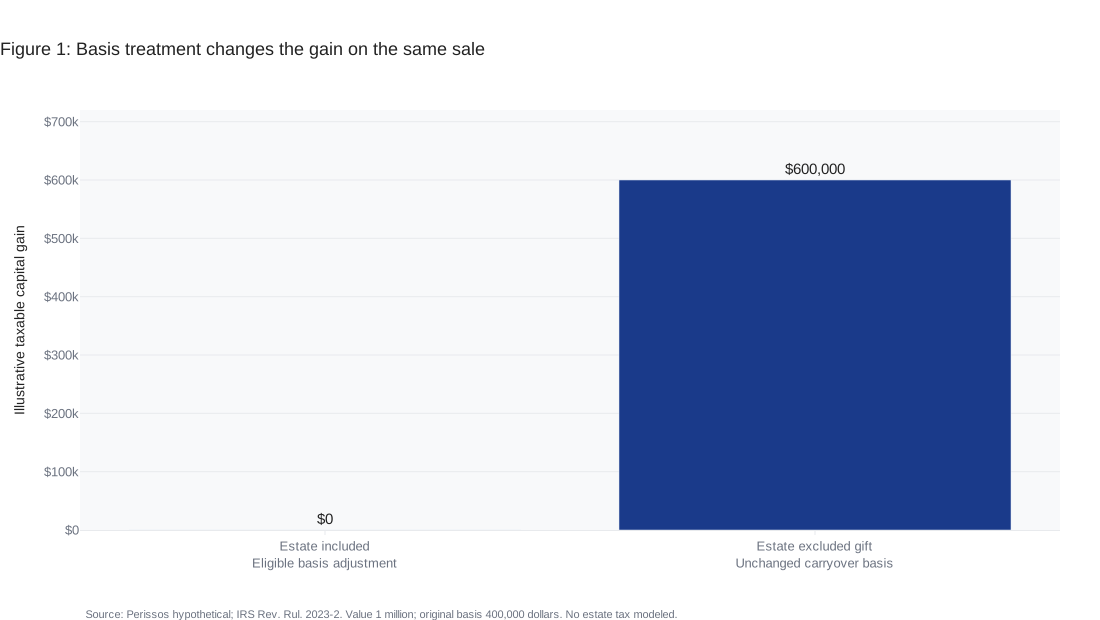
Assume an investment has a $400,000 basis and is worth $1 million at the owner's death. Under a simplified estate-included scenario eligible for a date-of-death basis adjustment, basis becomes $1 million and an immediate sale at that value creates no gain. Under a completed-gift, estate-excluded scenario with unchanged $400,000 basis, the same sale produces $600,000 of gain. Figure 1 illustrates this difference. It excludes estate tax, future price movement, transaction costs, and special basis rules, and it is not a recommendation to retain every asset until death.6
The right comparison considers potential estate-tax savings, future growth, capital-gain exposure, family objectives, and lost flexibility together. Our discussion of dynasty trusts and multigenerational planning explores a more specialized use. Complexity should follow a real objective, not substitute for identifying one.
Finish with an ownership and responsibility map
Before funding either trust, prepare an inventory showing each asset's current owner, proposed owner, beneficiary designation, basis, debt, and restrictions. Have counsel approve deeds and assignments; ask financial institutions what they require. Retirement accounts, business interests, and insurance require asset-specific analysis rather than a blanket instruction to retitle everything.
Compare that inventory with the broader estate documents an Oklahoma family needs. A trust does not replace healthcare instructions, authority over assets outside the trust, or every function of a will. Coordinate the documents instead of expecting one instrument to do every job.2
Ask the attorney and CPA to identify what changes today, what remains under your control, and what happens when the first trustee can no longer serve. Then verify that the intended transfers actually occurred. Keep a signed funding checklist and assign responsibility for reviewing it after a property purchase, business transaction, marriage, or death. The useful trust is the one whose terms, ownership records, and ongoing administration all support the family's intended decisions.
All my best,
Brandon VanLandingham, CFA, CMT, CFP
Founder / CIO
Citations
- Oklahoma Statutes, Title 60, Sections 175.25 and 175.41 (retrieved October 31, 2026).
- Oklahoma Bar Association: Wills and Trusts (retrieved October 31, 2026).
- IRS Trust Questions and Answers (retrieved October 31, 2026).
- IRS Form 1041 Instructions (retrieved October 31, 2026).
- IRS Form 706 Instructions, July 2026 (retrieved October 31, 2026).
- IRS Revenue Ruling 2023-2 (retrieved October 31, 2026).
Important Disclosures
This piece is educational. It is not legal, tax, or accounting advice and is not a recommendation to take or refrain from any specific action. Tax law is fact-specific and changes regularly. Please coordinate any decisions discussed here with your attorney, your CPA, and Perissos before acting.
Perissos Private Wealth Management is a Registered Investment Adviser ("RIA"). Registration as an investment adviser does not imply a certain level of skill or training, and the content of this communication has not been approved or verified by the United States Securities and Exchange Commission or by any state securities authority. Perissos Private Wealth Management renders individualized investment advice to persons in a particular state only after complying with the state's regulatory requirements, or pursuant to an applicable state exemption or exclusion. All investments carry risk, and no investment strategy can guarantee a profit or protect from loss of capital. Past performance is not indicative of future results.
The information contained in this newsletter is intended to provide general information about market themes. It is not intended to offer investment advice. Investment advice will only be given after a client engages our services by executing the appropriate investment services agreement. Information regarding investment products and services is given solely to provide education regarding our investment philosophy and our strategies. You should not rely on any information provided in making investment decisions.
Market data, articles and other content in this material are based on generally available information and are believed to be reliable. Perissos Private Wealth Management does not guarantee the accuracy of the information contained in this material.
Perissos Private Wealth Management will provide all prospective clients with a copy of our current Form ADV, Part 2A (Disclosure Brochure), Part 2B (Supplemental Brochures), and Part 3 (Client Relationship Summary) prior to commencing an advisory relationship. You can also view these documents at any time at adviserinfo.sec.gov or by contacting us requesting a copy.
Frequently Asked Questions
- Does a revocable trust reduce estate taxes?
- Usually no. A revocable trust often helps with management during incapacity and probate avoidance, but assets generally remain in the creator's taxable estate under current rules.
- Can an irrevocable trust still create income tax for the grantor?
- Yes. Some irrevocable trusts are treated as grantor trusts, which means the grantor may still report trust income, deductions, and credits on a personal return.
- Do all trust assets avoid probate automatically?
- No. Only assets properly titled or otherwise transferred into the trust generally avoid probate, while assets left outside the trust may still require estate administration.