

For several years, many estate-planning conversations began with a deadline: use the temporarily higher federal gift and estate tax exemption before it fell on January 1, 2026. That deadline is now obsolete. The 2025 tax law replaced the scheduled reduction with a $15 million basic exclusion amount per individual for 2026, indexed for inflation in later years.1,2
That correction matters. A Spousal Lifetime Access Trust, or SLAT, should not be created because a headline says the exemption is about to disappear. It should be considered only when the family has a credible estate-tax or legacy-planning problem, can permanently give up ownership of selected assets, and has enough liquidity outside the trust to remain financially independent.
First, the Sunset Did Not Happen
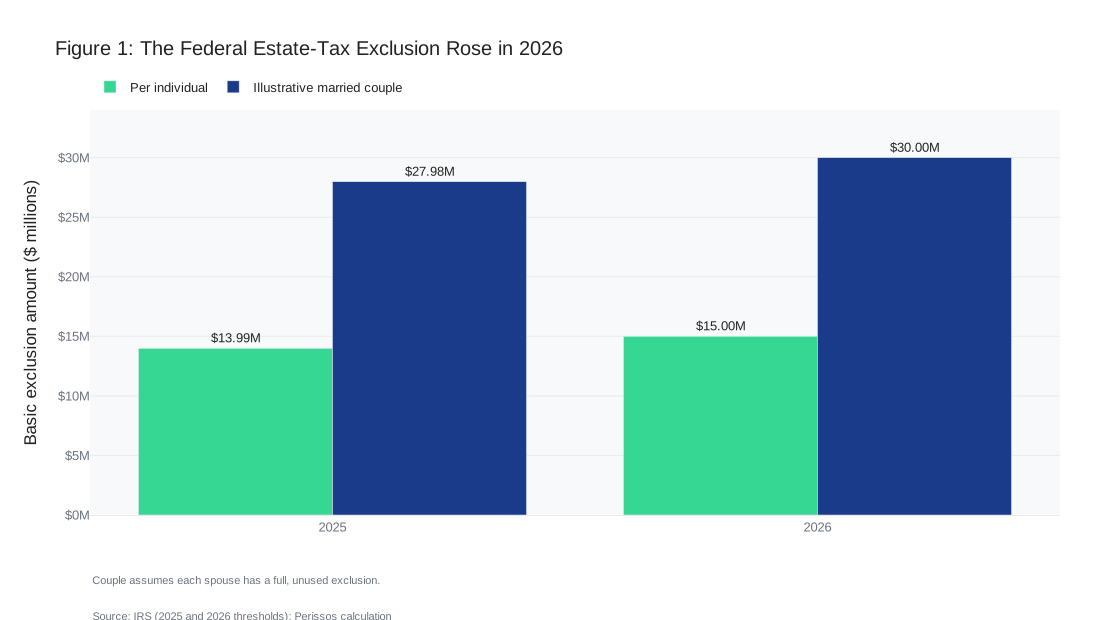
The federal basic exclusion amount was $13.99 million per individual in 2025 and is $15 million in 2026. For an illustrative married couple in which each spouse has a full, unused exclusion, that is $30 million of combined exclusion—not one shared $30 million exemption. Prior taxable gifts, portability, citizenship, asset ownership, and future law changes can alter the result.1,3
Figure 1 shows the actual direction of the federal threshold: it increased in 2026. This does not make estate planning unnecessary. It changes the reason for acting. Families whose estates are well below both federal and applicable state thresholds may have little tax reason to use a SLAT today. Families near or above those thresholds, especially those holding rapidly appreciating assets, may still find lifetime planning valuable.
What a SLAT Is
A SLAT is an irrevocable trust created by one spouse—the donor spouse—for the benefit of the other spouse and, often, descendants. The donor transfers assets to the trust as a completed gift. If the trust is properly drafted, funded, and administered, the transferred property and its future appreciation may be outside the donor's taxable estate.4,9 The beneficiary spouse can remain eligible for distributions under the trust's terms, which gives the household a measure of indirect access without restoring ownership or control to the donor.
The word “access” can be misleading. The donor has no personal withdrawal right and should not treat the trust as a family checking account. Federal gift-tax regulations generally treat a gift as complete only when the donor has parted with enough dominion and control that the donor cannot redirect the property for personal benefit.4 The spouse's potential benefit is therefore a planning backstop, not a promise that the donor can recover the assets.
How It Works
First, an estate-planning attorney designs the trust around the family's objectives, governing state law, trustee structure, beneficiaries, distribution standard, and succession provisions. The donor spouse then contributes assets the donor actually owns, usually separate property with clear records. A transfer of jointly owned or community property requires careful tracing and may first require a valid division of ownership.
Second, the transfer is valued and reported. A large gift to a SLAT typically uses part of the donor's lifetime gift and estate tax exclusion. The donor generally files Form 709, attaches the trust instrument for the first reported transfer, and includes the required valuation support. The IRS instructions emphasize adequate disclosure and supporting appraisals for relevant property.5 Using exemption is not the same as paying gift tax; gift tax is generally due only after available exclusion has been exhausted.1
Third, the trustee administers the trust as a separate legal arrangement. Depending on the document, the beneficiary spouse may receive distributions for health, education, maintenance, and support or under another discretionary standard. Children or later generations may also be beneficiaries. The trustee must follow the document rather than the donor's informal wishes.
Fourth, many SLATs are intentionally structured as grantor trusts for income-tax purposes. A grantor trust is generally ignored as a separate taxpayer to the extent the grantor is treated as its owner, so the grantor reports the trust's income, deductions, and credits.6 When the grantor pays that income tax, the payment generally is not an additional gift to the beneficiaries. That can allow the trust to compound without using trust assets for the tax, although mandatory reimbursement rights can create estate-inclusion concerns.7
Finally, the trust continues under its terms. Access through the beneficiary spouse may disappear if that spouse dies, and divorce can disrupt both the practical plan and its tax administration. Those events should be modeled before funding, not treated as remote footnotes.
Why the Strategy Can Still Matter
The central benefit is an estate freeze. The value transferred consumes exemption at the time of the gift, while later appreciation may occur outside the donor's estate. That can matter even with a $15 million 2026 exclusion when a family's current net worth, expected growth, life insurance, business interests, or state estate-tax exposure creates a reasonable chance of a taxable estate.
A SLAT can also serve non-tax purposes. Properly structured trusts may provide disciplined multigenerational stewardship, professional or independent administration, and a framework for protecting beneficiaries from poor decisions or outside claims. Those outcomes depend heavily on state law and the actual trust terms; “asset protection” should never be assumed from the acronym alone.
The strategy also carries an income-tax cost. Gifted assets generally retain the donor's basis, whereas qualifying property acquired from a decedent generally receives basis tied to fair market value at death.8 Removing a low-basis asset from the estate can therefore trade a possible estate-tax benefit for a larger future capital-gain burden. The right asset is not always the asset expected to appreciate fastest. Basis, cash flow, concentration risk, and the family's expected estate-tax exposure have to be evaluated together.
Who Benefits Most
The strongest candidates are married couples with estates already above, near, or likely to grow beyond federal or state estate-tax thresholds; substantial assets they can irrevocably part with; dependable cash flow and liquidity outside the trust; a stable marriage; and a genuine desire to transfer wealth to descendants or other long-term beneficiaries. Closely held business owners and families with concentrated, high-growth assets may have an especially strong reason to evaluate the strategy before a major appreciation or liquidity event.
Good candidates also understand that the trust is a legal and economic transfer, not a reversible tax election. They are willing to file gift-tax returns, obtain qualified valuations when needed, maintain separate records and accounts, respect the trustee's role, and coordinate the design with their estate attorney, CPA, and investment team.
Who Benefits Least
A SLAT is usually a poor fit for a couple that needs the transferred assets to fund retirement, expects to rely on the beneficiary spouse as a routine conduit back to the donor, has an unstable marriage, lacks sufficient assets outside the trust, or is unwilling to accept administrative cost and complexity. It may also be a weak tax strategy when the projected estate is comfortably below relevant thresholds and the assets have substantial unrealized gains that could otherwise qualify for a basis adjustment at death.
The structure is not available to an unmarried donor in its spousal form, and planning becomes more complex when either spouse is not a U.S. citizen, when community-property rules apply, or when creditor claims already exist. A transfer made after a claim arises may be attacked under fraudulent-transfer law. These are legal questions, not drafting details.
The Tradeoffs That Matter
The first tradeoff is control versus tax efficiency. Retaining too much control or an enforceable right to benefit from the property can undermine the intended estate-tax result. Section 2036 and its regulations can pull transferred property back into a donor's gross estate when the donor retains possession, enjoyment, income, or certain powers over the property.9
The second is access risk. The household's indirect access generally depends on the beneficiary spouse, the trustee, and the trust's distribution terms. Death, divorce, incapacity, or a change in family relationships can make that access unavailable just when the donor wants it most.
The third is basis. Estate-tax savings are only valuable if there is estate tax to save. For a family unlikely to owe estate tax, preserving the possibility of a basis adjustment may be more valuable than removing appreciation from the estate.
The fourth is reciprocal-trust risk. If spouses create trusts for each other that are too similar and leave each in roughly the same economic position, the IRS may invoke the reciprocal-trust doctrine and unwind the intended estate-tax treatment. In United States v. Estate of Grace, the Supreme Court focused on whether the trusts were interrelated and left the creators in substantially the same economic position.10 Merely signing documents on different days is not a reliable solution; substantive differences and independent planning purposes require experienced counsel.
A Better Decision Process
I would begin with a current balance sheet and a multi-year estate projection under more than one growth and tax-law scenario. Then identify which assets the family can truly give away, compare estate-tax exposure with embedded capital gains, test retirement and contingency liquidity outside the trust, and model the loss of spousal access after death or divorce.
Only after that analysis should the family decide the gift amount, assets, trustee, distribution standard, grantor-trust provisions, and whether one spouse or both spouses should create trusts. If both spouses proceed, the reciprocal-trust issue must be addressed in the design and economics, not papered over at the signing meeting.
The takeaway is straightforward: there is no 2026 federal estate-tax sunset to race against. A SLAT can still be a powerful planning tool, but only for families whose numbers, assets, and long-term intent justify an irrevocable transfer. Plan first, trust second.
Closing
What does this mean for your plan? Recheck any estate strategy that was built around a 2026 exemption reduction. The law changed, and the planning recommendation may have changed with it. Our team can help frame the financial and investment tradeoffs, but the final design and implementation should be coordinated with an experienced estate-planning attorney and CPA.
All my best,
Brandon VanLandingham, CFA, CMT, CFP
Founder / CIO
Lifetime Gifting Strategies for Families With $10M+
Asset Protection Trusts: What Oklahoma Allows
How to Use a Defined Benefit Plan as a Late-Career Tax Shield
Charitable Bequests vs. Lifetime Giving: Tax Implications
Citations
- Internal Revenue Service, “IRS Releases Tax Inflation Adjustments for Tax Year 2026, Including Amendments from the One, Big, Beautiful Bill,” IR-2025-103, October 9, 2025, https://www.irs.gov/newsroom/irs-releases-tax-inflation-adjustments-for-tax-year-2026-including-amendments-from-the-one-big-beautiful-bill.
- Public Law 119-21, § 70106, “Extension and Enhancement of Increased Estate and Gift Tax Exemption Amounts,” July 4, 2025, https://www.congress.gov/119/plaws/publ21/PLAW-119publ21.pdf.
- Internal Revenue Service, “Frequently Asked Questions on Estate Taxes,” updated December 22, 2025, https://www.irs.gov/businesses/small-businesses-self-employed/frequently-asked-questions-on-estate-taxes.
- 26 C.F.R. § 25.2511-2, “Cessation of Donor's Dominion and Control,” 2024 edition, https://www.govinfo.gov/content/pkg/CFR-2024-title26-vol16/pdf/CFR-2024-title26-vol16-sec25-2511-2.pdf.
- Internal Revenue Service, “Instructions for Form 709 (2025),” including adequate-disclosure and trust-transfer requirements, https://www.irs.gov/instructions/i709.
- Internal Revenue Service, “Instructions for Form 1041 and Schedules A, B, G, J, and K-1 (2025),” Grantor Type Trusts, https://www.irs.gov/instructions/i1041.
- Internal Revenue Service, Revenue Ruling 2004-64, 2004-27 I.R.B. 7, https://www.irs.gov/irb/2004-27_IRB.
- 26 U.S.C. §§ 1014 and 1015, “Basis of Property Acquired from a Decedent” and “Basis of Property Acquired by Gifts and Transfers in Trust,” 2024 edition, https://www.govinfo.gov/app/details/USCODE-2024-title26/USCODE-2024-title26-subtitleA-chap1-subchapO-partII-sec1014 and https://www.govinfo.gov/app/details/USCODE-2024-title26/USCODE-2024-title26-subtitleA-chap1-subchapO-partII-sec1015.
- 26 C.F.R. § 20.2036-1, “Transfers with Retained Life Estate,” 2025 edition, https://www.govinfo.gov/app/details/CFR-2025-title26-vol16/CFR-2025-title26-vol16-sec20-2036-1.
- United States v. Estate of Grace, 395 U.S. 316 (1969), https://www.govinfo.gov/content/pkg/USREPORTS-395/pdf/USREPORTS-395-316.pdf.
Important Disclosures
This piece is educational. It is not legal, tax, or accounting advice and is not a recommendation to take or refrain from any specific action. Tax law is fact-specific and changes regularly. Please coordinate any decisions discussed here with your attorney, your CPA, and Perissos before acting.
Perissos Private Wealth Management is a Registered Investment Adviser ("RIA"). Registration as an investment adviser does not imply a certain level of skill or training, and the content of this communication has not been approved or verified by the United States Securities and Exchange Commission or by any state securities authority. Perissos Private Wealth Management renders individualized investment advice to persons in a particular state only after complying with the state's regulatory requirements, or pursuant to an applicable state exemption or exclusion. All investments carry risk, and no investment strategy can guarantee a profit or protect from loss of capital. Past performance is not indicative of future results.
The information contained in this newsletter is intended to provide general information about market themes. It is not intended to offer investment advice. Investment advice will only be given after a client engages our services by executing the appropriate investment services agreement. Information regarding investment products and services is given solely to provide education regarding our investment philosophy and our strategies. You should not rely on any information provided in making investment decisions.
Market data, articles and other content in this material are based on generally available information and are believed to be reliable. Perissos Private Wealth Management does not guarantee the accuracy of the information contained in this material.
Perissos Private Wealth Management will provide all prospective clients with a copy of our current Form ADV, Part 2A (Disclosure Brochure), Part 2B (Supplemental Brochures), and Part 3 (Client Relationship Summary) prior to commencing an advisory relationship. You can also view these documents at any time at adviserinfo.sec.gov or by contacting us requesting a copy.
Sources
Explore topics
Share this article
Last reviewed: August 11, 2026
Frequently Asked Questions
- What is the federal basic exclusion amount for 2026?
- The 2025 tax law set the federal basic exclusion amount at $15 million per individual for 2026, which will be indexed for inflation in subsequent years.
- How does a SLAT provide indirect access to assets?
- A SLAT allows the beneficiary spouse to receive distributions for needs like health and maintenance, providing the household indirect access while the donor spouse gives up personal ownership.
- What is the primary tax benefit of an estate freeze using a SLAT?
- By transferring assets to a SLAT now, the donor uses their current exclusion while allowing future appreciation to occur outside their taxable estate, potentially reducing future tax liability.