

Written and reviewed by Brandon VanLandingham, CFA, CMT, CFP® · Last updated August 22, 2026
Why inherited property can create income-tax savings even when no estate tax is due
August 22, 2026
Most families hear the phrase "estate tax" and immediately think about the federal exemption. That matters, but it is not the whole story. For 2026, estates of decedents who die during the year have a $15,000,000 federal basic exclusion amount, up from $13,990,000 for 2025 decedents.5 That means many families will never owe federal estate tax.
But those same families may still have a major income-tax planning issue hiding in plain sight: basis.
Basis is the tax number used to measure gain or loss when property is sold. If you bought a stock, home, farm, rental property, or closely held business interest for $100,000 and it is later sold for $500,000, the starting point for the taxable gain calculation is usually the $400,000 difference. Estate planning changes that conversation because certain property acquired from a decedent generally receives a new basis equal to fair market value at the date of death, unless another valuation rule applies.1,3 That is the "step-up in basis."
The step-up is not only an estate tax concept. For many families, it is the estate planning concept that determines whether heirs inherit an asset with embedded capital gain or an asset with a fresh tax basis.
Why Basis Is the Tax Number Families Overlook
The basic rule is straightforward. Under Internal Revenue Code section 1014, property acquired from a decedent generally takes a basis equal to fair market value at the date of death.1 IRS Publication 551 describes the same practical rule for inherited property, with alternate valuation and special-use valuation exceptions when elected or applicable.3 IRS Publication 559 also explains that inherited property basis is generally fair market value at death, the alternate valuation date, or a special-use value for certain farm or closely held business real property.4
Figure 1 shows why this can matter more than the estate tax itself for a family below the federal exemption.
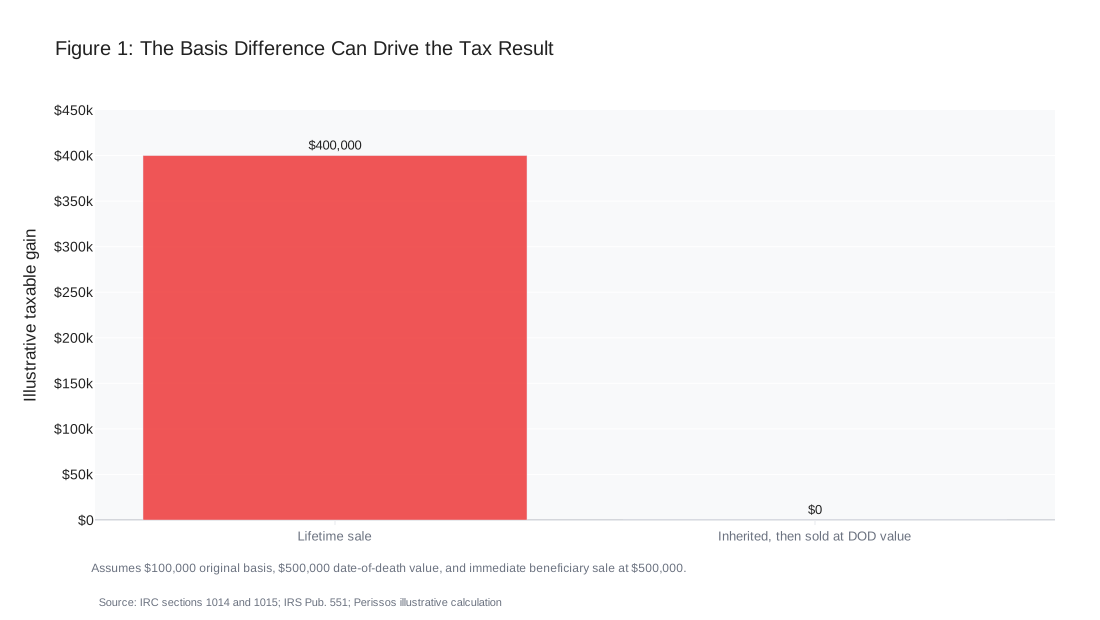
In the illustration, assume an asset was purchased for $100,000 and is worth $500,000. If the owner sells during life, the taxable gain before considering rates, exclusions, selling costs, state tax, or other adjustments is $400,000. If the same asset is inherited and the beneficiary sells immediately at the date-of-death value, the assumed taxable gain is $0 because the new basis equals the sale value. That does not mean every inherited asset is tax-free forever. It means the pre-death appreciation may be removed from the beneficiary's capital-gain calculation if the step-up rule applies.
Where the Step-Up Can Matter
The rule can apply to many assets families actually own: taxable brokerage accounts, real estate, land, rental property, closely held business interests, and other capital assets that have appreciated. It can be especially important when a family has done a good job holding assets for a long time. Long-term ownership often creates long-term appreciation. Appreciation is good, but it can also create a large embedded tax liability if the wrong asset is sold, gifted, titled, or transferred at the wrong time.
The contrast with lifetime gifting is important. Section 1015 generally provides that property acquired by gift takes the donor's basis, subject to special loss-basis and gift-tax adjustment rules.2 In plain English, when you give appreciated property during life, you may also give the built-in gain to the recipient. When appreciated property is inherited at death and qualifies under section 1014, the heir may receive a new basis instead.
This is why "just give the kids the asset now" can be too simple. Lifetime gifts can be excellent planning tools when the goals are asset protection, future-appreciation transfer, estate-tax reduction, creditor planning, business succession, or family governance. But for highly appreciated assets owned by a family that is not expected to owe estate tax, a lifetime gift can sometimes trade away a valuable basis adjustment for no meaningful estate-tax benefit.
The Estate Tax and Income Tax Are Connected, But They Are Not the Same
Estate tax is a transfer tax. Capital-gain tax is an income-tax issue. The step-up in basis sits between the two systems.
That distinction matters because the federal estate-tax exemption is currently high. A married couple may have substantial wealth and still be below the federal taxable-estate threshold, especially when portability is properly elected and available. Form 706 is also used to elect portability of a deceased spouse's unused exclusion amount, and the IRS instructions state that the estate tax return is generally due within nine months after death, with a potential six-month extension.6
The planning implication is practical: even if the family is not worried about a federal estate tax bill, the executor and advisors still need to document date-of-death values, evaluate whether a Form 706 should be filed, and preserve basis records for heirs. Poor records can turn a good tax rule into an administrative problem.
There is also an alternate valuation rule. If the executor elects alternate valuation under section 2032, estate property may be valued as of disposition during the six months after death or, for property not disposed of during that period, six months after death.7 That election is not a casual asset-by-asset choice; it has estate-wide consequences and should be coordinated carefully with the attorney and CPA.
When Step-Up Is Not the Answer
The step-up is powerful, but it is not universal.
Traditional IRAs and many retirement accounts are a common example. IRS Publication 559 explains that inherited traditional IRA distributions can be taxable to the beneficiary as income in respect of a decedent, up to the decedent's taxable balance.4 Those accounts may be excellent wealth-transfer assets, but they generally do not work like an appreciated brokerage account receiving a new capital-gain basis.
There are also special rules for property given to a decedent shortly before death. IRS Publication 559 describes an exception for appreciated property that a person or spouse gave to the decedent within the one-year period ending on the date of death and later received back from the decedent; in that case, basis may remain tied to the decedent's adjusted basis immediately before death instead of fair market value.4 Community property, joint ownership, trusts, depreciation, business entities, special-use valuation, conservation easements, and state inheritance or estate tax rules can also change the analysis.
The biggest planning mistake is treating the step-up as an automatic reason to hold every appreciated asset until death. That is too narrow. Sometimes the better plan is to sell, diversify, fund a trust, make lifetime gifts, reduce concentration risk, create liquidity, or simplify the estate. Tax efficiency matters, but it should not outrank the family's actual goals, cash-flow needs, risk tolerance, health situation, charitable intent, and governance concerns.
What This Means for Your Plan
The right question is not "How do we avoid every tax?" The right question is, "Which assets should be held, sold, gifted, retitled, or transferred, and why?"
For appreciated taxable assets, our team wants to know the current value, cost basis, unrealized gain, ownership structure, expected liquidity needs, charitable goals, and likely estate-tax exposure. Then we can coordinate with the client's CPA and estate attorney before recommending a transaction. That coordination matters because the same move can have different income-tax, estate-tax, legal, creditor, and family consequences.
A good review usually starts with a simple inventory. Identify taxable assets with large unrealized gains. Separate those from retirement accounts, Roth accounts, life insurance, annuities, business interests, and trust-owned assets. Confirm titling and beneficiary designations. Then evaluate whether the current ownership structure still matches the estate documents and the family's actual goals.
For many families, the step-up in basis is not a reason to do nothing. It is a reason to be precise.
Closing
Estate planning is not only about who gets what. It is also about what tax character, records, liquidity, and flexibility they inherit.
The step-up in basis is one of the clearest examples. Used thoughtfully, it can reduce unnecessary capital-gain tax and preserve more flexibility for heirs. Used carelessly, or ignored entirely, it can lead to avoidable tax friction and messy administration.
Before transferring a highly appreciated asset, selling a long-held position, adding a child to title, or changing trust ownership, pause and ask how basis will be affected. That one question can change the entire planning conversation.
All my best,
Brandon VanLandingham, CFA, CMT, CFP
Founder / CIO
Lifetime Gifting Strategies for Families With $10M+
Charitable Bequests vs. Lifetime Giving: Tax Implications
Generation-Skipping Transfer Tax: Planning Around the Exemption
Citations
- 6 U.S.C. § 1014, "Basis of property acquired from a decedent," U.S. Code, Office of the Law Revision Counsel, retrieved August 22, 2026. https://uscode.house.gov/view.xhtml?req=%28title%3A26%20section%3A1014%20edition%3Aprelim%29
- 26 U.S.C. § 1015, "Basis of property acquired by gifts and transfers in trust," U.S. Code, Office of the Law Revision Counsel, retrieved August 22, 2026. https://uscode.house.gov/view.xhtml?edition=prelim&num=0&req=granuleid%3AUSC-prelim-title26-section1015
- IRS Publication 551, "Basis of Assets," December 2025 revision, retrieved August 22, 2026. https://www.irs.gov/publications/p551
- IRS Publication 559, "Survivors, Executors, and Administrators," 2025 revision, retrieved August 22, 2026. https://www.irs.gov/publications/p559
- IRS, "IRS releases tax inflation adjustments for tax year 2026, including amendments from the One, Big, Beautiful Bill," IR-2025-103, October 9, 2025, retrieved August 22, 2026. https://www.irs.gov/newsroom/irs-releases-tax-inflation-adjustments-for-tax-year-2026-including-amendments-from-the-one-big-beautiful-bill
- IRS Instructions for Form 706, September 2025 revision, retrieved August 22, 2026. https://www.irs.gov/instructions/i706
- 26 U.S.C. § 2032, "Alternate valuation," U.S. Code, Office of the Law Revision Counsel, retrieved August 22, 2026. https://uscode.house.gov/view.xhtml?edition=prelim&num=0&req=%28title%3A26%20section%3A2032%20edition%3Aprelim%29
Important Disclosures
This piece is educational. It is not legal, tax, or accounting advice and is not a recommendation to take or refrain from any specific action. Tax law is fact-specific and changes regularly. Please coordinate any decisions discussed here with your attorney, your CPA, and Perissos before acting.
Perissos Private Wealth Management is a Registered Investment Adviser ("RIA"). Registration as an investment adviser does not imply a certain level of skill or training, and the content of this communication has not been approved or verified by the United States Securities and Exchange Commission or by any state securities authority. Perissos Private Wealth Management renders individualized investment advice to persons in a particular state only after complying with the state's regulatory requirements, or pursuant to an applicable state exemption or exclusion. All investments carry risk, and no investment strategy can guarantee a profit or protect from loss of capital. Past performance is not indicative of future results.
The information contained in this newsletter is intended to provide general information about market themes. It is not intended to offer investment advice. Investment advice will only be given after a client engages our services by executing the appropriate investment services agreement. Information regarding investment products and services is given solely to provide education regarding our investment philosophy and our strategies. You should not rely on any information provided in making investment decisions.
Market data, articles and other content in this material are based on generally available information and are believed to be reliable. Perissos Private Wealth Management does not guarantee the accuracy of the information contained in this material.
Perissos Private Wealth Management will provide all prospective clients with a copy of our current Form ADV, Part 2A (Disclosure Brochure), Part 2B (Supplemental Brochures), and Part 3 (Client Relationship Summary) prior to commencing an advisory relationship. You can also view these documents at any time at adviserinfo.sec.gov or by contacting us requesting a copy.
Sources
Explore topics
Share this article
Last reviewed: August 22, 2026
Frequently Asked Questions
- What is the primary benefit of a step-up in basis for heirs?
- The rule resets the tax basis of an inherited asset to its fair market value at the date of death, which can eliminate capital gains tax on appreciation that occurred during the decedent's lifetime.
- Do lifetime gifts receive a step-up in basis?
- No, property acquired by gift during the donor's lifetime generally takes the donor's original basis, meaning the recipient also inherits any built-in capital gains liability.
- Are retirement accounts eligible for a basis step-up?
- Traditional IRAs and other retirement accounts are typically excluded because they are considered income in respect of a decedent and remain taxable to the beneficiary.