

Written and reviewed by Brandon VanLandingham, CFA, CMT, CFP® · Last updated October 27, 2026
Structured Notes Explained: Reading the Fine Print
Understand the payment formula before deciding what the investment is worth.
October 23, 2026
A structured note can offer an attractive-looking combination: income, some exposure to market gains, and a measure of downside protection. The difficult part is discovering which conditions govern each benefit. A payment may depend on an observation date. Protection may disappear after a threshold is crossed. A favorable market move may end the investment early. The fine print is the investment.
I would approach a proposed note by drawing its cash flows before discussing whether its quoted coupon is appealing. What happens if markets rise, fall modestly, fall sharply, or recover after a decline? What happens if you need the money early? If the answers cannot be explained clearly in dollars, the household is not ready to make the allocation.
You own a promise with a formula
Structured notes combine a debt component with an embedded derivative. Their payments reference an asset, index, or other measure. The SEC’s Investor Bulletin: Structured Notes explains that the purchase price can exceed the issuer’s estimated initial value and that secondary-market liquidity may be limited.1
That makes the issuer part of the investment decision. A sound payoff formula cannot remove the risk that the party owing the money fails to pay. The joint SEC and FINRA principal-protection alert explains that even promised principal protection depends on issuer creditworthiness and generally requires holding to maturity.2
My planning implication is straightforward: do not put a note into the cash bucket merely because it includes the word “protected.” Map its repayment conditions to the obligation it is supposed to fund. A future tuition payment or known retirement withdrawal should not quietly depend on an equity-market condition the family has never examined.
Separate income, upside, and loss exposure
Start a review with three separate calculations. First, identify when a coupon is payable and when it can be skipped. Second, identify how much appreciation you receive and whether a cap limits it. Third, determine exactly when principal can be lost. Conditional coupons, participation rates, caps, and call provisions vary by note; they cannot be inferred from a headline rate.1,2
A coupon rate answers a narrower question than total return. For example, assume a hypothetical $100,000 investment pays $8,000 during its life and returns only $70,000 of principal. Total dollars received are $78,000, a $22,000 economic loss before taxes and other costs. That is a negative 22% cumulative result, not an 8% investment success. No annualized return can be calculated from those amounts without the payment dates.
For conventional bonds, Bond Yields Explained: Coupon, Yield-to-Maturity, and Duration distinguishes cash payments from investment return. Apply the same discipline here, with an additional step: the cash flows themselves may depend on future events. A promised formula is not the same as a predetermined payment schedule.
A buffer and a barrier are different agreements
Figure 1 shows two hypothetical maturity formulas for a $100,000 investment. These are teaching examples, not available offerings. Both reference an asset’s price change over the full term, have a 10% maximum upside return, and pay no interim coupons. Assume no dividends, taxes, additional fees, early redemption, or issuer default. The chart isolates principal-loss mechanics.
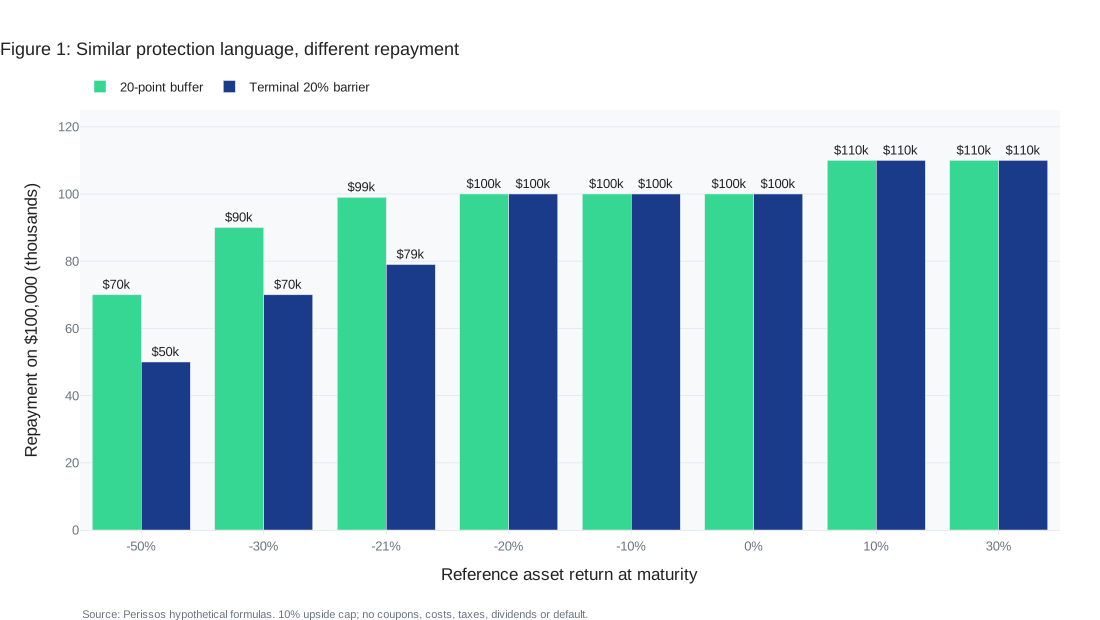
In the first formula, a 20-percentage-point buffer absorbs the first portion of a decline. A negative 10% reference return leaves the investment at $100,000; a negative 30% reference return leaves $90,000. We assume one-for-one losses beyond the buffer, so a negative 50% reference return leaves $70,000. Actual contracts can specify different participation and loss calculations.
In the second formula, a terminal barrier protects principal only when the final reference return is at least negative 20%. At negative 20%, repayment is $100,000. Just below that threshold, protection disappears and the full reference loss applies. A negative 21% outcome therefore returns $79,000, and a negative 30% outcome returns $70,000. The small market difference around the threshold creates a large repayment difference under this assumed contract.
Neither example implies that every buffer or barrier works this way. In particular, this illustration checks the barrier only at maturity. A contract that observes prices during the term requires a path-dependent analysis: two investments with the same final reference price might have different contractual outcomes. Ask the seller to identify the observation schedule and calculate scenarios immediately above and below every threshold.
Read the documents in decision order
Begin with the exact security and its final pricing supplement, together with the governing offering documents. Preliminary illustrations may not contain the final economics. I would write down the issue price, issuer and any guarantor, maturity, reference assets, payment dates, participation rules, caps, thresholds, and call terms. Then reconcile the resulting summary with the actual legal formula.
Next, ask for downside examples. Include a sharp fall in a single reference asset when several are involved. Ask whether the formula uses an average, a basket, or the weakest performer. Do not interpret a list of reference assets as diversification until you know how the payment depends on them. The request should be specific enough that the response can be independently recalculated.
The discipline in How to Read an ETF Prospectus Like a Portfolio Manager is useful here even though a note has a different legal structure. Start with the objective, mechanics, costs, and risks. Then connect them to the household’s intended holding period. A product summary can organize the review, but it cannot replace the controlling documents.
Plan for an inconvenient exit
An early sale can produce a result very different from the maturity illustration. The SEC warns that a note may have little secondary-market trading and that issuers need not provide a ready exit.1 I would ask who is expected to quote a bid, whether that commitment is contractual, and what information will be available to evaluate the quote. Treat an indicative account value and executable cash proceeds as separate things.
Also examine the opposite problem: repayment earlier than you wanted. A callable note may stop delivering its hoped-for payments and leave you to reinvest under different conditions.2 Build a spending plan that works if the note is called at the first permitted opportunity and another that works if it remains outstanding until maturity. The longer advertised term is not necessarily the duration of the household’s income stream.
Keep an inventory across issuers and reference exposures. Several different notes can still create dependence on the same market outcome or repayment source. I would evaluate the combined loss scenario before approving another subscription, especially when the family also owns a concentrated business or stock position. The unit of planning is the household portfolio, not each sales illustration in isolation.
Set the conditions for an allocation
A note may merit consideration when an investor understands a particular payoff, can accept its issuer and liquidity risks, and has a clearly defined use for that payoff. It is a poor fit for money that must remain readily available, for an investor seeking uncomplicated income, or for someone who would be surprised by the modeled loss. Complexity needs to solve a real problem.
Before buying, coordinate the proposed tax treatment and reporting with your CPA; do not assume all notes receive the same treatment. Seek legal review when material protections or ownership provisions are unclear. Ask the adviser to compare the proposal with a simpler allocation that addresses the same spending and risk objectives, using comparable dates and explicit assumptions.
The final decision should fit on a page: what the note promises, what can interrupt payment, what can cause loss, how it will be funded, and why those terms serve the plan. Keep the signed-off scenario analysis with the final documents. If the appeal disappears once the unfavorable cases are drawn, the fine print has done its job before your capital is committed.
All my best,
Brandon VanLandingham, CFA, CMT, CFP
Founder / CIO
Citations
- SEC, Investor Bulletin: Structured Notes, January 12, 2015. Retrieved October 23, 2026.
- SEC and FINRA, Structured Notes with Principal Protection: Note the Terms of Your Investment, June 2, 2011. Retrieved October 23, 2026. All numerical scenarios and Figure 1 are hypothetical calculations, not market quotes or product terms.
Important Disclosures
This piece is educational. It is not legal, tax, or accounting advice and is not a recommendation to take or refrain from any specific action. Tax law is fact-specific and changes regularly. Please coordinate any decisions discussed here with your attorney, your CPA, and Perissos before acting.
Perissos Private Wealth Management is a Registered Investment Adviser ("RIA"). Registration as an investment adviser does not imply a certain level of skill or training, and the content of this communication has not been approved or verified by the United States Securities and Exchange Commission or by any state securities authority. Perissos Private Wealth Management renders individualized investment advice to persons in a particular state only after complying with the state's regulatory requirements, or pursuant to an applicable state exemption or exclusion. All investments carry risk, and no investment strategy can guarantee a profit or protect from loss of capital. Past performance is not indicative of future results.
The information contained in this newsletter is intended to provide general information about market themes. It is not intended to offer investment advice. Investment advice will only be given after a client engages our services by executing the appropriate investment services agreement. Information regarding investment products and services is given solely to provide education regarding our investment philosophy and our strategies. You should not rely on any information provided in making investment decisions.
Market data, articles and other content in this material are based on generally available information and are believed to be reliable. Perissos Private Wealth Management does not guarantee the accuracy of the information contained in this material.
Perissos Private Wealth Management will provide all prospective clients with a copy of our current Form ADV, Part 2A (Disclosure Brochure), Part 2B (Supplemental Brochures), and Part 3 (Client Relationship Summary) prior to commencing an advisory relationship. You can also view these documents at any time at adviserinfo.sec.gov or by contacting us requesting a copy.
Frequently Asked Questions
- What is the biggest risk investors overlook in structured notes?
- Many investors focus on the coupon and overlook the exact payoff formula, issuer credit risk, and limited secondary-market liquidity. A note’s outcome can change materially based on thresholds, observation dates, and call provisions.
- How is a buffer different from a barrier in a structured note?
- A buffer absorbs an initial portion of a loss before principal declines, while a barrier may protect principal only until a threshold is breached. Once a barrier is crossed under the contract terms, losses can apply more abruptly.
- Why can selling a structured note early be problematic?
- An early sale may produce a value very different from the maturity illustration because secondary-market liquidity can be limited. Indicative account values and actual executable bids are not always the same.