

Written and reviewed by Brandon VanLandingham, CFA, CMT, CFP® · Last updated November 20, 2026
Domestic Asset Protection Trusts vs. Offshore Structures
Compare legal limits, control, reporting and costs before moving assets
November 20, 2026
A trust described as protective can sound like a simple answer to a complicated concern: how do you keep a lawsuit, business problem, or personal liability from disrupting the family's long-term plan? The useful question is more specific. Which assets face which risks, what protections already exist, and what control are you prepared to surrender for an additional layer of protection?
Domestic asset protection trusts and offshore structures approach that problem through different legal and administrative arrangements. Neither label establishes that assets are unreachable. I would evaluate them after reviewing insurance, ownership, business arrangements, and household liquidity, with an attorney who can assess creditor law in every relevant jurisdiction. This is an educational comparison, not a recommendation to move assets or an opinion on a particular family's exposure.
Understand whose assets and whose creditors are involved
A self-settled trust is funded by someone who can also benefit from it. That is different from a parent creating a trust solely for children. A domestic asset protection trust generally seeks to use a state's statutory framework to restrict creditor access while allowing specified retained benefits. Delaware's qualified-disposition statute, for example, specifies trustee qualifications, permitted retained interests, and limits on protection.1
Do not confuse that structure with an ordinary revocable living trust. A document used to organize succession does not automatically accomplish the same creditor-planning objective. Our plain-English comparison of revocable and irrevocable trusts is a useful starting point for separating control, administration, and tax treatment. Ask counsel to identify the provision that supports each claimed benefit.
The family should also distinguish protection for the person funding a trust from protection intended for future beneficiaries. Our discussion of dynasty trusts and multigenerational wealth addresses the latter planning context. A strategy designed for an heir should not be assumed to protect the creator's retained access in the same way.
Domestic structures remain dependent on the actual statute
Delaware provides one example rather than a universal model. Its law requires a qualified trustee and a qualifying instrument, restricts retained rights, and preserves exceptions for specified claims. The statute addresses matters including certain support obligations and specified pre-transfer injury claims.1 Other states use different definitions, exceptions, procedures, and time limits.
For an Oklahoma household considering another state's trust, request an analysis of the connection to that state, where the assets sit, and which court and law could govern a dispute. Do not assume that selecting favorable governing-law language answers every conflict-of-laws question. Ask the attorney to explain what is settled, what depends on facts, and what might have to be litigated.
Review ordinary operations as carefully as the legal opinion. Who approves distributions? Who manages investments? What records must be maintained? Can the trustee be replaced, and what happens during a disagreement? A family that expects unrestricted access whenever it asks may find that expectation inconsistent with the structure it is buying. Put the permitted control in writing rather than relying on informal assurances.
Offshore changes the administration, not every obligation
An offshore structure may involve foreign governing law, foreign trustees, or foreign administration. Those features require separate analysis rather than a general claim that a foreign address defeats U.S. creditors. For U.S. tax classification, the IRS uses court-supervision and control tests; the location of a bank account alone does not decide whether a trust is foreign.2
Nor does a foreign trust eliminate the significance of U.S. court orders directed at people subject to U.S. jurisdiction. In a 1998 enforcement matter, the FTC reported a civil-contempt finding against defendants who failed to repatriate assets held in an offshore trust.3 That historical example is not a prediction about every trust. It demonstrates why a claim that offshore assets can simply be ignored by U.S. courts deserves scrutiny.
Before considering a foreign arrangement, ask counsel in the relevant jurisdictions to explain enforcement, trustee duties, dispute resolution, and the practical consequences of a distribution request being refused. Understand who can change the trustee, where records are maintained, and how the family would obtain independent advice if the relationship fails. Cross-border complexity is part of the decision, not a detail to settle after funding.
Timing and transfer law are central limitations
Federal bankruptcy law adds another layer. Under 11 U.S.C. Section 548(e), specified transfers within ten years before a bankruptcy filing can be avoided when the debtor transfers property to a self-settled trust or similar device, remains a beneficiary, and acts with actual intent to hinder, delay, or defraud a creditor.4 This is a conditional avoidance rule, not a statement that every such trust fails for ten years.
Other transfer rules also matter. Section 548 includes provisions involving less than reasonably equivalent value combined with insolvency or other specified financial conditions.4 State-law rules and the facts of the transfer require separate review. Solvency, pending claims, guarantees, and foreseeable obligations should be disclosed fully to counsel before a transaction is proposed.
I would reject a plan whose appeal depends on hiding ownership, misleading a creditor, or assuming a known obligation will disappear. If a claim is already developing, obtain legal advice about the claim and permissible conduct before changing ownership. A trust review should produce a reasoned analysis of lawful prospective planning, not an instruction to move money quickly and ask questions later.
Tax reporting is an ongoing responsibility
The IRS explanation of foreign trusts makes clear that U.S. owners can remain taxable on trust income under grantor-trust rules. Certain transfers and distributions also have tax consequences, and information-reporting failures can produce significant penalties.5 Asset protection and tax exemption are separate questions.
Form 3520 can be required for reportable transfers, ownership, or distributions involving a foreign trust. Form 3520-A generally applies to a foreign trust with a U.S. owner, and that owner has responsibilities for ensuring appropriate reporting. The instructions address substitute filings when the foreign trust does not file as required.2,6 Ask an international-tax CPA to determine the complete filing calendar, including any other foreign-asset reporting obligations.
This work continues after the initial legal fee is paid. Require a clear agreement on who supplies statements, who prepares returns, who reviews them, and who confirms timely filing. A trustee's general promise to assist is not the same as a complete tax-reporting process. Include the cost of that work in the comparison before committing assets.
Compare the burden with the problem you are solving
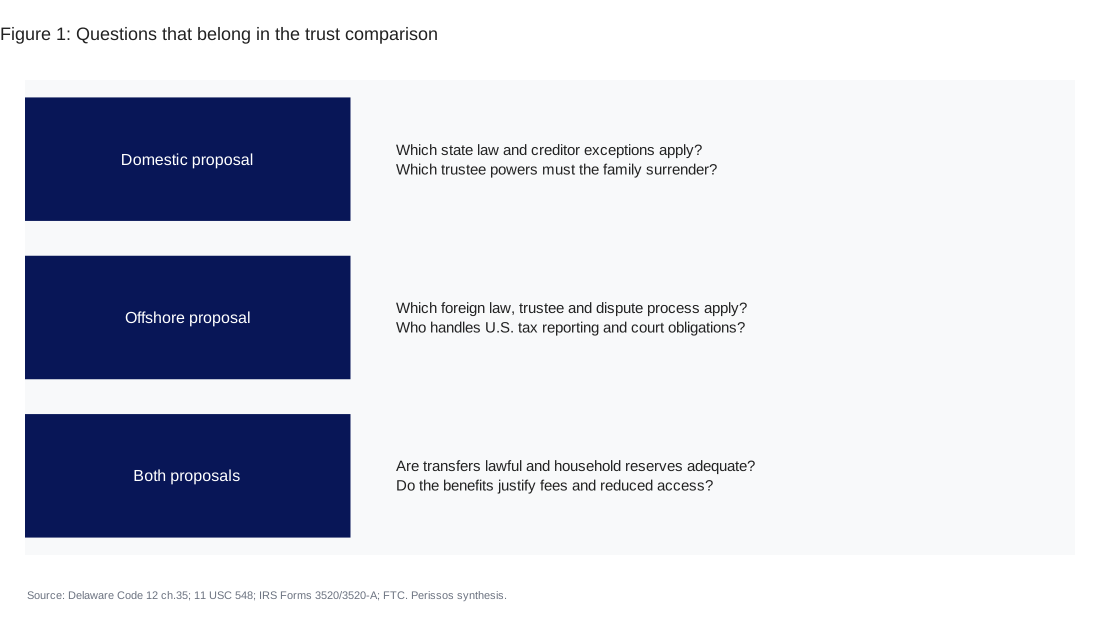
Figure 1 summarizes the questions to resolve for a domestic or offshore proposal. It deliberately avoids ranking one as universally stronger: enforceability depends on the actual law, facts, assets, and parties. The comparison is useful only when each provider's claims are translated into specific responsibilities and limitations.
Either structure may merit review for a household with substantial surplus assets, identifiable prospective exposure, and the willingness to fund ongoing legal and fiduciary administration. Either may be a poor fit when the transferred money is needed for ordinary living costs, the household cannot tolerate independent distribution decisions, or the expense exceeds the plausible benefit. Offshore administration adds questions about foreign law and U.S. reporting that the family must be prepared to manage.
Ask for written estimates covering setup, trustee administration, investment custody, tax preparation, periodic legal review, and an orderly exit or trustee transition. Compare those costs with improving existing insurance and business practices. Retain enough accessible resources for spending, taxes, and emergencies under a conservative household projection. A protective structure should not create a new liquidity problem.
Before signing, have your Oklahoma attorney coordinate with any additional jurisdiction's counsel and your CPA. Our team can help assess the assets, cash needs, and investment implications within that legal framework. Proceed only when you can explain the risk being addressed, the limitations that remain, who controls the property, and how the arrangement will be administered year after year.
All my best,
Brandon VanLandingham, CFA, CMT, CFP
Founder / CIO
Citations
- Delaware Code, Title 12, Chapter 35, Subchapter VI (retrieved November 12, 2026).
- IRS: Instructions for Form 3520-A (retrieved November 12, 2026).
- FTC: Civil Contempt Order Concerning Offshore Trust Assets, June 1998 (retrieved November 12, 2026).
- 11 U.S.C. Section 548, official U.S. Code (retrieved November 12, 2026).
- IRS: Foreign Trust Reporting Requirements and Tax Consequences (retrieved November 12, 2026).
- IRS: Instructions for Form 3520 (retrieved November 12, 2026).
Important Disclosures
This piece is educational. It is not legal, tax, or accounting advice and is not a recommendation to take or refrain from any specific action. Tax law is fact-specific and changes regularly. Please coordinate any decisions discussed here with your attorney, your CPA, and Perissos before acting.
Perissos Private Wealth Management is a Registered Investment Adviser ("RIA"). Registration as an investment adviser does not imply a certain level of skill or training, and the content of this communication has not been approved or verified by the United States Securities and Exchange Commission or by any state securities authority. Perissos Private Wealth Management renders individualized investment advice to persons in a particular state only after complying with the state's regulatory requirements, or pursuant to an applicable state exemption or exclusion. All investments carry risk, and no investment strategy can guarantee a profit or protect from loss of capital. Past performance is not indicative of future results.
The information contained in this newsletter is intended to provide general information about market themes. It is not intended to offer investment advice. Investment advice will only be given after a client engages our services by executing the appropriate investment services agreement. Information regarding investment products and services is given solely to provide education regarding our investment philosophy and our strategies. You should not rely on any information provided in making investment decisions.
Market data, articles and other content in this material are based on generally available information and are believed to be reliable. Perissos Private Wealth Management does not guarantee the accuracy of the information contained in this material.
Perissos Private Wealth Management will provide all prospective clients with a copy of our current Form ADV, Part 2A (Disclosure Brochure), Part 2B (Supplemental Brochures), and Part 3 (Client Relationship Summary) prior to commencing an advisory relationship. You can also view these documents at any time at adviserinfo.sec.gov or by contacting us requesting a copy.
Frequently Asked Questions
- Do domestic asset protection trusts make assets unreachable to creditors?
- No. A domestic asset protection trust depends on the specific state statute, retained rights, exceptions for certain claims, and how courts apply conflict-of-laws rules.
- Does moving assets offshore eliminate U.S. tax or court obligations?
- No. Offshore administration does not automatically change U.S. tax classification, and U.S. courts may still issue orders affecting people subject to U.S. jurisdiction.
- Why do timing and transfer law matter in asset protection planning?
- Transfers made when claims are developing or under facts suggesting intent to hinder, delay, or defraud creditors can face challenge under bankruptcy and state transfer laws.