

Written and reviewed by Brandon VanLandingham, CFA, CMT, CFP® · Last updated November 21, 2026
Estate Tax Exemption Sunset: Planning Before 2026 Ends
No sunset is scheduled for year-end 2026; review the decisions that still matter
November 21, 2026
There is no federal estate-tax exemption sunset scheduled for the end of 2026 under current law. The older sunset premise in this topic's title has been superseded. Public Law 119-21 changed the law for deaths and gifts after 2025, and the IRS confirms a $15 million basic exclusion per individual for 2026.1,2 A family should not make an irreversible gift merely to meet a deadline that no longer exists.
That correction does not make estate planning unnecessary. It changes the reason for acting. I would use the remainder of this year to confirm your available exclusion, review earlier planning assumptions, compare lifetime gifts with retaining assets, and make sure your family can carry out the plan. This memo addresses the federal framework for U.S. citizens and residents; cross-border situations require separate analysis.
Replace the old deadline with the law actually in force
Section 70106 of the enacted law replaced the basic statutory amount with $15 million, revised the inflation-adjustment provisions for years after 2026, and removed the prior temporary increase provision. It did not substitute a new December 2026 sunset.1 Future legislation can change the rules, but a possible future change is different from an enacted expiration.
The IRS estate and gift tax update lists $13.99 million for 2025 and $15 million for 2026.2 These are amounts for particular years, not promises about the value of an estate that will escape tax decades from now. For a future-year transaction, confirm that year's published amount before implementing it.
Review any presentation, spreadsheet, or trust recommendation prepared around the former sunset. The original strategy may still serve a family objective, but its justification should be updated. Ask which benefits remain, which assumptions changed, and whether the cost of giving up access is still warranted. A sound recommendation should stand on today's facts rather than on a deadline copied from an older memo.
Your available exclusion is a personal calculation
The basic exclusion is not a fresh amount available for every gift. Federal gift and estate taxes work together, and prior taxable gifts affect the later calculation. The IRS describes the estate-return filing test using the gross estate and adjusted taxable gifts, with other applicable items.3 Start with previously filed gift-tax returns, not just the balance shown on current investment statements.
For a simplified illustration, assume an individual has used $4 million of basic exclusion on prior taxable gifts, has no deceased-spousal unused exclusion, and has no other adjustments. Against a $15 million 2026 basic amount, that leaves $11 million before considering additional taxable transfers. This is an exclusion-use illustration, not a completed estate-tax return or an estimate of the person's eventual liability.
Ask the CPA and attorney to reconcile ownership, business interests, real estate, retirement accounts, insurance arrangements, and earlier transfers. The legal inclusion rules can differ from the way a household labels an asset on a net-worth statement. Our article on revocable and irrevocable trusts helps frame why a trust's name alone does not answer the tax question.
Preserve a spouse's exclusion deliberately
A married couple should not assume that multiplying $15 million by two settles the analysis. Ownership, prior gifts, the first spouse's estate plan, and portability all matter. The Form 706 instructions explain that portability generally requires a timely, complete estate-tax return to elect transfer of a deceased spouse's unused exclusion, even when the estate is otherwise below the filing threshold.4
Form 706 is generally due nine months after death, with an extension available under the applicable procedures. Certain estates that were not otherwise required to file may qualify for simplified late portability relief through the fifth anniversary of death. That relief has conditions and is not a general five-year filing deadline for taxable estates.4
If you are a surviving spouse, locate the filed return and confirmation of what was elected. If a death occurred recently, place the filing dates on the calendar now. The amount at stake and the cost of preparing the return should be evaluated with the estate's professionals. A high exclusion today is not a reason to overlook a potentially valuable election.
A large gift can trade estate-tax exposure for capital gains
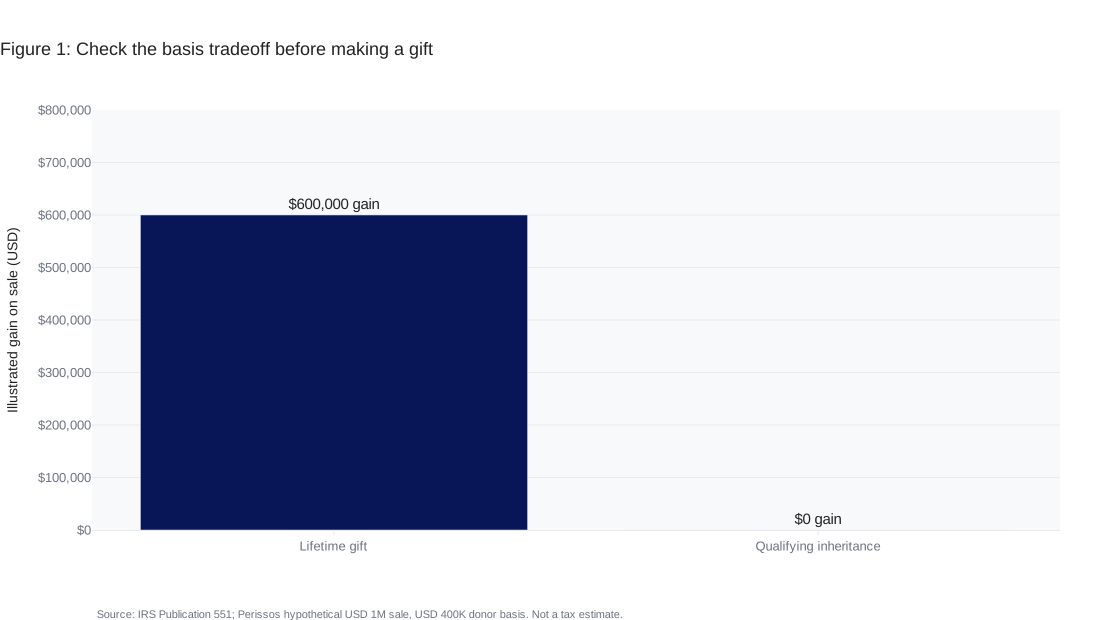
Removing future appreciation from a taxable estate can be useful, but the asset's income-tax basis belongs in the same analysis. For appreciated property given during life, the recipient generally uses the donor's adjusted basis for gain, subject to applicable adjustments. Inherited property generally receives a basis tied to date-of-death fair market value or another permitted estate valuation. Exceptions apply.5
Figure 1 uses a hypothetical asset worth $1 million with a $400,000 adjusted basis. Assume a completed lifetime gift with no gift-tax basis adjustment, followed by a sale for $1 million. The recipient's gain is $600,000. Alternatively, assume the property is retained, qualifies for a $1 million basis at death, and is sold for that same amount; the illustrated gain is zero. There are no transaction costs, later price changes, or special exceptions in this example.
This is a comparison of potential gain, not a calculation of tax savings. It excludes estate tax, federal and state income-tax rates, surtaxes, and future appreciation. The basis result can favor retention when estate-tax exposure is limited; a different balance sheet can favor gifting despite the basis cost. The point is to calculate both sides before treating a transfer as automatically tax-efficient.
Annual gifts still have their own rules
For 2026, the annual gift-tax exclusion is $19,000 per donor per recipient for qualifying gifts; two spouses can potentially provide $38,000 to one recipient. Larger gifts do not automatically create an immediate tax bill, but they can require reporting and use lifetime exclusion. Gift-splitting elections and gifts of future interests involve additional rules.6,7
The IRS also distinguishes direct qualifying tuition and medical payments from ordinary gifts. The payment route and eligible expense matter; giving cash to the family member is not the same arrangement.7 Before sending funds, have the CPA confirm how the proposed payment will be treated and what documentation should be retained.
Our discussion of lifetime gifting strategies for substantial estates places those tools in a broader plan. Use them to meet a real objective, such as supporting education or helping an heir establish financial stability. Do not let an available exclusion become a spending target that weakens your own retirement or care reserves.
Decide what merits action before year-end
For a family with limited projected estate-tax exposure, the useful work may be updating beneficiaries, improving incapacity arrangements, preserving basis records, and checking whether older trust formulas still fit. For a family with a rapidly growing business or substantial assets beyond available exclusions, lifetime transfers may still warrant serious analysis. Neither family needs an invented sunset to justify an orderly review.
Before funding an irrevocable arrangement, stress-test what remains under disappointing investment returns, higher spending, and an extended care need. Identify who controls distributions, who bears taxes and fees, and what happens if family circumstances change. Review state-law exposure separately when residence or property spans jurisdictions; the federal exclusion does not answer those questions.
Leave the year-end meeting with an agreed list of transfers, filings, valuations, and document changes, including who is responsible and when completion will be confirmed. If a proposed gift cannot be supported by clear objectives, adequate retained resources, and a coordinated tax analysis, take time to resolve those issues. The absence of a scheduled sunset gives the family room to make a better decision.
All my best,
Brandon VanLandingham, CFA, CMT, CFP
Founder / CIO
Citations
- Public Law 119-21, Section 70106 (retrieved November 12, 2026).
- IRS: What Is New — Estate and Gift Tax (retrieved November 12, 2026).
- IRS: Frequently Asked Questions on Estate Taxes (retrieved November 12, 2026).
- IRS: Instructions for Form 706 (July 2026) (retrieved November 12, 2026).
- IRS: Publication 551, Basis of Assets (retrieved November 12, 2026).
- IRS: Frequently Asked Questions on Gift Taxes (retrieved November 12, 2026).
- IRS: Instructions for Form 709 (retrieved November 12, 2026).
Important Disclosures
This piece is educational. It is not legal, tax, or accounting advice and is not a recommendation to take or refrain from any specific action. Tax law is fact-specific and changes regularly. Please coordinate any decisions discussed here with your attorney, your CPA, and Perissos before acting.
Perissos Private Wealth Management is a Registered Investment Adviser ("RIA"). Registration as an investment adviser does not imply a certain level of skill or training, and the content of this communication has not been approved or verified by the United States Securities and Exchange Commission or by any state securities authority. Perissos Private Wealth Management renders individualized investment advice to persons in a particular state only after complying with the state's regulatory requirements, or pursuant to an applicable state exemption or exclusion. All investments carry risk, and no investment strategy can guarantee a profit or protect from loss of capital. Past performance is not indicative of future results.
The information contained in this newsletter is intended to provide general information about market themes. It is not intended to offer investment advice. Investment advice will only be given after a client engages our services by executing the appropriate investment services agreement. Information regarding investment products and services is given solely to provide education regarding our investment philosophy and our strategies. You should not rely on any information provided in making investment decisions.
Market data, articles and other content in this material are based on generally available information and are believed to be reliable. Perissos Private Wealth Management does not guarantee the accuracy of the information contained in this material.
Perissos Private Wealth Management will provide all prospective clients with a copy of our current Form ADV, Part 2A (Disclosure Brochure), Part 2B (Supplemental Brochures), and Part 3 (Client Relationship Summary) prior to commencing an advisory relationship. You can also view these documents at any time at adviserinfo.sec.gov or by contacting us requesting a copy.
Frequently Asked Questions
- Is the federal estate-tax exemption scheduled to sunset at the end of 2026?
- No. Under current law, no year-end 2026 sunset is scheduled, and the IRS lists a $15 million basic exclusion per individual for 2026.
- Why does portability still matter for married couples if the exclusion is high?
- A surviving spouse generally must have a timely, complete Form 706 filed to elect portability of a deceased spouse's unused exclusion. Missing that election can reduce the combined exclusion available later.
- Can a large lifetime gift create a capital-gains tradeoff?
- Yes. Appreciated property given during life generally carries over the donor's basis, while inherited property often receives a basis tied to date-of-death value, which can change future taxable gain.