

Written and reviewed by Brandon VanLandingham, CFA, CMT, CFP® · Last updated November 19, 2026
Key Person and Disability Insurance for Owners
Protect household income and business continuity with a coordinated plan
November 19, 2026
An owner's absence can create two financial emergencies at once. The household still needs income, while the business may need cash to retain employees, serve customers, and hire someone who can keep operations moving. A policy that solves one problem may leave the other untouched. I would start an insurance review by identifying who needs the money, what event releases it, and how long the money must last.
For an Oklahoma business owner, the goal is a coordinated continuity plan. Coverage should support the operating business, the family's financial plan, and any ownership agreement without counting the same insurance proceeds twice. The discussion below uses general federal tax rules and hypothetical cash-flow assumptions. Actual coverage depends on underwriting, the contract, and the ownership structure.
Separate the business loss from the household loss
Key person life insurance generally places the business in the position of owner and beneficiary when an important employee or owner dies. Its purpose is to address the company's financial loss. The NAIC's small-business insurance guidance also describes key employee disability coverage payable to the business and overhead coverage for eligible operating expenses during an owner's disability.1
Personal disability income insurance addresses the individual's lost earnings. Business overhead coverage addresses specified business expenses. A disability buyout arrangement serves another purpose: financing a purchase of an owner's interest when the agreement's conditions are met. Have counsel compare that agreement with the actual policy rather than assuming that the word disability has the same meaning in both.
Write each need on a separate line before requesting quotes. Household living expenses belong in the personal-income calculation. Rent, retained staff, and other necessary operating costs belong in the business forecast. Recruiting and customer-retention costs belong in the key-person analysis. A purchase obligation belongs in the ownership-transition plan. This exercise makes double counting visible before it becomes expensive.
Estimate the loss that must be financed
A multiple of salary can be a conversation starter, but it does not explain how a particular business would function without its owner. Build a forecast around the work that would stop. Identify revenue likely to continue, costs that would disappear, and expenses that would increase. Then estimate the time needed to restore operations or complete an orderly sale or closure.
For example, an owner may generate most new business while employees handle existing accounts. The immediate problem could be replacement leadership and a declining sales pipeline. Another company may depend on the owner's professional license to deliver services at all. Those situations call for different operating plans even when annual compensation is identical. The insurance application should reflect a defensible financial exposure, not simply the largest benefit available.
Include a separate household forecast. If the family's salary and distributions both come from the same business, continuing distributions may be an optimistic assumption during a disruption. Consider what remains after essential business spending, debt service, and replacement management. Retirement assets should not become the automatic source of emergency business financing merely because they are visible on a net-worth statement.
The waiting period creates a cash requirement
An elimination period is the period after disability begins during which benefits are not payable under the contract. Definitions of disability, benefit periods, exclusions, and partial-disability provisions also vary. The NAIC's disability-insurance explanation emphasizes comparing these provisions rather than comparing premiums alone.2
Consider an illustration with $30,000 of eligible monthly overhead, no offsetting revenue, and a six-month interruption. Assume a policy reimburses that overhead after a three-month waiting period, with sufficient monthly and total limits. The first three months require $90,000 from business reserves. The next three months produce another $90,000 of expenses, assumed reimbursed by insurance. Without that modeled benefit, the full six-month requirement is $180,000. These are planning assumptions, not a policy quote or claim prediction.
Figure 1 shows the cumulative reserve use with and without the assumed reimbursement. It deliberately excludes household spending, premiums, taxes, uncovered expenses, and payment-processing delays. In practice, the reserve may need to bridge the time between paying a bill and receiving reimbursement. Ask the insurance professional to mark which forecast expenses are eligible and explain how claims timing would affect the cash account.
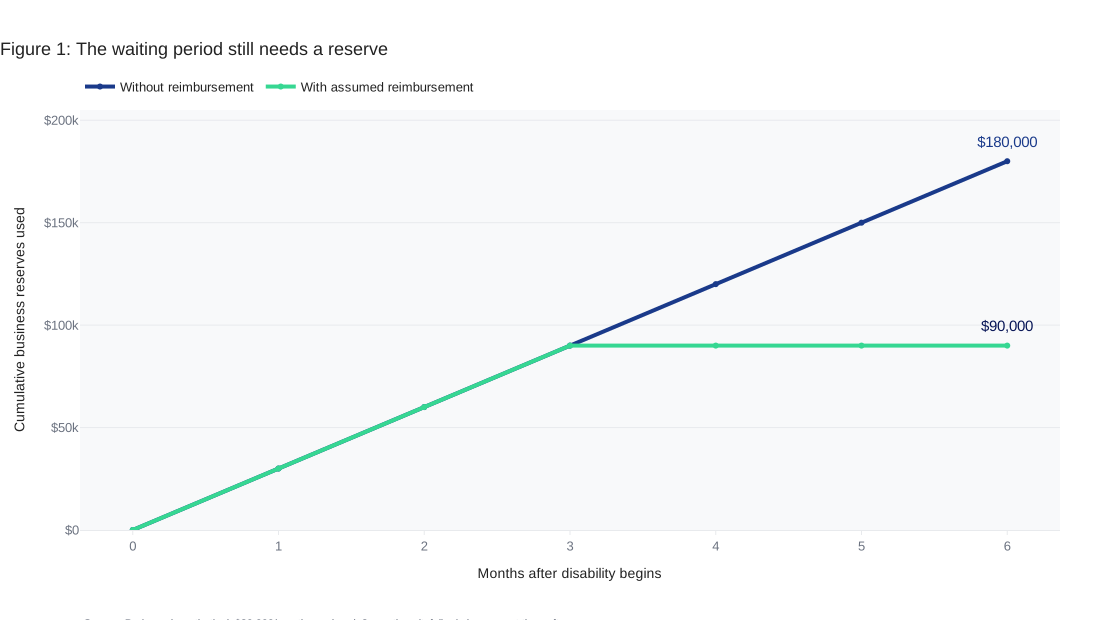
The chart also shows why extending a waiting period is a financing decision. A lower premium can be reasonable if the business can comfortably carry the additional exposure. It can be a poor bargain if the business would need to sell assets, delay payroll, or borrow on unfavorable terms before benefits begin.
Read the definition of disability against your actual work
A contract may measure disability against the insured's own occupation or against other work for which the person is qualified. Partial or residual benefits, exclusions, and limits can materially change the protection. Obtain the actual language and have the insurance professional explain it using your duties, income records, and potential return-to-work arrangements.2
Ask how a reduced schedule would be treated. Could the owner supervise but no longer perform the technical work that generates revenue? Would income earned through employees affect the benefit calculation? Does the contract require a particular income reduction or evidence of loss? Get written answers tied to policy provisions. A marketing description is insufficient for deciding how much risk the family retains.
Also test the end of the benefit period. If the business cannot recover by then, identify who would decide whether to sell, merge, or wind down. Insurance can create time to execute that decision; the operating plan still needs someone authorized and capable of making it.
Coordinate tax treatment before buying coverage
The IRS guidance on disability proceeds distinguishes benefits attributable to employer-paid premiums from benefits attributable to premiums the employee paid with after-tax dollars. Employer-paid coverage generally produces taxable personal disability benefits; benefits from coverage paid entirely with the individual's after-tax dollars generally are excluded. Mixed funding requires allocation.3 Ask the CPA how those principles apply to an owner, the entity's tax status, and the actual payroll treatment.
Do not extend that personal-benefit rule to every business policy. For life insurance, Section 264 generally denies a premium deduction when the taxpayer is directly or indirectly a beneficiary.4 Employer-owned life insurance also has a separate income-exclusion framework under Section 101(j). IRS Notice 2009-48 explains the required pre-issuance written notice and consent and the qualifying exceptions. Even a wholly owned corporation and its employee-owner are not automatically excused from those written requirements.5
The IRS uses Form 8925 for reporting covered employer-owned life insurance contracts.6 Have the CPA and attorney confirm the exception relied upon, retain the signed documents, and assign responsibility for reporting. A business purpose alone does not establish that premiums are deductible or proceeds are fully excludable. Avoid changing ownership or assigning a policy without another tax and legal review.
Make the coverage usable when the owner is absent
Insurance cannot sign a payroll authorization or make a medical decision. Review our discussion of financial and healthcare powers of attorney alongside the business's governing documents. The relevant authority must reach the assets and decisions involved. If business interests are held through a trust, our comparison of revocable and irrevocable trusts helps frame the separate questions of ownership and administration.
Coverage may be less compelling when operations are well diversified, replacement duties are documented, and ample liquid reserves can absorb the disruption. It may be particularly useful when one person's work supports both enterprise value and household income. Affordability matters: premiums that crowd out reserves can weaken the same plan they are intended to protect.
Before approving a purchase, ask for one coordinated worksheet showing the insured person, policy owner, beneficiary, triggering event, waiting period, benefit limit, premium payer, expected tax treatment, and person responsible for a claim. Reconcile it with the cash forecast and ownership agreement. Our team can help connect those decisions to the household plan, while the licensed insurance professional, CPA, and attorney confirm contract terms and implementation. Revisit the worksheet when ownership, debt, key employees, or the owner's role changes.
All my best,
Brandon VanLandingham, CFA, CMT, CFP
Founder / CIO
Citations
- NAIC — Small Business Insurance (retrieved November 13, 2026).
- NAIC — Simplifying the Complications of Disability Insurance (retrieved November 13, 2026).
- IRS — Life Insurance and Disability Insurance Proceeds (retrieved November 13, 2026).
- 26 U.S.C. Section 264 — Certain Amounts Paid in Connection With Insurance Contracts (retrieved November 13, 2026).
- IRS Notice 2009-48 — Employer-Owned Life Insurance (retrieved November 13, 2026).
- IRS — About Form 8925 (retrieved November 13, 2026).
Important Disclosures
This piece is educational. It is not legal, tax, or accounting advice and is not a recommendation to take or refrain from any specific action. Tax law is fact-specific and changes regularly. Please coordinate any decisions discussed here with your attorney, your CPA, and Perissos before acting.
Perissos Private Wealth Management is a Registered Investment Adviser ("RIA"). Registration as an investment adviser does not imply a certain level of skill or training, and the content of this communication has not been approved or verified by the United States Securities and Exchange Commission or by any state securities authority. Perissos Private Wealth Management renders individualized investment advice to persons in a particular state only after complying with the state's regulatory requirements, or pursuant to an applicable state exemption or exclusion. All investments carry risk, and no investment strategy can guarantee a profit or protect from loss of capital. Past performance is not indicative of future results.
The information contained in this newsletter is intended to provide general information about market themes. It is not intended to offer investment advice. Investment advice will only be given after a client engages our services by executing the appropriate investment services agreement. Information regarding investment products and services is given solely to provide education regarding our investment philosophy and our strategies. You should not rely on any information provided in making investment decisions.
Market data, articles and other content in this material are based on generally available information and are believed to be reliable. Perissos Private Wealth Management does not guarantee the accuracy of the information contained in this material.
Perissos Private Wealth Management will provide all prospective clients with a copy of our current Form ADV, Part 2A (Disclosure Brochure), Part 2B (Supplemental Brochures), and Part 3 (Client Relationship Summary) prior to commencing an advisory relationship. You can also view these documents at any time at adviserinfo.sec.gov or by contacting us requesting a copy.
Frequently Asked Questions
- What is the difference between key person insurance and personal disability insurance for an owner?
- Key person coverage is generally designed to protect the business from financial disruption, while personal disability income insurance is meant to replace the owner's lost earnings. Treating them as separate needs helps avoid double counting the same risk.
- Why does the waiting period matter in disability or overhead coverage?
- The elimination period creates a cash-flow gap the business must fund before benefits begin. In the example, a three-month waiting period on $30,000 of monthly overhead required $90,000 of reserves before reimbursement started.
- Why should owners compare a disability buyout agreement with the policy language?
- A buyout agreement and an insurance contract may define disability differently, which can create funding gaps when a trigger event occurs. Counsel should compare the agreement with the actual policy rather than assuming the same terminology means the same o...