
Written and reviewed by Brandon VanLandingham, CFA, CMT, CFP® · Last updated November 16, 2026
Successor Trustee Checklist: The First 90 Days
Establish authority, protect assets, and separate work targets from legal deadlines
November 16, 2026
The first task of a successor trustee is to establish an orderly administration. Family members may want immediate distributions, institutions may request unfamiliar documents, and bills may arrive before the trustee knows what the trust owns. A useful first-90-day plan protects people and property while building the records needed for later decisions.
This checklist focuses on an Oklahoma successor taking over after a settlor's death in late 2026. A transition during incapacity requires different documents, tax treatment, and attention to the living settlor's rights. The time blocks below are suggested work periods, not a legal deadline schedule. Actual deadlines may begin before you organize the file and may fall well inside the first 90 days.
First establish the authority to act
Obtain the signed trust, amendments, relevant restatements, and any resignation or death documentation. Ask the estate attorney to confirm which document governs, how the successor takes office, whether another trustee must participate, and whether the proposed actions require additional approval. Do not assume that being named in an old copy proves present authority.
Clarify whether you are also the estate's personal representative, an agent under a power of attorney, or simply the trustee. Those assignments are distinct, and the same person does not necessarily hold all of them. The CFPB trustee guide explains the practical responsibilities of managing trust property and the importance of understanding the document.1
Read our discussion of revocable and irrevocable trusts for the broader structure, then have counsel identify what changed at this death. With a joint trust, avoid assuming every asset or share now has identical treatment. Obtain written instructions for the authority and registration the financial institutions will require.
Days 1 through 10 protect essential property and services
Secure property, preserve important records, identify insurance policies, and arrange lawful access to the information needed for administration. Verify whether a vacant residence creates a coverage issue. Locate mortgage, utility, payroll, storage, and other recurring obligations. Determine which must continue while authority and ownership are being confirmed.
Create an urgent-payment list with the amount, due date, purpose, proposed paying account, and person approving it. Keep trust funds separate from personal funds and retain receipts. The CFPB identifies careful management, segregation of property, and complete records as core fiduciary practices.1 If you advance an expense personally, document it and obtain advice about reimbursement rather than treating the trust account as an informal family account.
Contact the attorney, CPA, and investment adviser early. Establish who will collect statements, prepare notices, review claims, and maintain the tax calendar. Ask what needs attention immediately even if the full inventory is unfinished. A trust holding an operating business may need management decisions much faster than one holding only liquid investments.
Start the legal notice calendar immediately
Under Oklahoma's Uniform Trust Code, Section 1608.12 generally requires notice to qualified beneficiaries within 60 days after accepting trusteeship. A separate 60-day notice generally begins when the trustee learns that an irrevocable trust exists or that a formerly revocable trust has become irrevocable. The required content differs, and statutory exceptions apply.2 Ask counsel to calculate both dates and prepare the appropriate notices now.
Do not assemble the recipient list solely from people currently receiving money. Oklahoma amended its definition of qualified beneficiary effective November 1, 2026, including specified successor-beneficiary categories. The enacted 2026 amendment also addresses application to existing relationships.3 Counsel should identify recipients and any authorized representation under current law, rather than reusing an older mailing list.
Keep the final notices, addresses, delivery evidence, triggering dates, and any responses in a dedicated file. An introductory family email is not a substitute for legally sufficient notice. Set a communication schedule so beneficiaries know whom to contact and when to expect an update. Explain what is known, what is still being investigated, and why a distribution date cannot yet be promised.
Days 11 through 30 build the ownership inventory
List each asset's legal owner, account or identifying information, date-of-death value, debt, income source, liquidity, and required follow-up. Distinguish trust-owned assets from assets passing through probate, joint ownership, or beneficiary designation. Route questions about assets outside the trust to the appropriate representative. This avoids taking action over property merely because it appeared on the deceased person's balance sheet.
Collect date-of-death statements and arrange necessary valuations. Inherited basis often depends on date-of-death fair market value, but exceptions and income-in-respect-of-a-decedent rules matter.4 Ask the CPA which assets need a basis adjustment and what evidence is required. An account's current market value is not a substitute for a documented historical valuation.
Record beneficiary-designated retirement accounts separately. If a trust is named as beneficiary, involve counsel and the CPA before moving or distributing the funds. Our article on inherited IRA rules and distribution planning explains why account type and beneficiary classification deserve their own review. Do not apply the ordinary taxable-account transfer process to an inherited IRA.
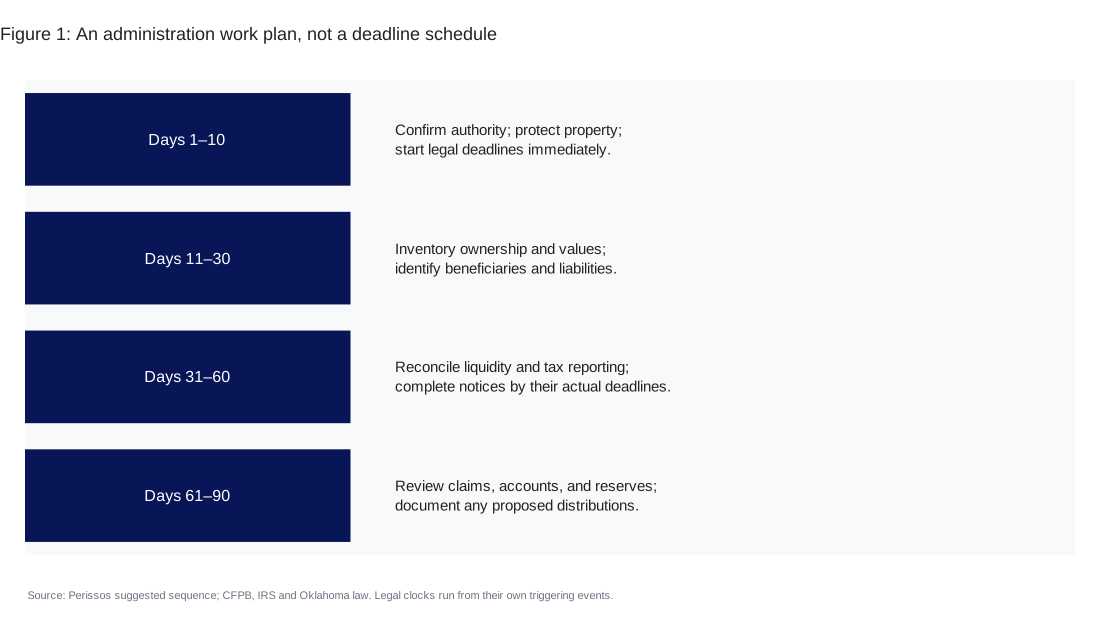
Figure 1 shows a suggested sequence for the administrative work. The notice calendar runs alongside every phase. A task assigned to a later work period should move forward if an actual deadline, payment need, or risk to property requires it.
Days 31 through 60 reconcile cash needs and tax reporting
Prepare a cash forecast for administration, required support, property expenses, and potential taxes. Identify money that must remain readily available and investment positions needing prompt review. Avoid both extremes: immediately liquidating everything without analysis and assuming every inherited holding should remain indefinitely. Document the reasons for material investment decisions with the adviser and counsel.
Ask the CPA to identify the taxpayer for each period and whether a new employer identification number is required. The IRS distinguishes a change of trustee alone from changes such as a revocable trust becoming irrevocable.5 Using the wrong taxpayer identification number can complicate reporting. Confirm account registrations and reporting instructions with each institution once the CPA has determined the treatment.
The IRS survivor and administrator guidance explains Form 56's role in notifying the IRS of a fiduciary relationship.4 The Form 1041 instructions address trust and estate income-tax returns and beneficiary reporting.6 Request a written calendar covering the decedent's final return, trust or estate returns, estimated payments, information reporting, and any relevant elections. Assign responsibility rather than assuming the attorney and accountant are each handling it.
Coordinate with the estate's personal representative on federal estate-tax filing and portability. Form 706 is generally due nine months after death when required, and a portability election may matter even if no estate tax is owed.7 The first 90 days should establish who will evaluate and handle that filing. They are not the time to assume that a large exclusion makes all estate-tax paperwork unnecessary.
Days 61 through 90 prepare decisions the records can support
Reconcile the ledger to financial statements and explain unresolved differences. Review the inventory, pending claims, remaining notices, professional fees, and cash reserve. Oklahoma law can subject a trust that was revocable at death to specified creditor claims and estate expenses when the probate estate is inadequate, subject to applicable qualifications.2 Ask counsel to evaluate those exposures before discretionary final distributions.
Prepare a written distribution proposal identifying the document provision, recipient, amount or asset, estimated tax consequences, and reserve remaining afterward. Distinguish interim support from a final settlement. Have the attorney explain any appropriate accounting, approval, receipt, or release procedure. The passage of 90 days does not itself establish that administration is complete or that claims have expired.
For an ongoing trust, establish the next reporting dates, investment review, distribution process, and document-retention system. For a trust approaching termination, identify the work still required and who will complete it. A clear status report is more useful than a rushed promise that all money will be paid immediately.
If the assignment involves a disputed document, a business, assets in several jurisdictions, beneficiary conflict, or a trustee who lacks time, obtain additional professional support early. The practical goal at day 90 is a defensible record of authority, property, notices, decisions, and remaining obligations. Use that record with counsel, the CPA, and our team to decide what can safely proceed and what still needs resolution.
All my best,
Brandon VanLandingham, CFA, CMT, CFP
Founder / CIO
Citations
- CFPB — Help for Trustees Under a Revocable Living Trust (retrieved November 13, 2026).
- Oklahoma HB 1850 Enrolled — Uniform Trust Code (retrieved November 13, 2026).
- Oklahoma SB 2104 Enrolled — 2026 Trust Amendments (retrieved November 13, 2026).
- IRS Publication 559 — Survivors, Executors, and Administrators (retrieved November 13, 2026).
- IRS — When to Get a New EIN (retrieved November 13, 2026).
- IRS Instructions for Form 1041 (retrieved November 13, 2026).
- IRS Instructions for Form 706 — July 2026 (retrieved November 13, 2026).
Important Disclosures
This piece is educational. It is not legal, tax, or accounting advice and is not a recommendation to take or refrain from any specific action. Tax law is fact-specific and changes regularly. Please coordinate any decisions discussed here with your attorney, your CPA, and Perissos before acting.
Perissos Private Wealth Management is a Registered Investment Adviser ("RIA"). Registration as an investment adviser does not imply a certain level of skill or training, and the content of this communication has not been approved or verified by the United States Securities and Exchange Commission or by any state securities authority. Perissos Private Wealth Management renders individualized investment advice to persons in a particular state only after complying with the state's regulatory requirements, or pursuant to an applicable state exemption or exclusion. All investments carry risk, and no investment strategy can guarantee a profit or protect from loss of capital. Past performance is not indicative of future results.
The information contained in this newsletter is intended to provide general information about market themes. It is not intended to offer investment advice. Investment advice will only be given after a client engages our services by executing the appropriate investment services agreement. Information regarding investment products and services is given solely to provide education regarding our investment philosophy and our strategies. You should not rely on any information provided in making investment decisions.
Market data, articles and other content in this material are based on generally available information and are believed to be reliable. Perissos Private Wealth Management does not guarantee the accuracy of the information contained in this material.
Perissos Private Wealth Management will provide all prospective clients with a copy of our current Form ADV, Part 2A (Disclosure Brochure), Part 2B (Supplemental Brochures), and Part 3 (Client Relationship Summary) prior to commencing an advisory relationship. You can also view these documents at any time at adviserinfo.sec.gov or by contacting us requesting a copy.
Frequently Asked Questions
- What should a successor trustee do first after a settlor dies?
- The trustee should confirm legal authority under the current trust documents, identify whether any co-trustee or approvals are required, and secure property, records, and urgent payment information.
- How soon do Oklahoma trust notices need to be reviewed?
- The post notes that Oklahoma Uniform Trust Code Section 1608.12 generally requires notice to qualified beneficiaries within 60 days after accepting trusteeship, with a separate 60-day notice period that may begin when an irrevocable trust is learned of or c...
- Why should inherited retirement accounts be handled separately?
- If a trust is named as beneficiary, inherited retirement accounts can involve different distribution and tax rules, so counsel and the CPA should review them before any transfer or distribution is made.