

Written and reviewed by Brandon VanLandingham, CFA, CMT, CFP® · Last updated November 14, 2026
Digital Assets in Your Estate Plan: Crypto, Photos, and Logins
Connect legal authority, secure access, and the records your family will need
November 14, 2026
An estate plan can identify who should receive your property while leaving that person unable to find it, document it, or gain lawful access. Digital assets make those gaps especially visible. A crypto holding may have financial value, a photo archive may have family value, and an email account may contain the records needed to administer everything else.
I would begin with the handoff you want your family to be able to complete. Who should preserve the records? Who should manage or sell an investment? Which private communications should remain private? This memo addresses general Oklahoma planning as of November 13, 2026. The right arrangement depends on the asset, the governing documents, and the provider's actual procedures.
Build an inventory that explains the job
Create a confidential inventory organized by purpose: financial property, family archives, administrative accounts, and business-related resources. Record the provider or storage location, account identifier, legal owner, intended recipient, and person responsible for the next step. Add where the governing documents and recovery instructions can be found. Keep the inventory itself access-controlled; it can reveal a great deal about the household even without passwords.
For each item, write an intended outcome. A photo collection might be copied for several family members. A subscription might be canceled after necessary records are exported. A financial account might need valuation before any transfer. A website or domain might need continued payment while a business succession decision is made. This turns a list of logins into a usable set of instructions.
Keep employer accounts and other people's information separate from your personal plan. Ask counsel and the business's authorized administrator to resolve ownership and access. Do not invite a family member to treat every account visible on a personal device as personal property.
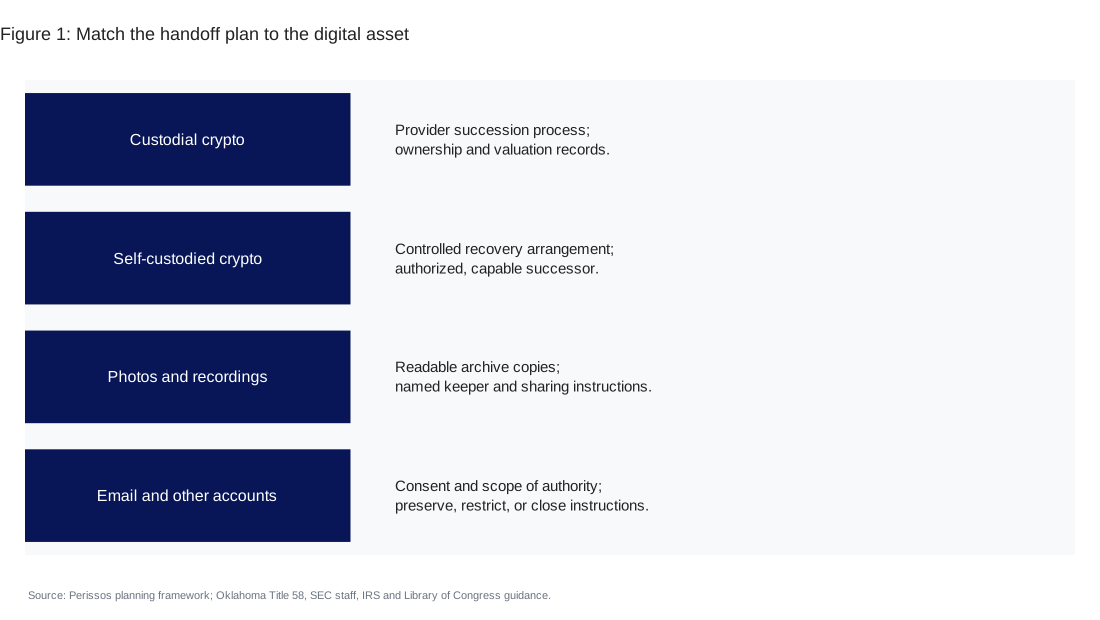
Figure 1 shows the information I would want available for each asset category. Each row addresses a different handoff problem; no single password list answers all of them.
Coordinate consent, documents, and provider settings
Oklahoma's Revised Uniform Fiduciary Access to Digital Assets Act distinguishes electronic-message content from other digital records. A qualifying online disclosure direction that can be changed or deleted at any time overrides a contrary direction in a will, trust, or power of attorney. Without that online direction, an estate document can allow or prohibit disclosure, subject to the Act.1
Disclosure of a deceased user's message content requires consent or court direction and prescribed documentation. An agent seeking message content under a power of attorney generally needs an express grant and required documentation. The Act does not enlarge the user's underlying rights, and fiduciary authority cannot be used to impersonate the user.1
Have the estate attorney review digital-asset clauses and account settings together. Ask which person may act during incapacity, which person may act after death, and what evidence each provider will require. Our discussion of financial and healthcare powers of attorney provides context for keeping those assignments distinct. A trusted person's name on an informal instruction sheet should prompt this review rather than end it.
Treat disclosure permission and the right to inherit an asset as separate planning questions. Ask counsel whether a particular designation addresses access, ownership, or both. Reconcile those answers with the beneficiary and trust provisions instead of assuming that selecting a legacy contact settles the entire estate plan.
Crypto requires a workable custody handoff
The SEC staff's crypto custody bulletin explains that wallets hold private keys used to authorize transactions. With self-custody, the owner is responsible for those keys; loss or theft can cause permanent loss of access. A recovery phrase can restore a wallet and must be protected. With third-party custody, a provider manages access to the keys, adding provider-related risks.2
For a custodial account, request the provider's current incapacity and deceased-account procedures. Document the department to contact, the required evidence, permitted account registrations, and any transfer restrictions. Confirm the intended successor can follow that process without relying on the deceased person's ordinary login credentials.
For self-custody, ask qualified legal and security professionals to design a recovery arrangement that remains secure during life and usable by an authorized successor. Keep actual private keys and recovery phrases out of the will, routine email, shared planning spreadsheets, and broadly circulated document packages. The inventory should identify the controlled recovery process, not expose the secret itself. Do not give a purported support representative a recovery phrase.
Run a supervised rehearsal using a separate demonstration wallet with no meaningful value. The successor should be able to explain where instructions are held, how authority is established, and when expert assistance is required. Avoid experimenting with an actual estate wallet while learning the process. If the design is too difficult for the intended successor to follow, simplify the custody arrangement while the owner can still make decisions.
Succession planning does not resolve investment suitability. Our article on crypto allocations from a fiduciary perspective addresses the separate questions of loss capacity and portfolio fit. Consider the ongoing administrative burden alongside any desired investment exposure.
Preserve the records needed to value and report property
The IRS digital-asset guidance treats covered digital assets as property for federal tax purposes and emphasizes records of transactions, units, values, and basis.3 Build a records package with transaction exports, purchase information, account statements, wallet identifiers, and documentation connecting holdings to their owner. Keep it separate from the secret credentials that permit transactions.
After a death, ask the CPA and estate attorney to determine the relevant valuation and basis treatment. Inherited property generally receives a basis tied to date-of-death fair market value, with exceptions and possible alternate valuation rules.4 That does not mean every digital receipt, payment, or later transaction is tax-free. Record historical values and any subsequent sale or transfer so the professionals can determine the actual reporting.
A current account balance is not a complete tax history. Assign someone to preserve available records before closing an account, disposing of a device, or reorganizing holdings. For a material or unusual asset, discuss valuation evidence and liquidity needs before authorizing a distribution.
Give family photographs their own preservation plan
The Library of Congress's personal photo guidance recommends identifying and organizing important images, adding descriptions, making copies in different locations, and checking that files remain readable.5 Apply that approach to the collection you actually want the family to keep. Start with irreplaceable photographs and recordings rather than waiting to organize every file you have ever saved.
Choose who will maintain the archive, which relatives should receive copies, and which materials should stay restricted. Add names, approximate dates, and context to meaningful images while someone still remembers them. Test a sample export and have the intended recipient open it. A collection that makes sense only to its creator still needs work.
Preservation and account closure should be coordinated. Establish a sequence for retaining selected materials, verifying the copies, handling private content, and then considering account closure. Ask counsel about any legal retention obligations before deleting records. Family value and financial value deserve different handling, but both need an accountable person.
Test the plan without weakening security
Choose a primary responsible person and a backup, and discuss their willingness before naming them. A technically capable helper can assist the legally authorized fiduciary without being given unrestricted ownership or discretion. Define that helper's task, supervision, confidentiality, and compensation with counsel when appropriate.
At a planning review, walk through an incapacity scenario and a death scenario. Can the responsible person locate the inventory, obtain the governing documents, identify the proper provider process, and reach professional help? Include the recovery arrangements for multifactor authentication and devices without circulating working secrets. The SEC staff recommends strong passwords and multifactor authentication for online crypto accounts.2 A succession plan should preserve those protections.
Update the inventory after a material account, device, family, or document change. For a household with limited digital property, a concise inventory and orderly archive may be enough; substantial self-custodied assets or business systems warrant more specialized work. Bring the unresolved ownership, authority, recovery, and recordkeeping questions to your attorney, CPA, and our team. Assign an owner and a completion date to each remaining task so the plan becomes usable.
All my best,
Brandon VanLandingham, CFA, CMT, CFP
Founder / CIO
Citations
- Oklahoma Statutes, Title 58 — Revised Uniform Fiduciary Access to Digital Assets Act (retrieved November 13, 2026).
- SEC Staff — Crypto Asset Custody Basics for Retail Investors (retrieved November 13, 2026).
- IRS — Digital Assets (retrieved November 13, 2026).
- IRS Publication 559 — Survivors, Executors, and Administrators (retrieved November 13, 2026).
- Library of Congress — Personal Archiving: Digital Photographs (retrieved November 13, 2026).
Important Disclosures
This piece is educational. It is not legal, tax, or accounting advice and is not a recommendation to take or refrain from any specific action. Tax law is fact-specific and changes regularly. Please coordinate any decisions discussed here with your attorney, your CPA, and Perissos before acting.
Perissos Private Wealth Management is a Registered Investment Adviser ("RIA"). Registration as an investment adviser does not imply a certain level of skill or training, and the content of this communication has not been approved or verified by the United States Securities and Exchange Commission or by any state securities authority. Perissos Private Wealth Management renders individualized investment advice to persons in a particular state only after complying with the state's regulatory requirements, or pursuant to an applicable state exemption or exclusion. All investments carry risk, and no investment strategy can guarantee a profit or protect from loss of capital. Past performance is not indicative of future results.
The information contained in this newsletter is intended to provide general information about market themes. It is not intended to offer investment advice. Investment advice will only be given after a client engages our services by executing the appropriate investment services agreement. Information regarding investment products and services is given solely to provide education regarding our investment philosophy and our strategies. You should not rely on any information provided in making investment decisions.
Market data, articles and other content in this material are based on generally available information and are believed to be reliable. Perissos Private Wealth Management does not guarantee the accuracy of the information contained in this material.
Perissos Private Wealth Management will provide all prospective clients with a copy of our current Form ADV, Part 2A (Disclosure Brochure), Part 2B (Supplemental Brochures), and Part 3 (Client Relationship Summary) prior to commencing an advisory relationship. You can also view these documents at any time at adviserinfo.sec.gov or by contacting us requesting a copy.
Frequently Asked Questions
- What should be included in a digital asset inventory?
- A useful inventory lists the provider or storage location, account identifier, legal owner, intended recipient, responsible person, and where recovery instructions and governing documents are stored. It should explain the next step for each asset without ex...
- Does naming a legacy contact or beneficiary automatically give access to digital accounts?
- Not always. The post explains that access rights, disclosure consent, and ownership can be separate questions, and Oklahoma's digital-asset law may give priority to an online disclosure direction over contrary estate documents.
- How should crypto be handled in an estate plan?
- Crypto requires a workable custody handoff that matches the type of wallet or account involved. For self-custody, recovery phrases should stay out of wills and routine files, while custodial accounts should have documented deceased-account procedures and re...