

Written and reviewed by Brandon VanLandingham, CFA, CMT, CFP® · Last updated October 26, 2026
Buffered ETFs and Defined-Outcome Strategies for Retirees
Match the outcome period to the spending plan—and understand what the buffer does not cover.
October 23, 2026
Retirees often face an uncomfortable tradeoff: they need growth, but a large loss early in retirement can make the spending plan harder to sustain. A buffered exchange-traded fund tries to reshape part of that market exposure. The appeal is understandable. Giving up some upside may feel reasonable if it reduces a defined portion of downside.
The important question is whether the actual investment fits the dates, withdrawals, and risks in your plan. A buffer is not a standing promise that your account cannot decline. I would evaluate it as a specific investment structure with a measurement period, an upside limit, costs, and remaining loss exposure. Those details determine whether the tradeoff is useful.
What the strategy is trying to do
A common structure uses options to target a reference asset’s price return up to a cap while absorbing an initial band of losses over an outcome period. A current SEC-filed summary prospectus describing buffer mechanics illustrates this approach and explicitly warns that results depend on investment timing. The document is evidence of one structure, not a recommendation or a description of every defined-outcome fund.1
“Defined outcome” describes a target under specified conditions. It should not be interpreted as an unconditional guarantee. Read the actual buffer range: absorbing the first portion of losses differs from protecting only a deeper band. Also identify the reference asset and whether the objective measures price return or total return including dividends. Fees reduce what the investor retains.1
For a retirement portfolio, I would frame the allocation as a change in the shape of risk. We need to decide which outcomes we are willing to give up and which losses we still can bear. Starting with a forecast that markets will be flat or mildly negative makes the decision depend too heavily on being right about the next period.
Draw the tradeoff before buying
Figure 1 shows a hypothetical one-year strategy with a 15-percentage-point initial loss buffer and a 10% upside cap. Assume purchase at the beginning of the outcome period and ownership through its end. The formula follows positive reference returns one-for-one until the cap and absorbs negative returns until the buffer is exhausted. It then bears losses one-for-one. These are teaching assumptions, not current fund terms.
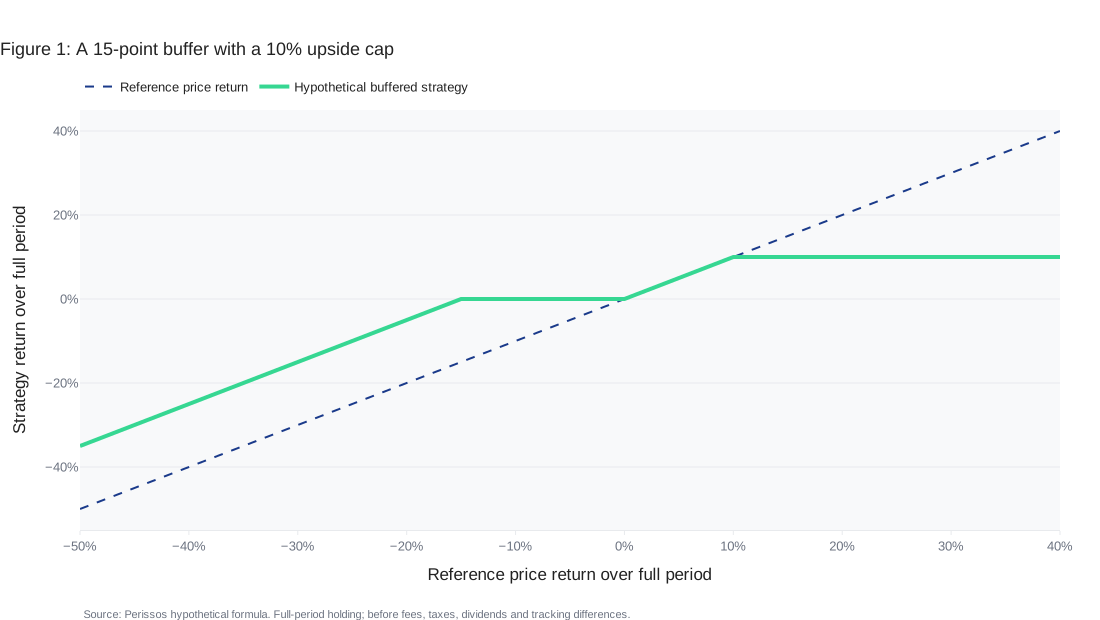
If the reference asset finishes down 10%, the modeled strategy returns 0% before fees. At a 30% decline, it returns negative 15%. If the reference asset rises 6%, the strategy returns 6%; if it rises 25%, the strategy returns 10%. The missed 15 percentage points in that last case are an economic cost of the chosen tradeoff, even though the investment itself has gained.
On a hypothetical $200,000 position, those negative 30% and positive 25% reference outcomes produce ending values of $170,000 and $220,000, respectively. Direct reference exposure would finish at $140,000 and $250,000, before dividends and costs. Neither column is universally better. One preserves more value in the selected decline; the other keeps more of the selected gain.
The chart omits expenses, trading costs, taxes, dividends, and tracking differences to isolate the payoff. A 0% modeled outcome is therefore not a promise to break even after costs. Ask for a second illustration using the specific fund’s disclosed expenses and your likely execution price. Make sure the comparison also treats dividends consistently. A price-return target should not quietly be compared with a total-return benchmark as though they were identical.
Your purchase date changes the question
The published cap and buffer usually describe the full outcome period. Buying after it starts can leave a different amount of upside and loss exposure from your purchase price. Selling before it ends can also produce a result unlike the target payoff.1 The exchange-traded wrapper provides a way to transact; it does not make the intended outcome apply to every holding period.
Consider a second simplified illustration. Suppose the original period begins at $100 per share and the maximum ending value is $110 before expenses. If you buy later at $108, the remaining appreciation to that same maximum is only $2 divided by $108, or about 1.85%. It is not 10%. This arithmetic is a ceiling illustration, not a model of the option portfolio’s interim price or remaining protection.
I would require an updated purchase-date analysis that states the remaining upside, the losses possible before any remaining buffer becomes effective, the protection still available, and the end date. Keep that analysis with the trade record. If a position is being added to gradually, each purchase may need its own evaluation rather than borrowing the economics of the first lot.
Retirement cash flow still needs its own reserve
The purpose of Why Retirees Need Three Types of Money: Now, Soon, Later is to give different dollars different jobs. A buffered equity allocation should not automatically inherit the job of cash or a maturity-matched spending reserve. The household needs a source for withdrawals that will occur before the outcome period ends.
Before adding a fund, place expected spending dates alongside its measurement period. Ask whether a medical bill, tax payment, home repair, or change in family support could force an early sale. If so, decide which other assets would fund that expense. The ability to wait is part of the strategy’s suitability, even when shares trade daily.
The related discussion in Sequence-of-Returns Risk: Real Examples From 2000, 2008, and 2022 explains why the order of losses and withdrawals matters. A buffer may change a particular period’s loss experience, but it does not solve the entire retirement problem. Spending flexibility, reserves, longevity, and the amount of growth capital remain separate planning decisions.
A reset requires a fresh decision
At the next outcome period, review the new terms rather than assuming the prior cap continues. The retrieved prospectus describes recurring periods with terms that can change.1 For planning purposes, I would model a range of future caps rather than repeatedly compounding today’s quoted maximum. A cap is a ceiling, not an expected return.
Ask what happens if a loss is followed by a strong recovery. A capped strategy can participate differently from an uncapped holding during that recovery. Conversely, avoiding part of an earlier loss can leave more capital available. The useful comparison is the household’s multi-period path after withdrawals and costs, not a single favorable chart. We should examine both sequences without declaring either inevitable.
Owning several funds with staggered periods also deserves a combined analysis. It may spread reset dates, but I would not assume the entire account acquires one uniform buffer measured from today. Record each position’s current terms and exposure, then evaluate the aggregate. Simpler labels should not conceal a more complicated portfolio to monitor.
Evaluate the fund and the household together
The SEC’s updated ETF investor bulletin explains market-price premiums and discounts, bid-ask spreads, and other trading considerations.2 Review those alongside annual expenses, the options implementation, and the fund’s disclosures. An attractive theoretical payoff can be less attractive at the price you actually pay.
The strongest fit is a retiree who can accept capped upside, understands the remaining downside, and can hold the selected exposure through the relevant period without interrupting essential spending. Poor fits include investors seeking guaranteed principal, investors likely to need an early exit, and those who require unrestricted growth from every equity dollar. Reducing ordinary stock exposure may be a simpler alternative worth testing.
Coordinate account placement and any proposed sale with your CPA, using the fund’s actual reporting and the household’s tax position. Then write down the allocation’s role, the planned holding period, the withdrawal source, and the date for reviewing replacement terms. The decision is ready when the family can explain both the protection it seeks and the growth it is prepared to surrender.
All my best,
Brandon VanLandingham, CFA, CMT, CFP
Founder / CIO
Citations
- SEC EDGAR, Buffer-strategy summary prospectus, May 5, 2026, supplemented September 1, 2026. Retrieved October 23, 2026. Cited for disclosed mechanics, not product endorsement; hypothetical figures do not use its offered terms.
- SEC, Updated Investor Bulletin: Exchange-Traded Funds (ETFs). Retrieved October 23, 2026. Figure 1 and purchase-date examples are author-selected assumptions and deterministic calculations.
Important Disclosures
This piece is educational. It is not legal, tax, or accounting advice and is not a recommendation to take or refrain from any specific action. Tax law is fact-specific and changes regularly. Please coordinate any decisions discussed here with your attorney, your CPA, and Perissos before acting.
Perissos Private Wealth Management is a Registered Investment Adviser ("RIA"). Registration as an investment adviser does not imply a certain level of skill or training, and the content of this communication has not been approved or verified by the United States Securities and Exchange Commission or by any state securities authority. Perissos Private Wealth Management renders individualized investment advice to persons in a particular state only after complying with the state's regulatory requirements, or pursuant to an applicable state exemption or exclusion. All investments carry risk, and no investment strategy can guarantee a profit or protect from loss of capital. Past performance is not indicative of future results.
The information contained in this newsletter is intended to provide general information about market themes. It is not intended to offer investment advice. Investment advice will only be given after a client engages our services by executing the appropriate investment services agreement. Information regarding investment products and services is given solely to provide education regarding our investment philosophy and our strategies. You should not rely on any information provided in making investment decisions.
Market data, articles and other content in this material are based on generally available information and are believed to be reliable. Perissos Private Wealth Management does not guarantee the accuracy of the information contained in this material.
Perissos Private Wealth Management will provide all prospective clients with a copy of our current Form ADV, Part 2A (Disclosure Brochure), Part 2B (Supplemental Brochures), and Part 3 (Client Relationship Summary) prior to commencing an advisory relationship. You can also view these documents at any time at adviserinfo.sec.gov or by contacting us requesting a copy.
Frequently Asked Questions
- Do buffered ETFs guarantee that retirees will not lose money?
- No. Buffered ETFs generally absorb only a stated portion of losses during a defined outcome period, and investors can still lose money from declines beyond the buffer, fees, or buying and selling at the wrong time.
- Why does the purchase date matter with a defined-outcome ETF?
- The published cap and buffer usually apply to the full outcome period, not every entry point. Buying after the period starts or selling before it ends can materially change the remaining upside and downside exposure.
- Can a buffered ETF replace a retiree’s cash reserve?
- Usually not by itself. Retirees still need assets set aside for near-term withdrawals, taxes, medical costs, or repairs that may arise before the fund’s outcome period ends.