

Written and reviewed by Brandon VanLandingham, CFA, CMT, CFP® · Last updated October 13, 2026
Treasury Inflation-Protected Securities (TIPS) in a $1M+ Portfolio
Sizing inflation protection around future spending obligations
October 13, 2026
A seven-figure portfolio can look substantial on a statement and still leave a household exposed to rising living costs. The relevant question is how much future spending those dollars can support. Treasury Inflation-Protected Securities, or TIPS, can help connect part of the bond portfolio to inflation-adjusted obligations. Their usefulness comes from that connection, not from the size of the account or a forecast that inflation is about to accelerate.
I would not assign TIPS a fixed percentage merely because a portfolio exceeds $1 million. A retiree funding essential expenses, an executive still saving, and a family reserving capital for heirs have different obligations. Start with the spending that needs protection, subtract dependable income available for it, and then decide which assets should meet the remaining gap.
Understand what the Treasury adjusts
TIPS are marketable Treasury securities whose principal rises with inflation and falls with deflation. The coupon rate is fixed, but the dollar interest payment changes because it applies to adjusted principal. Treasury pays interest every six months. At maturity, the payment is the greater of inflation-adjusted principal or original principal. New TIPS are issued with five-, ten-, and thirty-year terms.1
The Treasury's explanation of TIPS makes a distinction that matters for secondary-market buyers: the maturity floor relates to original principal. It does not guarantee reimbursement of whatever purchase price you pay. A buyer paying a premium, including accumulated inflation adjustments, can invest more than the amount protected by that floor.1
Inflation protection also follows the designated consumer-price index, not your household's personal budget. Healthcare, property maintenance, tuition, or travel expenses can rise differently from broad consumer prices. A TIPS position is therefore a useful tool for a defined exposure, not a contract that pays every increase in your actual cost of living. We should still stress-test the categories that dominate your plan.
Real yield is different from the coupon
The coupon determines the interest-payment formula. The real yield reflects the purchase price and scheduled cash flows before future inflation adjustments. Paying a premium or discount changes that yield. Treasury permits negative real yields, so the existence of inflation indexing does not itself guarantee a positive return above inflation at the price paid.1,2
For illustration, imagine an inflation-linked investment purchased at a 2% real yield and a nominal alternative yielding 4.5%. Ignoring differing cash-flow timing, taxes, liquidity, and pricing details, the simple yield gap is 2.5 percentage points. That is a starting point for comparing inflation compensation, not a forecast of next year's inflation or a precise break-even calculation for every security.
The Federal Reserve's analysis of TIPS inflation compensation explains that observed yield differences also reflect inflation-risk and liquidity premiums. The market spread is not a pure survey of expected inflation. I would use it to understand the price of protection, while choosing the amount of protection from the household's obligations.3
A principal illustration shows the protection and its limits
Figure 1 isolates principal purchasing power for an assumed $100,000 original investment held for ten years. At constant 2% annual inflation, an inflation-adjusted principal amount grows to approximately $121,899. At 4%, it grows to approximately $148,024. In both simplified scenarios, dividing the adjusted amount by cumulative inflation returns $100,000 in starting purchasing power.
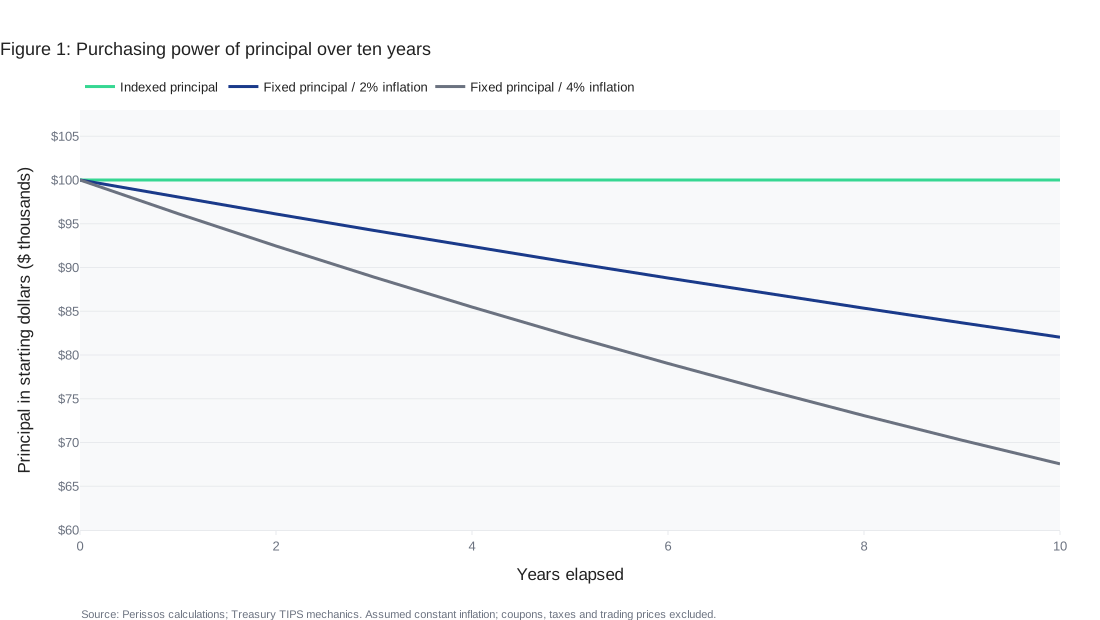
A fixed $100,000 nominal principal payment has a different outcome: approximately $82,035 of starting purchasing power after ten years at 2% inflation, or $67,556 at 4%. These calculations omit coupons, taxes, purchase premiums, indexation lags, and trading prices. They compare principal only and should not be read as a total-return contest between actual bonds. A nominal bond's coupon income is part of its economics too.
That limitation is useful. It keeps us focused on the specific risk TIPS are intended to address without claiming they must outperform another investment. If a future spending obligation grows with inflation, indexed principal can help meet it. If the future obligation is fixed in dollars, a nominal bond matched to that date may be the more direct fit.
Inflation protection does not eliminate price volatility
Before maturity, TIPS prices respond to changes in real yields. If the market requires a higher real yield, an existing bond's price can fall even while its inflation-adjusted principal rises. An investor who must sell during that decline can realize a loss. The ability to trade a security is different from the ability to sell it at an attractive price.1,2
Longer maturities generally bring greater sensitivity to yield changes. For money needed soon, buying a long TIPS because its real yield looks appealing can create a mismatch between the investment and the spending deadline. For a long-dated obligation, the same maturity may be reasonable. The household's cash reserve should make the holding period practical rather than merely aspirational.
A broadly diversified TIPS fund provides convenient exposure but normally does not promise repayment of your purchase amount on one personal target date. Its holdings change, its share price fluctuates, and expenses reduce results. The SEC's bond-fund risk guidance is relevant even when the underlying issuers are governments. Individual bonds and funds solve different implementation problems.4
Account location changes the spending result
In a taxable account, both TIPS interest and increases in principal from inflation adjustments are generally subject to federal income tax in the year they occur. Those principal increases can create tax liability before the additional principal is paid at maturity. Treasury interest and inflation adjustments are exempt from state and local income taxes.2
This creates a practical cash-flow question: where will the money for the federal tax come from? A retiree who spends all coupon income may need a separate reserve. A tax-deferred account can simplify current cash-tax management, but eventual withdrawals follow that account's rules; inflation protection does not make the withdrawal tax-free. Evaluate the household's tax-diversified retirement portfolio before deciding where to hold the exposure.
Coordinate the purchase and annual reporting with your CPA. Secondary-market purchases, deflation adjustments, and account-specific issues deserve individual review. The after-tax purchasing power that reaches the household matters more than a pretax real yield printed on the trade screen. The illustration deliberately excludes those taxes so the underlying principal mechanics remain visible.
Build the allocation from the obligation
Begin by identifying essential spending in today's dollars and the years over which it needs support. Then account for the income sources already available, their reliability, and their inflation characteristics. A household with a substantial uncovered spending gap may benefit from more explicit inflation protection than one whose basic needs are already well covered, even if the two portfolios have identical balances.
Our article on building a retirement TIPS ladder explains how individual maturities can support that process. A ladder requires careful cash-flow matching: coupon dates, maturity proceeds, purchase prices, and taxes must be reconciled with withdrawals. A fund may be simpler for an investor seeking ongoing inflation-linked bond exposure without a year-by-year spending schedule.
TIPS can be a poor fit for emergency money, for an investor unable to tolerate interim losses, or for someone buying long maturities with no matching long-term purpose. Before investing, document the obligation being protected, the intended holding period, and the source of any tax payments. Then decide how much nominal fixed income, growth assets, and readily available cash should remain alongside the TIPS position. That decision makes inflation protection part of the plan rather than a reaction to the latest inflation headline.
All my best,
Brandon VanLandingham, CFA, CMT, CFP
Founder / CIO
Citations
- U.S. Treasury, Treasury Inflation-Protected Securities. Retrieved October 3, 2026.
- U.S. Treasury, Comparison of TIPS and Series I Savings Bonds. Retrieved October 3, 2026.
- Federal Reserve, Tips from TIPS: Update and Discussions. Retrieved October 3, 2026.
- SEC Investor.gov, Bond Funds and Income Funds. Retrieved October 3, 2026.
Important Disclosures
This piece is educational. It is not legal, tax, or accounting advice and is not a recommendation to take or refrain from any specific action. Tax law is fact-specific and changes regularly. Please coordinate any decisions discussed here with your attorney, your CPA, and Perissos before acting.
Perissos Private Wealth Management is a Registered Investment Adviser ("RIA"). Registration as an investment adviser does not imply a certain level of skill or training, and the content of this communication has not been approved or verified by the United States Securities and Exchange Commission or by any state securities authority. Perissos Private Wealth Management renders individualized investment advice to persons in a particular state only after complying with the state's regulatory requirements, or pursuant to an applicable state exemption or exclusion. All investments carry risk, and no investment strategy can guarantee a profit or protect from loss of capital. Past performance is not indicative of future results.
The information contained in this newsletter is intended to provide general information about market themes. It is not intended to offer investment advice. Investment advice will only be given after a client engages our services by executing the appropriate investment services agreement. Information regarding investment products and services is given solely to provide education regarding our investment philosophy and our strategies. You should not rely on any information provided in making investment decisions.
Market data, articles and other content in this material are based on generally available information and are believed to be reliable. Perissos Private Wealth Management does not guarantee the accuracy of the information contained in this material.
Perissos Private Wealth Management will provide all prospective clients with a copy of our current Form ADV, Part 2A (Disclosure Brochure), Part 2B (Supplemental Brochures), and Part 3 (Client Relationship Summary) prior to commencing an advisory relationship. You can also view these documents at any time at adviserinfo.sec.gov or by contacting us requesting a copy.
Explore topics
Share this article
Last reviewed: October 10, 2026
Frequently Asked Questions
- Should a $1 million-plus portfolio hold a fixed percentage in TIPS?
- Not necessarily. The content recommends sizing TIPS to inflation-sensitive spending needs after subtracting dependable income, rather than assigning a fixed allocation based only on portfolio size.
- Do TIPS guarantee a positive return above inflation?
- No. TIPS adjust principal for inflation, but the purchase price determines real yield, and real yields can be negative, so inflation indexing alone does not ensure a positive return above inflation.
- Why can TIPS create tax complications in taxable accounts?
- Federal income tax generally applies each year to both coupon interest and inflation adjustments to principal, even though the added principal is not paid until maturity. That can create a cash-flow need for taxes before the bond matures.