
Written and reviewed by Brandon VanLandingham, CFA, CMT, CFP® · Last updated November 23, 2026
How to Talk to Your Kids About Inheritance Without Killing Motivation
Prepare heirs for responsibility while respecting their independence
November 23, 2026
Parents often want two things that can feel difficult to reconcile: give their children meaningful financial security and preserve their desire to build a life of their own. Staying silent about wealth may seem like a way to protect motivation. But silence also leaves children to guess what support exists, what responsibilities they may inherit, and what the family expects of them.
I would not treat one conversation as a test of whether your children deserve an inheritance. I would treat preparation as an ongoing part of the estate plan. The aim is to communicate honestly, provide room for independent decisions, and explain the responsibilities attached to family resources. No script guarantees motivation, and the approach below is a planning framework rather than a prediction about how any child will respond.
Begin with purpose before discussing the balance sheet
Before inviting the children, parents should discuss their own intentions. Is the money intended to support education, provide a safety net, expand career choices, sustain a family enterprise, support charitable work, or do several of those things? Which choices are you willing to fund during life, and which remain the child's responsibility? If parents disagree privately, a family meeting is unlikely to resolve that disagreement gracefully.
Explain the history behind the wealth without making it a moral scoreboard. You can describe saving decisions, business risks, help received from others, and mistakes that changed your judgment. The useful lesson is how decisions were made. A story that presents every success as proof of superior character can make it harder for a child to discuss a genuine problem or admit uncertainty.
The CFPB's guidance on talking about money choices recommends matching conversations to children's financial development and choosing a productive, comfortable setting.1 For an inheritance discussion, my practical extension is to begin with shared understanding rather than opening with a net-worth announcement. A child can learn what the money is meant to support before knowing every account balance.
Separate today's help from a possible future inheritance
Be explicit about what is available now, what is planned for later, and what remains uncertain. A parent can intend to leave substantial assets while still needing those assets for retirement, healthcare, or business obligations. I would avoid telling a child to organize a career or borrowing decision around an inheritance whose amount and timing are unknown.
For example, a hypothetical parent might say: We plan to help with an agreed education budget, but your ongoing spending needs to fit your own resources. Our estate plan may provide additional support later; it is not money you should assume is available today. The words should match the family's actual commitments, and the child should have an opportunity to ask what those commitments mean in practice.
Our discussion of lifetime gifting strategies connects current support with the parents' long-term financial capacity. Before making promises, model the effect of gifts on the resources you retain. A generous intention becomes more useful when the family understands whether it is a recurring commitment, a one-time opportunity, or a decision that must be reviewed each year.
Share information in stages, with a reason for each stage
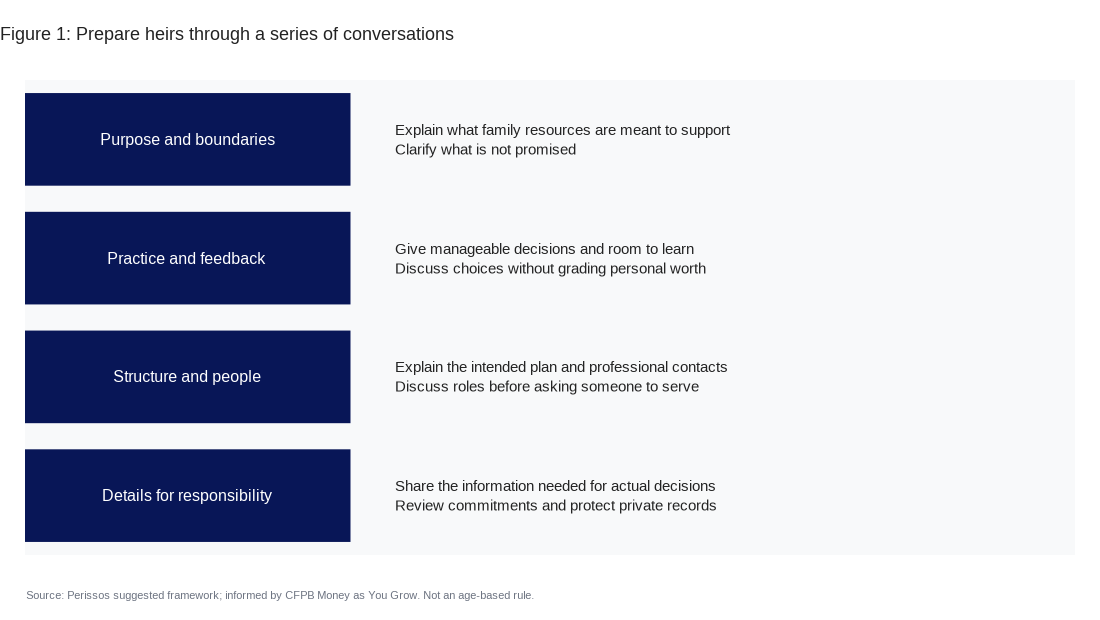
There is no universal birthday when a child must receive the entire family balance sheet. I would choose the amount of detail according to the decisions the person is being asked to make. An adolescent learning to budget needs a different conversation from an adult child who may soon serve as successor trustee or help manage a parent's affairs.
Figure 1 lays out a suggested progression: purpose and boundaries, practical money skills, the structure of the estate plan, and eventually the details needed for a real role. These are conversation stages, not a ranking of children or a research-based schedule. Families can revisit a stage or discuss several together when circumstances require it.
An adult accepting a fiduciary role needs enough detail to decide whether to serve and whom to contact for help. Privacy can still be respected through an organized briefing rather than a broad family email containing sensitive documents. Explain why information is being shared, who else may receive it, and what should remain confidential. Avoid asking one child to keep consequential promises secret from another without considering the strain that creates.
Give children decisions they can practice
Financial readiness is more useful than memorizing account terminology. The CFPB's money milestones for teenagers and young adults emphasizes financial habits and skills and suggests explaining everyday money decisions aloud.2 That provides a practical starting point without requiring the family to disclose every asset.
Consider giving a young person responsibility for a defined spending budget, asking them to compare the full cost of two education options, or inviting them to explain a charitable gift they would like to make. Set the boundaries before the decision and allow manageable mistakes within them. If every choice is immediately corrected, there is little opportunity to practice judgment.
For an adult child, the work might involve reviewing a personal cash-flow plan, understanding taxes on compensation, or comparing investment risk with a near-term spending need. Ask the person what they want to learn. Bringing in an adviser can be helpful when it gives the child an independent place to ask questions, rather than turning the adviser into an enforcer of parental preferences.
Explain fairness without turning money into approval
Equal treatment and appropriate support can be different objectives. One child may have a disability, another may work in the family business, and another may have received substantial help earlier. I would decide how those differences should affect the plan with counsel, then explain the reasoning in language that does not compare the children's worth.
Consider how a rule will operate before announcing it. A promise to match earned income, for example, can favor a highly paid career over caregiving or public service. A condition tied to a particular degree may age poorly if a child develops a different, responsible path. These are design concerns to discuss, not arguments that every condition is inappropriate.
If a trust is part of the plan, explain its purpose, who will administer it, and how the beneficiary can raise questions. Our discussion of dynasty trusts and multigenerational wealth offers context for the longer-term planning conversation. Ask the attorney to distinguish your nonbinding wishes from enforceable provisions. Do not promise flexibility that the actual documents do not provide.
Make the first meeting useful and limited
For an initial meeting, I would choose a modest agenda: explain the family's goals, clarify current support, introduce the people responsible for the estate plan, and invite questions. Give everyone time to think afterward. A meeting that tries to settle every distribution, role, and family disagreement at once may ask more of the participants than they can productively address.
Avoid holding the discussion during a holiday celebration or immediately after a dispute about money. If there is serious conflict, coercion, addiction, or a safety concern, individual conversations and an appropriately qualified professional may be the better first step. Respect an adult child's right to decline a role or request time before discussing private financial matters.
Finish by assigning one concrete next step to each willing participant: review the contact sheet, attend an educational conversation, identify questions for the attorney, or confirm whether they can serve in a proposed role. Coordinate any legal changes with counsel and any gifts with the CPA and our team. The next meeting should build on what the family learned, with commitments documented accurately and room for the children to develop their own judgment.
All my best,
Brandon VanLandingham, CFA, CMT, CFP
Founder / CIO
Citations
- CFPB: Talking About Money Choices (retrieved November 12, 2026).
- CFPB: Money Milestones for Teenagers and Young Adults (retrieved November 12, 2026).
Important Disclosures
This piece is educational. It is not legal, tax, or accounting advice and is not a recommendation to take or refrain from any specific action. Tax law is fact-specific and changes regularly. Please coordinate any decisions discussed here with your attorney, your CPA, and Perissos before acting.
Perissos Private Wealth Management is a Registered Investment Adviser ("RIA"). Registration as an investment adviser does not imply a certain level of skill or training, and the content of this communication has not been approved or verified by the United States Securities and Exchange Commission or by any state securities authority. Perissos Private Wealth Management renders individualized investment advice to persons in a particular state only after complying with the state's regulatory requirements, or pursuant to an applicable state exemption or exclusion. All investments carry risk, and no investment strategy can guarantee a profit or protect from loss of capital. Past performance is not indicative of future results.
The information contained in this newsletter is intended to provide general information about market themes. It is not intended to offer investment advice. Investment advice will only be given after a client engages our services by executing the appropriate investment services agreement. Information regarding investment products and services is given solely to provide education regarding our investment philosophy and our strategies. You should not rely on any information provided in making investment decisions.
Market data, articles and other content in this material are based on generally available information and are believed to be reliable. Perissos Private Wealth Management does not guarantee the accuracy of the information contained in this material.
Perissos Private Wealth Management will provide all prospective clients with a copy of our current Form ADV, Part 2A (Disclosure Brochure), Part 2B (Supplemental Brochures), and Part 3 (Client Relationship Summary) prior to commencing an advisory relationship. You can also view these documents at any time at adviserinfo.sec.gov or by contacting us requesting a copy.
Frequently Asked Questions
- When should parents tell children about a future inheritance?
- There is no universal age. The content suggests sharing information in stages based on the decisions a child is being asked to make, such as budgeting, serving as trustee, or helping manage affairs.
- How can parents discuss inheritance without reducing a child's motivation?
- Start with the purpose of the wealth instead of the balance sheet, and separate current help from uncertain future inheritance. That frames family resources as a responsibility, not a substitute for the child's own planning.
- Should all children receive exactly the same inheritance information and support?
- Not necessarily. The post explains that equal treatment and appropriate support can differ when factors like disability, family business roles, or substantial prior help are involved.