

Written and reviewed by Brandon VanLandingham, CFA, CMT, CFP® · Last updated November 24, 2026
Beneficiary Designations Override Your Will — Here's Why That Matters
Coordinate account instructions with the estate plan you intend
November 24, 2026
You can sign a carefully drafted will and still leave a major account to someone you no longer intend to benefit. The problem is usually a mismatch between the estate documents and the instructions attached to the asset. A beneficiary designation deserves the same attention as the paragraph in your will that describes your wishes.
The headline is a useful warning, with an important qualification: valid beneficiary arrangements generally direct covered assets outside the will, but account terms, spousal protections, court orders, and applicable law still matter. The IRS requires retirement beneficiaries to be designated through the plan's procedures, while the SEC explains how transfer-on-death registration moves securities outside probate.1,2 I would review the entire transfer plan account by account, not assume that the newest document controls everything.
Start with the instruction attached to each asset
A will and a beneficiary form do different jobs. Transfer-on-death registration can transfer securities directly to a named recipient without probate. The SEC also notes that institutions have their own procedures for registering and transferring those assets.2 That makes the institution's accepted record an important piece of evidence.
For retirement accounts, the IRS beneficiary guidance directs owners to follow the plan's designation procedures and notes that some plans require particular beneficiaries.1 A statement of intent in a family letter should not be treated as a substitute. Ask for the current designation on file, including contingent beneficiaries and any institution-specific elections.
Include insurance contracts, bank accounts, employer benefits, and jointly owned property in the attorney's review as well. Do not assume identical rules apply to each category. The useful output is an asset map showing ownership, the controlling transfer instruction, the intended recipient, and the person who will confirm that the paperwork is accepted. A spreadsheet records the plan; it does not itself change legal rights.
A simple example shows why coordination matters
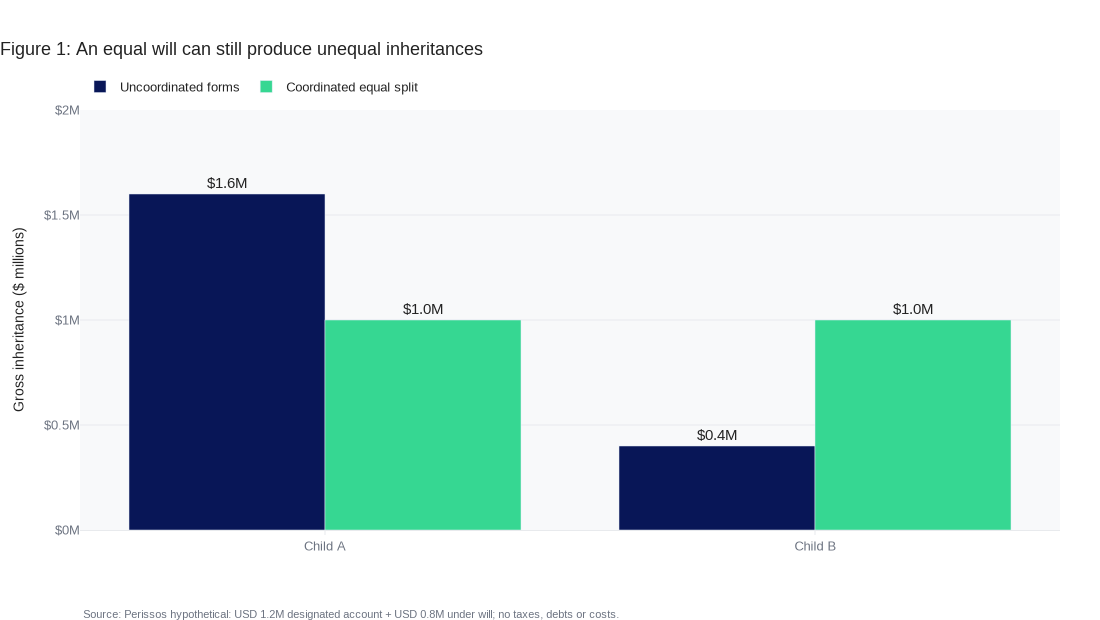
Assume a parent intends two adult children to share a $2 million estate equally. The hypothetical assets are a $1.2 million account with a valid beneficiary designation naming Child A alone and $800,000 of other property that passes equally under the will. Assume no taxes, debt, expenses, ownership dispute, or legal exception, and that all transfers operate as described.
Child A receives the $1.2 million account plus $400,000 under the will, for $1.6 million. Child B receives $400,000. The result is 80% and 20%, although the will divides the property it controls equally. Figure 1 compares that result with a hypothetical coordinated arrangement in which both assets are divided equally. This is arithmetic illustrating the planning issue, not a prediction about any actual estate.
The repair is not automatically to name both children on every account. There may be reasons to leave different assets to different heirs, including tax treatment, liquidity, a business succession plan, or a beneficiary's support needs. The repair is to compare the combined result with your intentions before choosing the forms that implement it.
Spousal protections can change what a form can accomplish
The IRS discussion of a spouse's death explains that many retirement plans require the spouse to be the primary beneficiary unless the spouse gives written consent to an alternative. The same guidance recommends reviewing and potentially changing designations when a spouse dies.3 Do not assume an account portal will capture every legal requirement just because it lets you enter a name.
This matters for blended families. A parent may want to support a current spouse while preserving an inheritance for children from a prior relationship. Naming the children directly, naming the spouse, and naming an appropriately designed trust can produce very different outcomes. Bring the actual plan documents, marital agreements, and estate instruments to counsel. The question is what arrangement is permitted and appropriate for the whole family.
Divorce deserves a separate review. The IRS explains that a qualified domestic relations order can allocate retirement benefits and that participants seeking a beneficiary change should follow the administrator's procedures.4 Do not rely on assumptions that divorce automatically removes an ex-spouse from every account, and do not make a change that violates an order or settlement. Ask counsel what can be changed, when, and with what documentation.
The recipient also inherits a tax timetable
Naming the right person is only part of the decision. Many nonspouse individual IRA beneficiaries are subject to a ten-year distribution rule, while eligible designated beneficiaries and other cases can follow different rules. Annual distributions can also be required within that period, depending on the owner's circumstances. Inherited traditional IRA withdrawals are taxable to the extent they are not a recovery of basis.5
Our article on planning around the ten-year beneficiary rule explains why the distribution schedule deserves advance attention. Equal account balances do not necessarily mean equal after-tax inheritances. Compare the recipient's likely tax position and the character of each asset before using account values alone to measure fairness.
A trust named as IRA beneficiary requires specialized review. IRS Publication 590-B describes conditions under which underlying trust beneficiaries can be treated as designated beneficiaries. Naming an estate or an unsuitable trust can change the distribution framework.5 A trust should be evaluated for both its protective purpose and its tax consequences, not added to a form simply because the household already has one.
Plan for the second choice and the difficult cases
Ask what happens if a primary beneficiary dies first, disclaims the benefit, or cannot receive the property as intended. Read the institution's contingent-beneficiary and descendant provisions rather than assuming that a familiar phrase has the same operational meaning everywhere. Have counsel confirm how the selected language works with the family tree and the governing agreement.
If the intended recipient is a minor, has significant support needs, or would benefit from supervised management, discuss the receiving structure before submitting the designation. Our comparison of revocable and irrevocable trusts provides context for that conversation. The legal documents should address who manages the property and under what standards, not just whose name appears first.
An outright designation may be a good fit for a capable adult when simplicity is a priority. It may be a poor fit when you want ongoing management, coordination with public benefits, or protection against rapid spending. Conversely, a complicated trust can impose costs and administration that the family does not need. Match the structure to a concrete concern and understand the tradeoff before signing.
Finish the review with accepted records
I would bring the will, trust, current account statements, beneficiary confirmations, and relevant family changes to one coordinated review with your attorney, CPA, and advisory team. For each asset, compare the legal recipient with your intended recipient and compare the total after-tax outcome with your fairness objective. Identify which professional is responsible for each unresolved question.
Then submit the required forms, obtain confirmation, and retain the accepted version with your estate records. Recheck after a marriage, divorce, death, account transfer, or material change in the plan. Ask the receiving institution to confirm designations after a transfer rather than assuming the old instructions followed the assets. A completed review ends with evidence that the accounts and the documents tell the same story.
All my best,
Brandon VanLandingham, CFA, CMT, CFP
Founder / CIO
Citations
- IRS: Retirement Topics — Beneficiary (retrieved November 12, 2026).
- SEC Investor.gov: Transferring Assets (retrieved November 12, 2026).
- IRS: Retirement Topics — Death of Spouse (retrieved November 12, 2026).
- IRS: Retirement Topics — Divorce (retrieved November 12, 2026).
- IRS: Publication 590-B (2025) (retrieved November 12, 2026).
Important Disclosures
This piece is educational. It is not legal, tax, or accounting advice and is not a recommendation to take or refrain from any specific action. Tax law is fact-specific and changes regularly. Please coordinate any decisions discussed here with your attorney, your CPA, and Perissos before acting.
Perissos Private Wealth Management is a Registered Investment Adviser ("RIA"). Registration as an investment adviser does not imply a certain level of skill or training, and the content of this communication has not been approved or verified by the United States Securities and Exchange Commission or by any state securities authority. Perissos Private Wealth Management renders individualized investment advice to persons in a particular state only after complying with the state's regulatory requirements, or pursuant to an applicable state exemption or exclusion. All investments carry risk, and no investment strategy can guarantee a profit or protect from loss of capital. Past performance is not indicative of future results.
The information contained in this newsletter is intended to provide general information about market themes. It is not intended to offer investment advice. Investment advice will only be given after a client engages our services by executing the appropriate investment services agreement. Information regarding investment products and services is given solely to provide education regarding our investment philosophy and our strategies. You should not rely on any information provided in making investment decisions.
Market data, articles and other content in this material are based on generally available information and are believed to be reliable. Perissos Private Wealth Management does not guarantee the accuracy of the information contained in this material.
Perissos Private Wealth Management will provide all prospective clients with a copy of our current Form ADV, Part 2A (Disclosure Brochure), Part 2B (Supplemental Brochures), and Part 3 (Client Relationship Summary) prior to commencing an advisory relationship. You can also view these documents at any time at adviserinfo.sec.gov or by contacting us requesting a copy.
Frequently Asked Questions
- Do beneficiary designations really override a will?
- For many assets, yes. Valid beneficiary forms for retirement accounts, insurance, and transfer-on-death registrations generally control those assets outside the will, subject to plan terms, spousal rights, court orders, and applicable law.
- Which accounts should be reviewed with an estate plan?
- Review retirement accounts, insurance contracts, bank accounts, employer benefits, jointly owned property, and transfer-on-death assets. The goal is to confirm the institution's accepted records match the overall transfer plan.
- Why can equal account values still lead to unequal inheritances?
- Different assets can follow different tax rules and distribution timelines. For example, many nonspouse IRA beneficiaries face a 10-year payout framework, which can change the after-tax result even when account balances look equal.