

Written and reviewed by Brandon VanLandingham, CFA, CMT, CFP® · Last updated November 10, 2026
Stock Options 101: ISOs, NQSOs, and the AMT Trap
Understand the cash commitment before chasing the tax treatment
November 10, 2026
An employee can exercise stock options, receive no cash, and still create a tax problem. That is the central reason to plan an exercise before submitting the instruction. The option's paper value is not the same as spendable wealth, and a favorable tax label does not remove the risk of holding one company's stock.
The starting distinction is between incentive stock options, or ISOs, and nonqualified stock options, often called NQSOs or nonstatutory options. The IRS stock-option overview identifies statutory and nonstatutory categories.1 The award agreement and employer records establish what you actually hold. This memo addresses common federal treatment as of October 23, 2026, with examples involving vested shares; unusual restrictions, early exercises and state taxation need separate analysis.
Separate the grant, the exercise and the sale
A grant gives the employee an option under specified terms. Vesting determines when the employee can exercise, subject to the agreement. Exercise means paying the exercise price to acquire shares. Selling those shares is another transaction. These dates can occur in different tax years, and they should not be collapsed into a single event called cashing out.
Before modeling taxes, collect the grant date, option type, vesting schedule, exercise price, expiration date and any post-employment deadline. Determine whether shares can actually be sold after exercise. A private-company valuation does not establish that a buyer is available. A public-company employee may also face trading restrictions. The plan administrator and securities counsel should resolve those conditions before the tax projection becomes an action plan.
NQSOs generally create compensation income at exercise
For the common NQSO whose value was not readily determinable at grant, exercising into substantially vested shares generally creates compensation income equal to the value received minus the amount paid. For employees, that spread is reported as wages and is generally subject to applicable payroll taxes. The basis of the acquired shares includes both the exercise cost and compensation already included in income.2
Suppose an employee exercises 1,000 vested options with a $10 exercise price when the stock is worth $50. The exercise cost is $10,000 and the spread is $40,000. Under the stated NQSO assumptions, the $40,000 is compensation income and the shares' total basis is $50,000. Selling immediately for $50,000 would produce no additional capital gain before transaction costs. Holding the shares exposes their value to subsequent changes; it does not undo the compensation event.
IRS Publication 525 warns that reported broker basis may omit compensation income for options granted on or after January 1, 2014.2 Reconcile the brokerage report with payroll and exercise records so the same economic spread is not taxed again through an understated basis. Withholding is also a payment toward the liability, not a guarantee that the final return has been fully funded.
ISOs add a second tax calculation
A qualifying ISO exercise generally does not create regular federal income at exercise, but it can create an alternative minimum tax adjustment. For vested shares held beyond the exercise year, the adjustment generally reflects the exercise-date value above the amount paid. The Form 6251 instructions describe the adjustment and the need to track a separate AMT basis.3
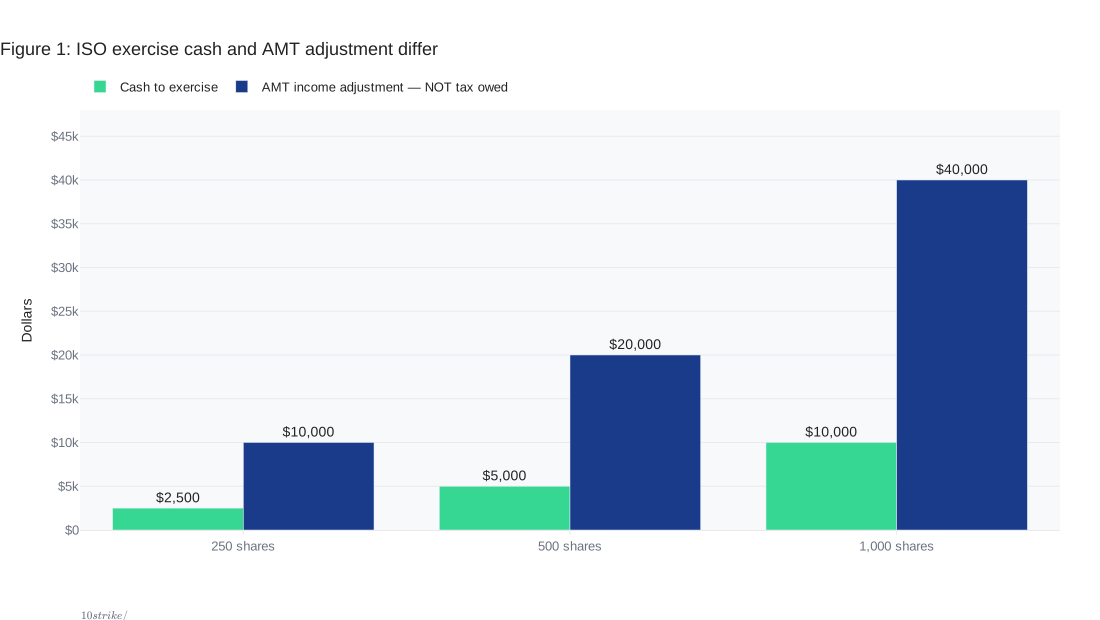
Figure 1 applies the same assumed $10 exercise price and $50 stock value to 250, 500 and 1,000 ISO shares. Exercise cash is $2,500, $5,000 and $10,000. The corresponding AMT income adjustments are $10,000, $20,000 and $40,000. These are adjustments to the tax calculation, not amounts of AMT owed. The shares are assumed substantially vested at exercise, no amount was paid for the option itself, and the shares remain held at year-end.
Actual AMT depends on the entire return, including the applicable exemption, phaseout, other adjustments and the relationship between tentative minimum tax and regular tax. Multiplying the spread by a headline AMT rate does not reliably determine the incremental liability. The example intentionally calculates only exercise cost and adjustment. It assumes no fees or other transactions and estimates neither federal nor state tax due.
The liquidity concern is straightforward: the employee must fund the exercise and any resulting tax without necessarily having sold shares. If the stock subsequently falls, the household may have much less liquid value available than it expected. If it falls after the exercise year has closed, a later sale does not simply rewrite the earlier year's exercise-date adjustment.
Holding-period benefits come with market exposure
The regular-tax ISO holding requirements generally require waiting until after the later of two years from grant and one year from transfer of the shares. The employment requirement also generally requires exercise within three months after leaving employment, with special rules including disability. These tax conditions are separate from the contractual life of the option.4
Satisfying the required holding periods can allow capital-gain treatment on a qualifying sale. Selling earlier is generally a disqualifying disposition, with compensation income and any remaining capital gain or loss determined under the applicable rules.4,2 The lower-tax possibility is valuable only if the additional holding risk is acceptable. Waiting for a tax anniversary is not a guarantee that the stock's value will remain intact.
Selling ISO shares in the same calendar year as exercise generally eliminates the separate ISO exercise adjustment for AMT, although regular-tax consequences remain.3 That can make an exercise-year review useful, particularly after a large price change. It does not make every same-year sale optimal. Review the specific lots, sale restrictions and estimated tax effects with the CPA before deciding whether to retain or sell.
A possible AMT credit is not cash in the bank
AMT attributable to qualifying deferral items can generate a minimum-tax credit for later years. The Form 8801 instructions distinguish deferral items from exclusion items and govern the credit calculation.5 A potential future credit should not be treated as an immediate refund available to pay today's exercise cost or tax bill. Its use depends on subsequent tax circumstances.
Keep regular-tax basis, AMT basis and credit carryforwards together in the permanent records. Ask the CPA to model the exercise year and a possible sale year, including a lower-price scenario. The important output is the timing of cash the family must provide and may eventually recover, not merely the lifetime tax total under one optimistic price path.
Decide how much company exposure belongs in the plan
Salary, future grants and shares already owned can tie multiple parts of a household to the same employer. Before exercising and holding, ask whether you would voluntarily invest the same cash in that stock today if you did not already own the options. Our discussion of planning around a highly appreciated portfolio addresses the related decision of moving wealth out of a concentrated holding.
An exercise-and-sale approach may fit someone who needs liquidity or already has substantial employer exposure. A partial exercise may preserve more flexibility. Exercising and holding can be considered when the employee can fund the cost and tax reserve, understands the restrictions, and can withstand a substantial decline. A household relying on a future sale merely to pay the exercise-year tax should examine that dependence carefully.
Include the rest of the tax return in the comparison. Wages are excluded from net investment income, but investment gains can be relevant to NIIT, and wage income can affect the threshold calculation.6 Our NIIT planning discussion provides context. State residency and employment history can add another layer, so a federal-only estimate is not enough for implementation.
Put the exercise on a funded calendar
Before authorizing an exercise, obtain a written comparison of doing nothing, exercising and selling, and exercising and holding the proposed number of shares. Identify the cash source, tax reserve, sale restrictions and next review date. Confirm who will reconcile Form W-2, Form 3921 when applicable, broker reporting and basis records.
The IRS's 2026 estimated-tax guidance includes AMT in the payment-planning process.7 Have the CPA calculate the required payment timing rather than waiting for the annual return. Then decide the largest stock decline the family could tolerate after exercise. If that decline would force borrowing, an unwanted sale or a change in essential spending, reduce the proposed exposure before the tax benefit becomes the reason to accept more risk than the plan can support.
All my best,
Brandon VanLandingham, CFA, CMT, CFP
Founder / CIO
Citations
- IRS, Topic 427, Stock Options (retrieved October 23, 2026).
- IRS, Publication 525 (2025), Taxable and Nontaxable Income (retrieved October 23, 2026).
- IRS, Instructions for Form 6251 (2025), Line 2i (retrieved October 23, 2026).
- 26 U.S.C. Section 422, Incentive Stock Options (retrieved October 23, 2026).
- IRS, Instructions for Form 8801 (2025) (retrieved October 23, 2026).
- IRS, Questions and Answers on the Net Investment Income Tax (retrieved October 23, 2026).
- IRS, Publication 505 (2026), Tax Withholding and Estimated Tax (retrieved October 23, 2026).
Important Disclosures
This piece is educational. It is not legal, tax, or accounting advice and is not a recommendation to take or refrain from any specific action. Tax law is fact-specific and changes regularly. Please coordinate any decisions discussed here with your attorney, your CPA, and Perissos before acting.
Perissos Private Wealth Management is a Registered Investment Adviser ("RIA"). Registration as an investment adviser does not imply a certain level of skill or training, and the content of this communication has not been approved or verified by the United States Securities and Exchange Commission or by any state securities authority. Perissos Private Wealth Management renders individualized investment advice to persons in a particular state only after complying with the state's regulatory requirements, or pursuant to an applicable state exemption or exclusion. All investments carry risk, and no investment strategy can guarantee a profit or protect from loss of capital. Past performance is not indicative of future results.
The information contained in this newsletter is intended to provide general information about market themes. It is not intended to offer investment advice. Investment advice will only be given after a client engages our services by executing the appropriate investment services agreement. Information regarding investment products and services is given solely to provide education regarding our investment philosophy and our strategies. You should not rely on any information provided in making investment decisions.
Market data, articles and other content in this material are based on generally available information and are believed to be reliable. Perissos Private Wealth Management does not guarantee the accuracy of the information contained in this material.
Perissos Private Wealth Management will provide all prospective clients with a copy of our current Form ADV, Part 2A (Disclosure Brochure), Part 2B (Supplemental Brochures), and Part 3 (Client Relationship Summary) prior to commencing an advisory relationship. You can also view these documents at any time at adviserinfo.sec.gov or by contacting us requesting a copy.
Frequently Asked Questions
- What is the main tax difference between ISOs and NQSOs at exercise?
- NQSOs generally create compensation income at exercise equal to the spread between fair market value and the exercise price. ISOs usually do not create regular federal income at exercise, but they can create an AMT adjustment.
- Why can stock options create a cash-flow problem even if no shares are sold?
- Exercising options can require cash for the exercise price and may also trigger taxes in the same year. If shares cannot be sold quickly or later decline in value, the household may face a liquidity strain.
- How long must ISO shares generally be held for qualifying sale treatment?
- The regular-tax holding period generally requires selling after the later of two years from grant and one year from transfer of the shares. Separate post-employment exercise rules, often three months after leaving work, may also apply.