

Written and reviewed by Brandon VanLandingham, CFA, CMT, CFP® · Last updated November 11, 2026
Concentrated Stock Position? Five Ways to Diversify Tax-Efficiently
Reduce dependence on one company without letting taxes make every decision
November 11, 2026
A concentrated stock position often represents something positive: years of saving, a successful business or compensation that grew more valuable than expected. The planning problem begins when protecting the tax benefit of holding the stock becomes more important than protecting the family's ability to use its wealth.
I would begin with the loss the household could absorb, then design the tax-aware route toward an acceptable position size. The five approaches below address different parts of that route. Some produce cash for reinvestment; others transfer wealth to charity or change the timing of taxation. They are not interchangeable ways to retain every dollar without tax. This discussion addresses federal planning as of October 23, 2026; Oklahoma and other state consequences require a separate calculation.
First define the exposure you need to change
Inventory shares by account, acquisition date, adjusted basis and restrictions. Include employer-related income and future equity awards when considering how much of the family's economic life depends on one company. A taxable position and shares inside a retirement account do not have the same tax mechanics. These five approaches focus primarily on appreciated stock held in a taxable account.
Choose a target concentration and a timetable before choosing a tax technique. If a substantial decline would compromise retirement or a near-term obligation, a slow exit may be inappropriate even if it reduces the immediate tax bill. Our broader discussion of reducing capital gains on an appreciated portfolio provides context for combining investment and tax decisions.
1. Sell deliberately selected tax lots
Different lots of the same stock can have very different gains. IRS Publication 550 explains specific identification: tell the broker which shares to sell at the time of the transaction and obtain written confirmation within a reasonable time.1 Selecting higher-basis shares can reduce the gain recognized for a given amount sold, provided holding periods and other relevant facts support that choice.
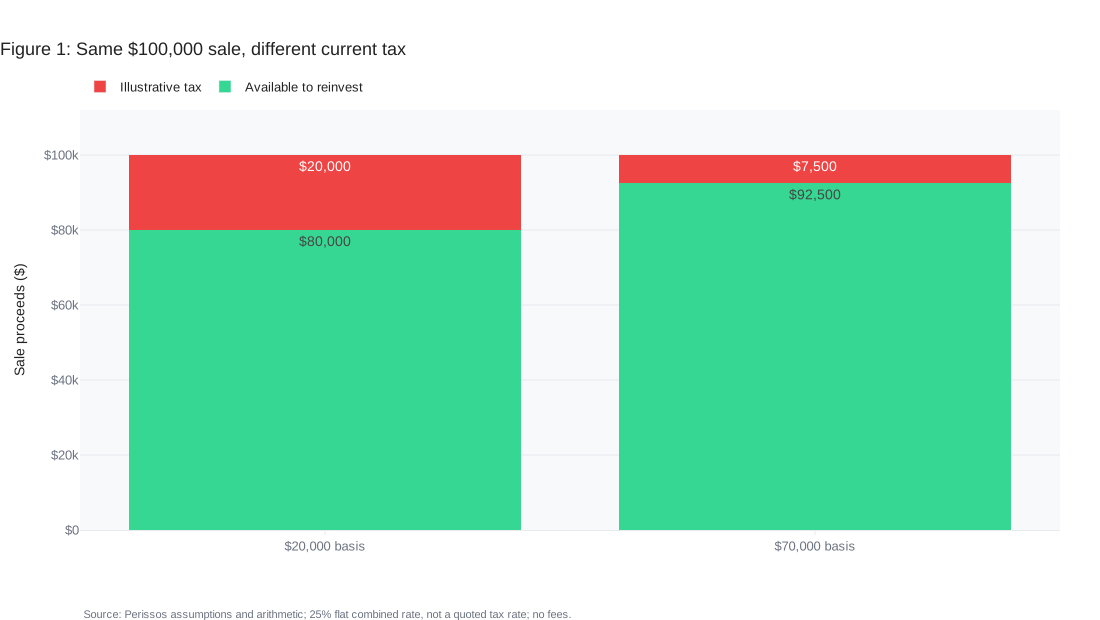
Figure 1 assumes two available lots, each worth $100,000 and held more than one year. One has $20,000 basis; the other has $70,000 basis. Selling the first realizes $80,000 of gain; selling the second realizes $30,000. At an assumed flat combined tax rate of 25% applied to the incremental gain, the respective tax costs are $20,000 and $7,500, leaving $80,000 and $92,500 for reinvestment.
That is a $12,500 difference in current tax, not a permanent elimination of the remaining embedded gain. The unsold lower-basis shares retain their tax exposure. The 25% rate is an illustration, not a stated federal or Oklahoma rate; it assumes any applicable surtax and state burden are already included. It ignores fees, bracket changes and other tax interactions. Actual lot selection needs a full projection.
This approach is useful when suitable higher-basis lots exist. It offers little flexibility when nearly all shares have the same low basis. Holding-period considerations can also change the answer: the IRS generally treats gains on assets held more than one year as long-term, while shorter holdings are generally short-term.2
2. Spread sales across a deliberate timetable
Staged sales can distribute recognized gains across tax years rather than concentrating them in one return. The potential benefit depends on the household's other income and applicable rates. It is not automatic: postponing a sale may merely postpone the same tax, and the stock remains exposed to market risk during the waiting period.
I would set both a calendar and a maximum acceptable remaining exposure. For example, a household can establish review dates and a gain budget, then reconsider the pace if spending needs or the position's size changes. New cash flows can be directed elsewhere while the reduction proceeds. The objective is a measurable move toward diversification, not a timetable that is repeatedly extended because selling feels uncomfortable.
Include net investment income tax in the projection. The IRS explains that the 3.8% tax applies to the lesser of net investment income or modified adjusted gross income above the applicable threshold, rather than automatically to every gain.3 A staged plan also needs estimated-payment planning and a review of state rules. For restricted or insider holdings, involve the employer's securities counsel before establishing the sale process.
3. Pair gains with usable capital losses
Realized capital losses elsewhere in the taxable portfolio may offset realized gains under the capital-gain netting rules.2 This can support a diversification sale that would otherwise create a larger current taxable gain. Confirm the amount and character of loss carryforwards with the CPA; a negative position on an account statement is not the same as an available tax loss.
The wash-sale rule can disallow a loss when substantially identical securities are acquired within 30 days before or after a loss sale. Purchases through other accounts or a spouse can matter.1 Coordinate replacement investments, automatic reinvestment and household trading. The rule concerns the loss transaction; selling the concentrated winner does not itself create a deductible loss.
Our explanation of direct indexing for tax-aware investors discusses one setting in which selective losses may be available. It cannot manufacture useful losses on demand. Avoid retaining an oversized position indefinitely while waiting for markets to produce an offset, and avoid allowing the tax transaction to create an unsuitable replacement allocation.
4. Give appreciated shares when a gift is already intended
For a family with genuine charitable goals, contributing qualifying long-term appreciated shares directly to a qualified public charity can avoid a donor-level sale and may support a fair-market-value deduction, subject to the applicable limitations.4 The key is that the charity receives the property. The donor no longer has those assets available for retirement, spending or heirs.
A deduction is not a dollar-for-dollar reimbursement. The usable amount depends on the property, recipient, income limits and substantiation. IRS guidance for 2026 also identifies the new 0.5%-of-AGI floor for itemized charitable contributions and the limitation affecting itemized deductions at the highest bracket.5 Do not assume the full gift value produces an immediate deduction at the donor's headline rate.
Coordinate acceptance and transfer instructions with the recipient before initiating delivery. Confirm valuation and reporting requirements, especially for shares that are not publicly traded.6 A gift can reduce the concentration remaining on the family's balance sheet, but it does so by giving wealth away. It is a poor substitute for a sale when the family needs the proceeds for its own obligations.
5. Consider a charitable remainder trust for an income-and-giving goal
A charitable remainder trust is irrevocable. It provides payments to noncharitable beneficiaries and ultimately directs the remainder to charity. Appreciated assets transferred to a properly structured trust can be sold with income-tax deferral, while beneficiary payments follow distribution-tax rules. The gain is not simply erased, and the charitable deduction relates to the qualifying remainder interest rather than the entire contribution.7
This can connect diversification with a planned income stream and a substantial charitable commitment. It is a poor fit if the donor needs unrestricted access to principal, wants all remaining assets to pass to family, or cannot justify the legal, administrative and tax-reporting costs. Have the attorney and CPA evaluate structure, payout terms and transaction timing before assets are committed. A trust should serve a genuine giving plan, not be adopted solely because a tax illustration looks attractive.
Turn the options into an execution plan
Ask the planning team for a comparison showing the shares remaining, after-tax proceeds available to the family, assets committed to charity and the next action date under each feasible approach. Keep those categories separate. A strategy that shows a small tax bill because it transfers substantial wealth away is solving a different problem from a straightforward diversification sale.
Then assign responsibility for lot identification, trade restrictions, transfers and tax payments. Decide where sale proceeds will be invested before trading begins. The plan should reduce dependence on the original company, preserve enough accessible resources for the household and make the cost of waiting visible. Paying a known tax can be a reasonable price for moving an essential family goal out of a single stock.
All my best,
Brandon VanLandingham, CFA, CMT, CFP
Founder / CIO
Citations
- IRS, Publication 550 (2025), Investment Income and Expenses (retrieved October 23, 2026).
- IRS, Topic 409, Capital Gains and Losses (retrieved October 23, 2026).
- IRS, Questions and Answers on the Net Investment Income Tax (retrieved October 23, 2026).
- IRS, Publication 526 (2025), Charitable Contributions (retrieved October 23, 2026).
- IRS, Publication 505 (2026), Tax Withholding and Estimated Tax (retrieved October 23, 2026).
- IRS, Publication 561, Determining the Value of Donated Property (retrieved October 23, 2026).
- IRS, Charitable Remainder Trusts (retrieved October 23, 2026).
Important Disclosures
This piece is educational. It is not legal, tax, or accounting advice and is not a recommendation to take or refrain from any specific action. Tax law is fact-specific and changes regularly. Please coordinate any decisions discussed here with your attorney, your CPA, and Perissos before acting.
Perissos Private Wealth Management is a Registered Investment Adviser ("RIA"). Registration as an investment adviser does not imply a certain level of skill or training, and the content of this communication has not been approved or verified by the United States Securities and Exchange Commission or by any state securities authority. Perissos Private Wealth Management renders individualized investment advice to persons in a particular state only after complying with the state's regulatory requirements, or pursuant to an applicable state exemption or exclusion. All investments carry risk, and no investment strategy can guarantee a profit or protect from loss of capital. Past performance is not indicative of future results.
The information contained in this newsletter is intended to provide general information about market themes. It is not intended to offer investment advice. Investment advice will only be given after a client engages our services by executing the appropriate investment services agreement. Information regarding investment products and services is given solely to provide education regarding our investment philosophy and our strategies. You should not rely on any information provided in making investment decisions.
Market data, articles and other content in this material are based on generally available information and are believed to be reliable. Perissos Private Wealth Management does not guarantee the accuracy of the information contained in this material.
Perissos Private Wealth Management will provide all prospective clients with a copy of our current Form ADV, Part 2A (Disclosure Brochure), Part 2B (Supplemental Brochures), and Part 3 (Client Relationship Summary) prior to commencing an advisory relationship. You can also view these documents at any time at adviserinfo.sec.gov or by contacting us requesting a copy.
Frequently Asked Questions
- What is the first step in reducing a concentrated stock position?
- Start by inventorying shares by account, basis, acquisition date, and any restrictions, then set a target concentration and timetable. The article emphasizes defining the acceptable loss the household could absorb before choosing a tax technique.
- Can staged stock sales lower taxes automatically?
- No. Spreading sales across tax years may help in some cases, but it can also simply defer the same tax while leaving the position exposed to market risk.
- When can gifting appreciated stock help diversify tax-efficiently?
- Directly donating qualifying long-term appreciated shares to a public charity can avoid a donor-level sale and may support a fair-market-value deduction, subject to IRS limits and substantiation rules. The shares are no longer available for spending, retire...