

A founder can build an extraordinary company and still have an estate plan that is oddly disconnected from it. The operating documents are current, the cap table is clean, and the next financing or sale is being modeled down to the decimal. Yet the estate plan still treats the business as if its value will stand still. It won't.
That is the planning problem a grantor retained annuity trust, or GRAT, is built to address. A GRAT does not make today's value disappear. It separates today's appraised value from tomorrow's potential appreciation. The founder contributes an asset to an irrevocable trust, receives a prescribed stream of annuity payments back, and directs whatever remains after the term to family members or trusts for their benefit. If the asset grows faster than the IRS hurdle rate, the excess growth can move outside the founder's estate with a relatively small taxable gift.
The strategy is particularly relevant to founders because private-company value rarely moves in a straight line. A product launch, financing round, major contract, or sale process can change the equity's value quickly. The opportunity is to act before that value is obvious. The caution is that timing, valuation, governance, liquidity, and mortality all matter. A GRAT is a precise instrument. It is not a form downloaded on Friday and funded on Monday.
A Freeze on Future Growth, Not a Gift of Today's Company
Congress added Sections 2701 through 2704 to the Internal Revenue Code in 1990 to establish special valuation rules for transfers among family members. Section 2702 generally says that when someone transfers property in trust for family but retains an interest, that retained interest is valued at zero unless it is a "qualified interest." A right to receive fixed amounts at least annually is one of those qualified interests, and Section 7520 supplies the interest rate and actuarial framework used to value it.1,2
That framework is the foundation of the GRAT. The founder's annuity has a present value. The taxable gift is the fair market value of the property transferred, less the present value of the annuity the founder keeps. The IRS describes the remainder for the non-charitable beneficiaries as the taxable gift and treats the GRAT as a grantor trust for federal income-tax purposes.3
The modern short-term, near-zero-gift GRAT traces to Walton v. Commissioner. In that case, the Tax Court considered two-year GRATs whose annuity payments continued to the grantor's estate if she died during the term. The court concluded that the retained annuity payable for the stated term was a qualified interest, and the IRS later announced that it would follow the decision.4 That history matters because it explains why a GRAT can be designed so the present value of the retained annuity absorbs nearly all the initial transfer value. Practitioners often call that a "zeroed-out" GRAT, although careful documents usually leave a small reported gift rather than pretending valuation and rounding are perfect.
This is less like giving away the orchard than assigning the next harvest. The founder is scheduled to receive back value equal, on an actuarial basis, to what went into the trust. The family receives only the crop above the IRS growth assumption. If the orchard produces no excess crop, the transfer produces little or no remainder.
The Mechanics From Funding to Finish
The sequence starts with the trust document and the asset, not the tax return. Counsel drafts an irrevocable GRAT for a stated term and names the remainder beneficiaries. The founder transfers shares or other property to the trust at fair market value. An independent appraisal is usually indispensable when the asset is private-company equity because the annuity formula, the reported gift, and the later defense of the transaction all depend on the opening value.
The trust then pays the founder the stated annuity on schedule. The regulations require a qualified annuity to be paid at least annually. The amount may be a stated dollar sum or a fixed percentage of the contributed property's initial value, and a payment may rise from one year to the next by no more than 20%. The trust also cannot accept additional contributions during the GRAT term, cannot distribute to someone other than the annuity holder during that term, and cannot simply prepay the annuity interest.5 Those are not clerical details. Missing an annuity payment or funding the wrong asset can damage the intended tax treatment.
At the end of the term, any property left after all annuity payments passes to the remainder beneficiaries under the trust agreement. If investment or business growth merely matches the Section 7520 assumption, there should be little economic remainder. If the asset underperforms, the annuity payments tend to return most or all of the property to the founder. If the asset materially outperforms, the spread belongs to the remainder side of the trust.
The hurdle is set when the GRAT is funded. For August 2026, the Section 7520 rate is 5.2%. The IRS calculates that monthly rate as 120% of the applicable federal mid-term rate, rounded to the nearest two-tenths of one percent.6 A lower hurdle helps, but rate-shopping is not the real thesis for a founder. The more important question is whether the contributed shares have a credible path to appreciate faster than the hurdle during the chosen term.
Because the GRAT is a grantor trust, its income, deductions, and credits are generally reported by the founder during the period of grantor-trust treatment. When a grantor pays income tax attributable to a grantor trust, the IRS has ruled that the tax payment is not an additional gift to the beneficiaries.7 Economically, that can leave more value inside the trust to compound. It also means the founder needs enough outside liquidity to pay a tax bill that may relate to income retained inside the GRAT.
Why Founders Have a Special Use Case
Founder equity has three characteristics that can make a GRAT unusually effective: concentrated upside, an identifiable catalyst calendar, and limited personal liquidity. The first two create the opportunity. The third creates the constraint.
Consider a founder who expects a financing round or strategic process but has not signed a binding transaction. If the company is independently valued today at a supportable level and later receives a substantially higher valuation because business facts improve, a GRAT can capture part of that appreciation for the remainder beneficiaries. The planning value comes from real post-transfer growth, not from an aggressive opening appraisal. If a sale is already practically certain, there is much less room to defend the timing and opening value. Earlier is generally cleaner, but "early" does not mean "before the facts are ready." The founder still needs reliable financial records, defensible forecasts, and properly documented rights attached to the transferred shares.
A GRAT can also help a founder who wants to keep lifetime gift-tax exemption available for other planning. The basic exclusion amount is $15 million per individual in 2026.8 That is substantial, but a company worth $20 million today can become a $60 million company faster than an estate plan can be rewritten. A near-zero-gift GRAT aims at the appreciation rather than consuming exemption equal to the full appraised value on day one.
Control needs separate attention. Transferring nonvoting shares may preserve operating control, but voting rights, transfer restrictions, investor agreements, buy-sell provisions, S-corporation eligibility, and lender covenants can all affect what may be transferred and how the interest should be valued. A trust that works under the tax code but violates the shareholders' agreement does not work. The business attorney, estate attorney, valuation professional, CPA, and advisory team need to work from the same cap table and the same transaction calendar.
The Math: A Two-Year Founder GRAT
Let's look at a simplified example. Assume a founder transfers $10 million of appraised private-company shares to a two-year GRAT in August 2026. The illustration uses the month's 5.2% Section 7520 rate, level annual payments at each year-end, no valuation discount, no income-tax drag, no distributions, and no transaction expenses. A level annuity with a present value of $10 million is approximately $5.39 million per year. This is a planning illustration, not a quote for a real trust; the actual calculation belongs in the attorney's documents and the filed gift-tax return.
Now assume the shares appreciate 25% in each trust year. Figure 1 shows the cash-flow logic. The initial $10 million grows to $12.5 million before the first annuity, the trust returns about $5.39 million to the founder, and roughly $7.11 million remains invested. In year two, that balance grows to about $8.88 million before the second annuity. After the final payment, approximately $3.49 million remains for the beneficiaries. That remainder is the excess performance the GRAT was designed to isolate.
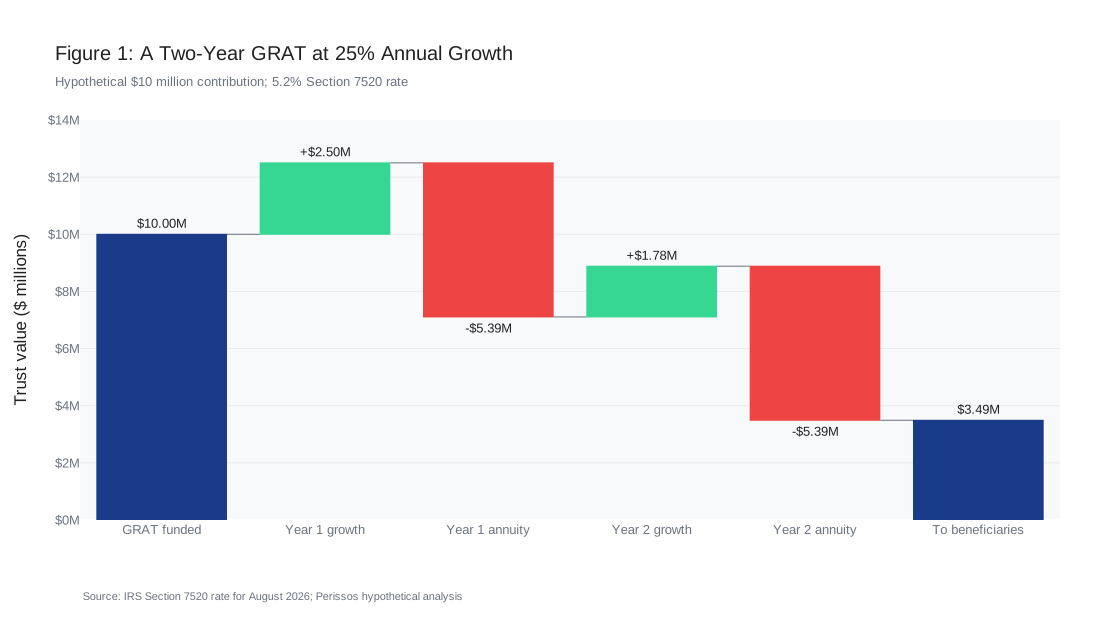
Figure 2 shows why the outcome depends so heavily on the asset rather than the trust wrapper. At growth equal to the 5.2% hurdle, the modeled remainder is effectively zero. At 10% annual growth, the projected remainder is about $774,000. At 20%, it is about $2.53 million, and at 30%, it is about $4.50 million. If the shares compound at 50% for both years, the modeled remainder reaches roughly $9.02 million. These are deliberately mechanical scenarios. Private-company returns are lumpy, valuations can fall, and a financing or exit can be delayed.
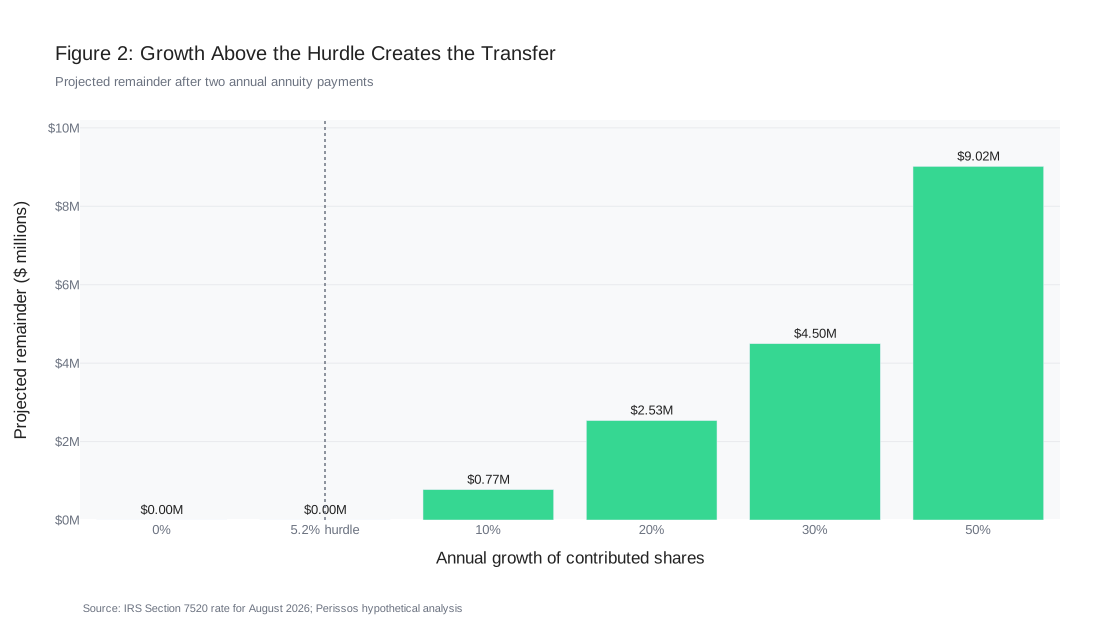
The takeaway: a GRAT is a bet on relative performance, not a promise of tax savings. The trust wins only to the extent the contributed asset beats the hurdle after accounting for expenses and administration. For founders, that often means selecting the right slice of equity and the right business window is more important than selecting the longest possible term.
Where GRATs Break Down
The first failure mode is simple: the asset does not outperform. In that case, the annuity payments bring the property back to the founder and little or nothing passes to the beneficiaries. The founder has still paid legal, appraisal, accounting, and administrative costs. That is why I view a GRAT as a repeatable transfer strategy for the right facts, not as a one-shot prediction that must work.
The second risk is death during the term. Treasury regulations provide that if the grantor dies while retaining the annuity interest, all or part of the trust corpus may be included in the grantor's gross estate under Section 2036.9 Short terms reduce that mortality exposure, but they also give the asset less time to outperform. A founder in poor health may need a different structure, even when the business upside looks compelling.
The third problem is liquidity. A private company may not pay dividends, yet the GRAT must make its annuity payment. The trustee may have to return shares in kind, which puts equity back in the founder's estate and requires a reliable valuation process for each payment. A founder who expects every transferred share to remain inside the trust has misunderstood the transaction. The annuity is not decorative. It is the value the founder retained.
The fourth issue is generation-skipping planning. Section 2642 generally restricts allocation of generation-skipping transfer exemption during an estate-tax inclusion period, which can continue while the GRAT property would be included in the grantor's estate if the grantor died.10 That makes a GRAT less natural for a direct dynasty-trust objective than some other structures. It can still fit into a larger plan, but the remainder beneficiary design deserves its own analysis.
Finally, valuation discipline is non-negotiable. The Form 709 instructions state that adequate disclosure generally requires a description of the property, the trust and its terms, and either a qualified appraisal or a detailed explanation of the valuation method. Adequate disclosure starts the limitations period for the reported gift.11 For founder shares, the report needs to grapple with the actual security rights, recent financings, forecasts, customer concentration, transfer restrictions, and any transaction discussions already underway. The objective is not the lowest number an appraiser will sign. It is a number the facts can support.
How We Approach This
I start with the business calendar. What could change value over the next 12 to 36 months? Is there a financing, contract award, regulatory milestone, product launch, recapitalization, or likely sale process? How certain is it, and what has already been communicated to outsiders? The best GRAT candidate is not simply the asset with the highest hoped-for return. It is an asset with asymmetric upside, a defensible current value, and enough time for the future event to remain genuinely uncertain.
Then we model the annuity and the founder's liquidity together. We want to know which shares are likely to come back, whether cash could fund any payments, how income taxes would be paid, and what happens if the company value falls by half. We also compare the GRAT with an outright exemption gift, a sale to a grantor trust, a spousal lifetime access trust, and doing nothing. Plan first, product second. The GRAT should win because it fits the family and the business, not because its acronym sounds sophisticated.
Implementation is coordinated work. The estate attorney drafts the trust. The business attorney confirms the equity can be transferred. The valuation professional establishes fair market value. The CPA handles the gift-tax return and ongoing reporting. Our role is to keep the investment, liquidity, estate, and transaction pieces connected. This is the framework; the specifics are a conversation with us, your attorney, and your CPA.
A GRAT can be an excellent tool for a founder whose company has more upside than current transfer-tax room. It can also be an expensive stack of documents attached to the wrong asset. The distinction comes down to valuation, timing, liquidity, and coordination. Our team will continue evaluating those pieces together and act when the facts—not the acronym—justify it.
All my best,
Brandon VanLandingham, CFA, CMT, CFP
Founder / CIO
Section 453, the Installment Sale, and the "453 Trust"
Lifetime Gifting Strategies for Families With $10M+
Section 1202 (QSBS): The HNW Founder's Best Tax Break
Citations
- Internal Revenue Service, "Definition of a Qualified Interest in a Grantor Retained Annuity Trust and a Grantor Retained Unitrust," Internal Revenue Bulletin 1999-28, discussing the 1990 enactment of Sections 2701 through 2704 and the Section 2702 qualified-interest framework: https://www.irs.gov/pub/irs-irbs/irb99-28.pdf
- Office of the Law Revision Counsel, U.S. House of Representatives, 26 U.S.C. Section 2702, current through July 27, 2026: https://uscode.house.gov/view.xhtml?req=%28title%3A26+section%3A2702+edition%3Aprelim%29
- Internal Revenue Service, "Abusive Trust Tax Evasion Schemes—Special Types of Trusts," Grantor Retained Annuity Trust section: https://www.irs.gov/businesses/small-businesses-self-employed/abusive-trust-tax-evasion-schemes-special-types-of-trusts
- Internal Revenue Service, Internal Revenue Bulletin 2004-35, discussion of Walton v. Commissioner, 115 T.C. 589 (2000), and Notice 2003-72: https://www.irs.gov/irb/2004-35_IRB
- Internal Revenue Service, Private Letter Ruling 200030010, summary of Treasury Regulation Section 25.2702-3 requirements. Private letter rulings are directed only to the requesting taxpayer and are cited here solely for the regulation summary: https://www.irs.gov/pub/irs-wd/0030010.pdf
- Internal Revenue Service, "Section 7520 Interest Rates," including the August 2026 rate: https://www.irs.gov/businesses/small-businesses-self-employed/section-7520-interest-rates
- Internal Revenue Service, Revenue Ruling 2004-64, Internal Revenue Bulletin 2004-27, grantor payment of income tax attributable to a grantor trust: https://www.irs.gov/irb/2004-27_IRB
- Internal Revenue Service, Revenue Procedure 2025-32, Internal Revenue Bulletin 2025-45, 2026 basic exclusion amount: https://www.irs.gov/irb/2025-45_IRB
- Internal Revenue Service and Department of the Treasury, T.D. 9414, Internal Revenue Bulletin 2008-35, application of Section 2036 to retained annuity interests: https://www.irs.gov/irb/2008-35_IRB
- Office of the Law Revision Counsel, U.S. House of Representatives, 26 U.S.C. Section 2642(f), estate-tax inclusion period rules: https://uscode.house.gov/view.xhtml?edition=prelim&num=0&req=granuleid%3AUSC-prelim-title26-section2642
- Internal Revenue Service, Instructions for Form 709 (2025), "Adequate Disclosure": https://www.irs.gov/instructions/i709
Important Disclosures
This piece is educational. It is not legal, tax, or accounting advice and is not a recommendation to take or refrain from any specific action. Tax law is fact-specific and changes regularly. Please coordinate any decisions discussed here with your attorney, your CPA, and Perissos before acting.
Perissos Private Wealth Management is a Registered Investment Adviser ("RIA"). Registration as an investment adviser does not imply a certain level of skill or training, and the content of this communication has not been approved or verified by the United States Securities and Exchange Commission or by any state securities authority. Perissos Private Wealth Management renders individualized investment advice to persons in a particular state only after complying with the state's regulatory requirements, or pursuant to an applicable state exemption or exclusion. All investments carry risk, and no investment strategy can guarantee a profit or protect from loss of capital. Past performance is not indicative of future results.
The information contained in this newsletter is intended to provide general information about market themes. It is not intended to offer investment advice. Investment advice will only be given after a client engages our services by executing the appropriate investment services agreement. Information regarding investment products and services is given solely to provide education regarding our investment philosophy and our strategies. You should not rely on any information provided in making investment decisions.
Market data, articles and other content in this material are based on generally available information and are believed to be reliable. Perissos Private Wealth Management does not guarantee the accuracy of the information contained in this material.
Perissos Private Wealth Management will provide all prospective clients with a copy of our current Form ADV, Part 2A (Disclosure Brochure), Part 2B (Supplemental Brochures), and Part 3 (Client Relationship Summary) prior to commencing an advisory relationship. You can also view these documents at any time at adviserinfo.sec.gov or by contacting us requesting a copy.
Sources
Explore topics
Share this article
Last reviewed: August 11, 2026
Frequently Asked Questions
- What is the Section 7520 hurdle rate for a GRAT?
- The Section 7520 rate is a monthly interest rate used by the IRS to value the retained interest in a GRAT; the trust's assets must appreciate faster than this rate to successfully transfer value to beneficiaries.
- Can a GRAT be used for private company equity?
- Yes, founders frequently use GRATs to capture appreciation in private shares before a liquidity event, provided an independent appraisal establishes a supportable fair market value at the time of funding.
- What happens if the assets in a GRAT do not grow?
- If the trust assets underperform or fail to beat the IRS hurdle rate, the remaining property is simply returned to the founder via annuity payments, resulting in little to no taxable gift.