

Written and reviewed by Brandon VanLandingham, CFA, CMT, CFP® · Last updated August 24, 2026
How fiduciary income tax returns connect trust administration, beneficiary distributions, and the broader estate plan.
August 22, 2026
Form 1041 is the federal income tax return for estates and trusts. That sounds narrow, but the planning issue is usually broader: who should report the income, when should distributions be made, and how should the trustee coordinate the return with the trust document, the CPA, the attorney, and the beneficiaries?
The IRS describes Form 1041 as the return used by the fiduciary of a domestic decedent's estate, trust, or bankruptcy estate to report income, deductions, gains, losses, accumulated or distributed income, income tax liability, household employment taxes, and net investment income tax when applicable.1 In practice, that means the return is part tax filing and part administration record. It helps document what happened inside the trust or estate during the year and what income, if any, moved out to beneficiaries.
The takeaway is simple: do not wait until tax season to think about Form 1041. For non-grantor trusts and estates, distribution timing, accounting income, cash reserves, capital gains, deductions, estimated tax payments, and beneficiary reporting can all affect the final answer.
The Return Is About Who Pays The Tax
A trust or estate is generally a separate legal entity for federal income tax purposes. The IRS instructions explain that a decedent's estate comes into existence at death, and that a trust can be created during life or at death under a will. If the trust terms cause the grantor to be treated as the owner, the trust is a grantor trust for income tax purposes.2
That distinction matters. A revocable living trust is generally treated as a grantor trust while the creator is alive, so the income usually continues to be reported by the person who created the trust. The return problem often appears after death, after a trust becomes irrevocable, or when an irrevocable non-grantor trust already exists.
For a non-grantor trust or estate, the income may be taxed at the trust or estate level, passed through to beneficiaries, or partly split between the two. The IRS instructions call out the income distribution deduction as the major distinction: distributions to beneficiaries can create a deduction to the trust or estate, and Schedule K-1 tells beneficiaries what amounts to include on their own returns.2
This is why I do not view Form 1041 as a stand-alone compliance task. It is the annual tax expression of the trust's administration. The trustee, CPA, attorney, and investment advisor all need to understand whether income is being retained for a reason or distributed for a reason.
The Filing Obligation Comes Up Faster Than People Expect
A domestic decedent's estate generally must file Form 1041 if it has gross income of $600 or more for the tax year, has a nonresident alien beneficiary, or holds certain qualified opportunity fund investments.3 A domestic trust taxable under section 641 generally must file if it has any taxable income, gross income of $600 or more, a nonresident alien beneficiary, or certain qualified opportunity fund investments.3
The $600 threshold surprises families because it is not hard for an estate or trust to cross it. A checking account, brokerage account, rental property, bond, CD, business interest, or inherited IRA can generate reportable income during administration.
Calendar-year estates and trusts file Form 1041 and Schedule K-1 by April 15 of the following year. Fiscal-year estates and trusts file by the 15th day of the fourth month after the close of the tax year, with weekend and legal-holiday adjustments. For the 2025 calendar-year return, the IRS instructions listed April 15, 2026 as the deadline and noted that Form 7004 provides an automatic 5.5-month extension of time to file.4 The extension is for filing, not a free extension to ignore payment planning.
There is also a practical sequence. The fiduciary may need an employer identification number, income statements, brokerage tax forms, records of expenses, records of distributions, beneficiary information, and the governing document before the CPA can finish the return. If the trust or estate owns real estate, a closely held business, partnership interests, oil and gas interests, private credit, or hard-to-value assets, tax season can become a document chase unless the trustee starts early.
Trust Tax Brackets Are Compressed
Non-grantor trusts and estates reach the top federal ordinary income bracket much faster than individual taxpayers. For 2026, the estate and trust ordinary income schedule reaches the 37% bracket once taxable income is over $16,000. By comparison, the married filing jointly schedule reaches the 37% bracket once taxable income is over $768,700.5 Figure 1 shows the scale of that difference.
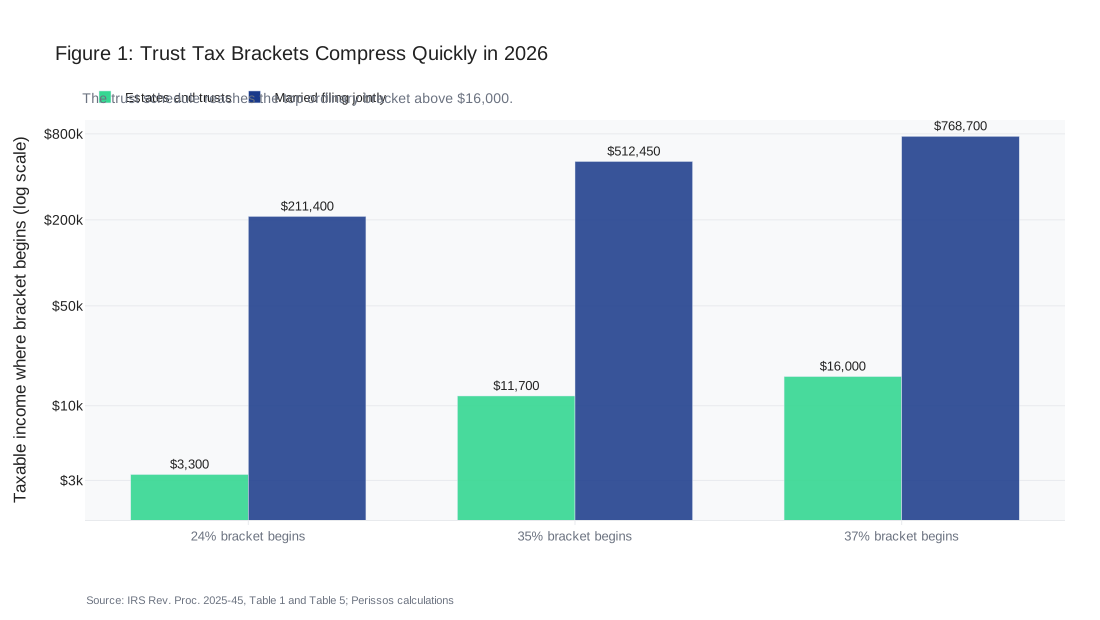
The same compression shows up in the preferential capital gain and qualified dividend thresholds. For 2026, the maximum 0% capital gain amount for estates and trusts is $3,300, and the maximum 15% amount is $16,250.5 The specific capital gain result still depends on the character of the income, the trust document, fiduciary accounting rules, and how gains are allocated.
The point is not that distributions are always better. Sometimes a trustee should retain income for liquidity, reserves, fairness among beneficiaries, creditor concerns, disability planning, spendthrift protection, pending expenses, or the terms of the trust. But the compressed brackets mean retained taxable income should be intentional. "We just left it in the trust" is usually not enough analysis.
The Distribution Decision Is The Planning Center
For a simple trust, income generally must be distributed currently. For a complex trust or estate, the answer can be more flexible, but flexibility creates decisions. The fiduciary must determine fiduciary accounting income under the governing document and applicable local law before preparing Form 1041, because the income distribution deduction depends in part on that amount.2
The key tax concept is distributable net income, usually shortened to DNI. The IRS instructions state that the income distribution deduction is limited to DNI, and DNI is also used to determine how much of an amount distributed to a beneficiary is included in that beneficiary's gross income.2 Schedule B is used to compute the income distribution deduction when income is required to be distributed or other amounts are paid, credited, or required to be distributed.6
There are two planning conversations here. First, what does the trust document require? Second, within the discretion allowed by the document and state law, what tax and cash-flow result makes sense for the trust and the beneficiaries?
That second question is where planning and investment management interact. A trust invested for long-term growth may still need near-term liquidity for tax payments, expenses, or required distributions. A trust generating ordinary income may face a very different tax profile than a trust generating mostly qualified dividends, municipal bond interest, or long-term capital gains. A beneficiary in a lower bracket may absorb income more efficiently, but that has to be weighed against asset protection, family dynamics, spending behavior, and the purpose of the trust.
Timing Elections Can Matter
The calendar does not always close the planning window on December 31. A fiduciary of a complex trust or decedent's estate may make a section 663(b) election to treat an amount paid or credited to a beneficiary within 65 days after year-end as paid or credited on the last day of the prior tax year. The IRS instructions state that the election is available to the fiduciary of a complex trust or executor of a decedent's estate, must be made on a timely filed return including extensions, and is irrevocable once made.7
Estimated tax payments can also be coordinated. The IRS instructions explain that fiduciaries of trusts that pay estimated tax may elect under section 643(g) to allocate estimated tax payments to beneficiaries. For a decedent's estate, that election is available only for the final year of the estate. The election is made by filing Form 1041-T by the 65th day after the close of the trust or estate tax year.8
These elections should not be used casually. They are tools for aligning cash flow, income reporting, withholding, and beneficiary tax obligations after the trustee and CPA understand the full year. Used well, they can prevent avoidable tax friction. Used poorly, they can create confusion or push income to beneficiaries who were not expecting it.
What Trustees Should Gather Before Filing
A trustee or executor should build the Form 1041 file as the year unfolds. At a minimum, that file should include the trust or will and amendments, the EIN confirmation, prior returns if any, year-end account statements, Forms 1099, K-1s received from partnerships or other trusts, real estate income and expense records, records of fiduciary fees and professional fees, charitable payments if permitted by the document, and a distribution ledger by beneficiary.
The beneficiary side matters just as much. Schedule K-1 can affect the beneficiaries' individual returns, estimated tax planning, state tax reporting, and cash-flow expectations. Beneficiaries often do not understand why a distribution can carry taxable income, why a distribution may not match taxable income dollar-for-dollar, or why a trust can have capital gains that are not automatically distributed.
If the trust or estate has multiple beneficiaries, separate shares, charitable beneficiaries, nonresident alien beneficiaries, special needs concerns, or generation-skipping transfer considerations, the return can become more than a routine filing. That is the time to slow down and coordinate with the attorney and CPA before distributions are finalized.
When A Revocable Trust Changes After Death
Many families use revocable living trusts to avoid probate and organize asset transfers. While the grantor is alive, those trusts are generally grantor trusts for income tax purposes.2 At death, the trust may become irrevocable, continue under one or more subtrusts, distribute outright, hold assets for a surviving spouse, or operate alongside the decedent's probate estate.
There is a special election under section 645 that can allow a qualified revocable trust to be treated and taxed as part of the related estate during an election period. The IRS instructions state that Form 8855 is generally filed by the due date for the first Form 1041 of the related estate, and that the election is irrevocable once made.9 This can be useful in some administrations, but it is not automatic and should be evaluated by the CPA and estate attorney.
This is also the point where account titling, beneficiary designations, and the estate plan meet the tax return. A trust can be legally well drafted but still administratively messy if assets were not retitled, beneficiary forms were not coordinated, or taxable accounts and retirement accounts were handled without a post-death tax plan.
Where This Can Go Wrong
The most common mistake is treating Form 1041 as a year-end paperwork item rather than an administration process. By the time the CPA receives the documents, the trustee may already have made distributions, sold assets, retained income, or missed a timing election.
Another mistake is assuming the lowest tax bill is always the right answer. A distribution that reduces trust-level tax can be inappropriate if it violates the document, undermines asset protection, creates beneficiary conflict, disrupts a special needs plan, or leaves the trustee without liquidity for expenses. Good planning is tax-aware, not tax-driven.
A third mistake is failing to explain the K-1 result to beneficiaries. Beneficiaries may receive taxable income even when the cash distribution feels different from the tax form. They may also need the K-1 before they can file their own returns. Clear communication reduces frustration and gives beneficiaries time to plan.
Closing
Form 1041 is one of those returns where the form is only the surface. Underneath it are fiduciary duties, trust accounting, investment income, distribution decisions, beneficiary tax reporting, and coordination with the estate plan.
For clients serving as trustee or executor, I would rather have this conversation early in the year than late in tax season. Start with the document, the asset list, the income expected during the year, the required and discretionary distributions, and the beneficiary tax picture. Then coordinate the filing with the CPA and attorney before decisions become hard to unwind.
All my best,
Brandon VanLandingham, CFA, CMT, CFP
Founder / CIO
Lifetime Gifting Strategies for Families With $10M+
Net Investment Income Tax (NIIT): What Triggers It and How to Plan
Section 1202 (QSBS): The HNW Founder's Best Tax Break
Citations
- Internal Revenue Service, "About Form 1041, U.S. Income Tax Return for Estates and Trusts," retrieved August 22, 2026. https://www.irs.gov/forms-pubs/about-form-1041
- Internal Revenue Service, "Instructions for Form 1041 and Schedules A, B, G, J, and K-1 (2025)," General Instructions, Income Taxation of Trusts and Decedents' Estates and Definitions, retrieved August 22, 2026. https://www.irs.gov/instructions/i1041
- Internal Revenue Service, "Instructions for Form 1041 and Schedules A, B, G, J, and K-1 (2025)," Who Must File, retrieved August 22, 2026. https://www.irs.gov/instructions/i1041
- Internal Revenue Service, "Instructions for Form 1041 and Schedules A, B, G, J, and K-1 (2025)," When To File and Extension of Time To File, retrieved August 22, 2026. https://www.irs.gov/instructions/i1041
- Internal Revenue Service, Internal Revenue Bulletin 2025-45, Rev. Proc. 2025-45, 2026 adjusted tax rate tables and capital gains thresholds, retrieved August 22, 2026. https://www.irs.gov/irb/2025-45_IRB
- Internal Revenue Service, "Instructions for Form 1041 and Schedules A, B, G, J, and K-1 (2025)," Schedule B, Income Distribution Deduction, retrieved August 22, 2026. https://www.irs.gov/instructions/i1041
- Internal Revenue Service, "Instructions for Form 1041 and Schedules A, B, G, J, and K-1 (2025)," Other Information, Question 6, section 663(b) election, retrieved August 22, 2026. https://www.irs.gov/instructions/i1041
- Internal Revenue Service, "Instructions for Form 1041 and Schedules A, B, G, J, and K-1 (2025)," Section 643(g) Election, retrieved August 22, 2026. https://www.irs.gov/instructions/i1041
- Internal Revenue Service, "Instructions for Form 1041 and Schedules A, B, G, J, and K-1 (2025)," Special Rule for Certain Revocable Trusts, retrieved August 22, 2026. https://www.irs.gov/instructions/i1041
Important Disclosures
This piece is educational. It is not legal, tax, or accounting advice and is not a recommendation to take or refrain from any specific action. Tax law is fact-specific and changes regularly. Please coordinate any decisions discussed here with your attorney, your CPA, and Perissos before acting.
Perissos Private Wealth Management is a Registered Investment Adviser ("RIA"). Registration as an investment adviser does not imply a certain level of skill or training, and the content of this communication has not been approved or verified by the United States Securities and Exchange Commission or by any state securities authority. Perissos Private Wealth Management renders individualized investment advice to persons in a particular state only after complying with the state's regulatory requirements, or pursuant to an applicable state exemption or exclusion. All investments carry risk, and no investment strategy can guarantee a profit or protect from loss of capital. Past performance is not indicative of future results.
The information contained in this newsletter is intended to provide general information about market themes. It is not intended to offer investment advice. Investment advice will only be given after a client engages our services by executing the appropriate investment services agreement. Information regarding investment products and services is given solely to provide education regarding our investment philosophy and our strategies. You should not rely on any information provided in making investment decisions.
Market data, articles and other content in this material are based on generally available information and are believed to be reliable. Perissos Private Wealth Management does not guarantee the accuracy of the information contained in this material.
Perissos Private Wealth Management will provide all prospective clients with a copy of our current Form ADV, Part 2A (Disclosure Brochure), Part 2B (Supplemental Brochures), and Part 3 (Client Relationship Summary) prior to commencing an advisory relationship. You can also view these documents at any time at adviserinfo.sec.gov or by contacting us requesting a copy.
Sources
Explore topics
Share this article
Last reviewed: August 22, 2026
Frequently Asked Questions
- Who is required to file Form 1041?
- A domestic decedent's estate or trust generally must file if it has gross income of $600 or more in a tax year or has a nonresident alien beneficiary.
- How do trust tax brackets differ from individual brackets?
- Trust brackets are highly compressed; in 2026, the top 37% ordinary income bracket begins at just $16,000 of taxable income, compared to much higher thresholds for individuals.
- What is the purpose of Schedule K-1 in trust filing?
- Schedule K-1 is used to report the beneficiary's share of income, deductions, and credits, indicating what amounts they must include on their own personal tax returns.