

Healthcare in Early Retirement: Bridging to Medicare
Coverage needs its own retirement income plan
September 18, 2026
Retiring before Medicare eligibility means replacing an employer health plan while income and tax decisions are also changing. The first question is not just the premium. It is whether a coverage option lasts until Medicare, includes the care you need, and fits the household's expected income.1
Map the gap before comparing plans
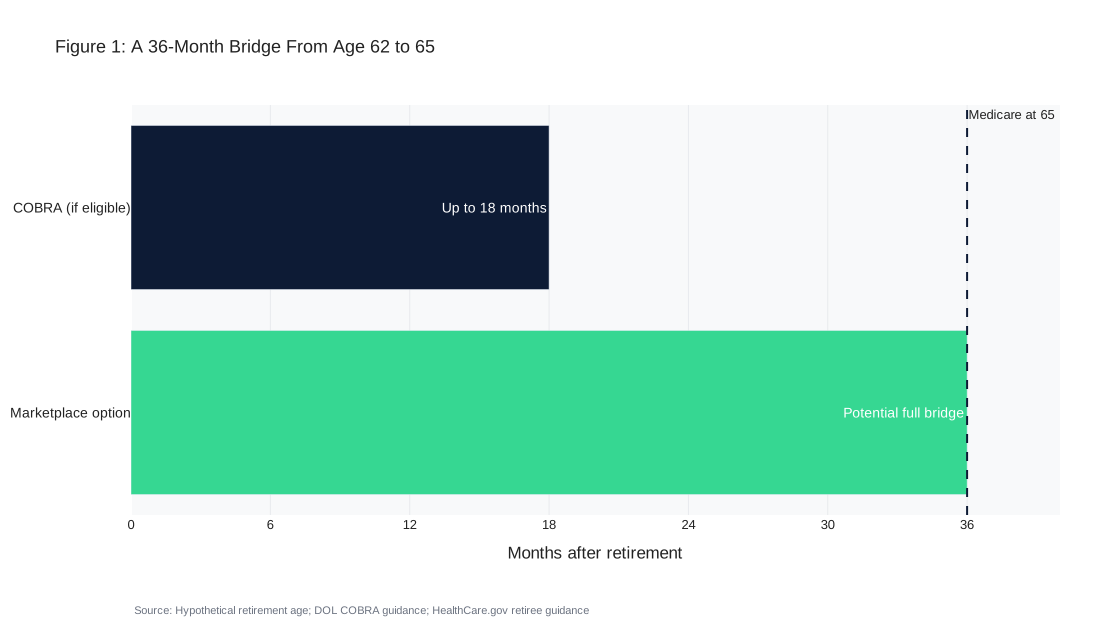
Consider a hypothetical retirement at age 62 with Medicare beginning at 65: that is a three-year coverage bridge. Figure 1 shows the timing. Federal COBRA continuation after employment ends is often available for up to 18 months, subject to eligibility, so it may cover only part of this example's 36-month gap. Marketplace coverage can potentially cover the remaining period, subject to enrollment and plan availability. Actual dates, retiree benefits, and family members' ages change the map.1,2
If retirement causes the loss of job-based coverage, the Marketplace generally offers a special enrollment period beginning 60 days before and ending 60 days after the separation date. COBRA can preserve the employer plan's provider network and deductible progress, but the qualified beneficiary may pay up to 102% of the plan's full cost, including the portion the employer previously paid. Compare premiums, deductibles, out-of-pocket maximums, prescriptions, and providers across both options.1,2
Income planning affects Marketplace cost
The Marketplace uses household modified adjusted gross income to assess savings. For 2026, the premium tax credit generally requires household income no more than 400% of the applicable federal poverty level; the temporary removal of that upper limit applied to tax years 2021 through 2025. A large Roth conversion, capital gain, or IRA withdrawal may therefore change the household's net coverage cost. The exact effect depends on family size, location, plan prices, and the full-year tax return.3,4
This can create a real tradeoff: a Roth conversion may make sense over decades but increase the current year's health coverage cost. We would compare the tax benefit and the lost credit together, and update income estimates during the year. A household above the credit range can still consider Marketplace coverage; it simply needs to budget for the unsubsidized price.3
Avoid an enrollment gap at 65
Medicare's usual initial enrollment period lasts seven months: the three months before the month you turn 65, the birthday month, and the three months after. Coverage start dates depend on when you enroll. COBRA or retiree coverage does not necessarily protect you from a Part B late enrollment penalty. Set the Medicare transition date well before the 65th birthday and confirm the interaction with any spouse's coverage.5,6
COBRA has another timing trap. Letting COBRA expire can open a Marketplace special enrollment period, while voluntarily dropping it early generally does not. That detail can matter if the initial plan is to use COBRA for a few months and switch midyear.7
I would build a month-by-month coverage calendar, request the employer's COBRA and retiree-plan terms, price available Marketplace choices, and run several income scenarios with the CPA. Then we can coordinate withdrawals and conversions with coverage, instead of discovering after enrollment that the tax plan changed the health plan's cost.
All my best,
Brandon VanLandingham, CFA, CMT, CFP
Founder / CIO
Citations
- HealthCare.gov, "Health coverage for retirees," accessed September 18, 2026. https://www.healthcare.gov/retirees/
- U.S. Department of Labor, "FAQs on COBRA Continuation Health Coverage for Workers," accessed September 18, 2026. https://www.dol.gov/agencies/ebsa/about-ebsa/our-activities/resource-center/faqs/cobra-continuation-health-coverage-workers
- IRS, "Premium Tax Credit (PTC) overview," accessed September 18, 2026. https://www.irs.gov/credits-deductions/premium-tax-credit-ptc-overview
- IRS, "Questions and answers on the Premium Tax Credit," accessed September 18, 2026. https://www.irs.gov/affordable-care-act/individuals-and-families/questions-and-answers-on-the-premium-tax-credit
- Medicare, "When does Medicare coverage start?" accessed September 18, 2026. https://www.medicare.gov/basics/get-started-with-medicare/sign-up/when-does-medicare-coverage-start
- Medicare, "When can I sign up for Medicare?" accessed September 18, 2026. https://www.medicare.gov/basics/get-started-with-medicare/sign-up/when-can-i-sign-up-for-medicare
- HealthCare.gov, "Getting health coverage outside Open Enrollment," accessed September 18, 2026. https://www.healthcare.gov/coverage-outside-open-enrollment/special-enrollment-period/
Important Disclosures
This piece is educational. It is not legal, tax, or accounting advice and is not a recommendation to take or refrain from any specific action. Tax law is fact-specific and changes regularly. Please coordinate any decisions discussed here with your attorney, your CPA, and Perissos before acting.
Perissos Private Wealth Management is a Registered Investment Adviser ("RIA"). Registration as an investment adviser does not imply a certain level of skill or training, and the content of this communication has not been approved or verified by the United States Securities and Exchange Commission or by any state securities authority. Perissos Private Wealth Management renders individualized investment advice to persons in a particular state only after complying with the state's regulatory requirements, or pursuant to an applicable state exemption or exclusion. All investments carry risk, and no investment strategy can guarantee a profit or protect from loss of capital. Past performance is not indicative of future results.
The information contained in this newsletter is intended to provide general information about market themes. It is not intended to offer investment advice. Investment advice will only be given after a client engages our services by executing the appropriate investment services agreement. Information regarding investment products and services is given solely to provide education regarding our investment philosophy and our strategies. You should not rely on any information provided in making investment decisions.
Market data, articles and other content in this material are based on generally available information and are believed to be reliable. Perissos Private Wealth Management does not guarantee the accuracy of the information contained in this material.
Perissos Private Wealth Management will provide all prospective clients with a copy of our current Form ADV, Part 2A (Disclosure Brochure), Part 2B (Supplemental Brochures), and Part 3 (Client Relationship Summary) prior to commencing an advisory relationship. You can also view these documents at any time at adviserinfo.sec.gov or by contacting us requesting a copy.
Explore topics
Share this article
Last reviewed: September 18, 2026
Frequently Asked Questions
- How long can COBRA help cover early retirement before Medicare starts?
- Federal COBRA is often available for up to 18 months after employment ends, subject to eligibility. If retirement occurs at 62, that may cover only part of a three-year gap before Medicare at 65.
- Can retirement income affect Marketplace health insurance costs?
- Yes. Marketplace premium tax credits are tied to household modified adjusted gross income, so Roth conversions, capital gains, or IRA withdrawals can change net coverage costs for the year.
- When should someone enroll in Medicare if retiring before 65?
- Medicare's usual initial enrollment period lasts seven months: the three months before age 65, the birthday month, and the three months after. Enrolling on time matters because COBRA or retiree coverage may not prevent a Part B late enrollment penalty.